
Heavy-Duty Floating Hoses, Buoys & Subsea Tie-In Modules
Precision-moulded rotomolded polyethylene shells combined with closed-cell polyurethane foam and high-grade elastomeric cores engineered for peak offshore performance.




Global Commercial & Industrial Macro Dynamics
Offshore dredging, coastal reclamation mega-projects, deep-water mining, and marine fluid transport face unprecedented operational and environmental challenges.
Port Expansion & Capital Dredging
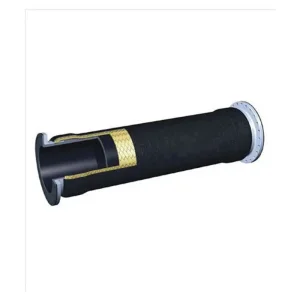
Global port automation and deepening programs to accommodate ultra-large container vessels (ULCVs) demand uninterrupted sediment discharge. Conventional floating lines suffer accelerated carcass fatigue and sudden rupture under heavy marine swell. Modern projects insist on continuous-buoyancy floating hoses that mitigate kinking at dynamic wave boundaries.
High-Density Tailings & Deep-Sea Mining
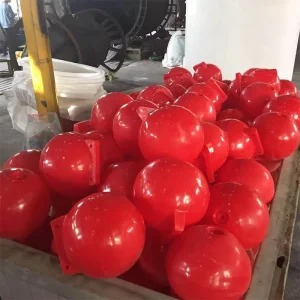
Extracting transition minerals requires the hydraulic lifting and transport of hyper-abrasive slurries with specific gravities exceeding 1.6 kg/dm³. Standard pipelines buckle under these dense payload weights. Modern floating line design integrates variable closed-cell polyethylene floats to maintain an uninterrupted positive waterline offset.
Stringent Marine Safety & ESG Governance
Environmental standards mandated by PIANC, IMO, and regional environmental protection agencies enforce zero-tolerance protocols against marine leaks and microplastic shedding. Operators are phasing out fragile metal pontoons that risk galvanic corrosion in favour of non-corrosive UV20+ stabilized rotomolded polyethylene casings.
Physics-Driven Buoyancy & Hydrodynamic Stability Architecture
Floating hoses and dredge buoyancy collars must survive severe cyclical bending moments, vortex-induced vibrations (VIV), and internal hydrostatic pressures without loss of freeboard.
The Hydrostatic Buoyancy Margin Formula
A frequent error in marine pipeline procurement is calculating buoyancy requirements using empty pipeline weights or clean water density (1.0 t/m³). To prevent line submersion, wave swamp, and sea-floor drag during dynamic slurry pumping, engineers apply the standardized reserve factor:
Total Reserve Buoyancy (B_total) ≥ [ W_pipe + W_flanges + (V_internal × ρ_slurry) + W_hardware ] × 1.25 to 1.30
| Pipeline Outer Diameter (OD) | Matched Float Shell Dimensions | Polyurethane Core Density | Net Buoyancy per Pair | Slurry SG Operating Rating | Hydrodynamic Status |
|---|---|---|---|---|---|
| 250 mm (10 in) | OD 750 mm × L 1000 mm | 35 - 40 kg/m³ Closed Cell | 380 kg | Up to 1.65 SG | Calm Estuary / Inland Canal |
| 450 mm (18 in) | OD 1100 mm × L 1200 mm | 38 - 45 kg/m³ Closed Cell | 790 kg | Up to 1.70 SG | Protected Bay / Harbor Basin |
| 630 mm (25 in) | OD 1400 mm × L 1400 mm | 40 - 50 kg/m³ Closed Cell | 1,420 kg | Up to 1.80 SG | Open Ocean Coastal Reclamation |
| 800 mm (32 in) | OD 1800 mm × L 2000 mm | 45 - 55 kg/m³ Closed Cell | 2,950 kg | Up to 1.85 SG | Heavy Offshore Swell Operations |
| 1000 mm (40 in) | OD 2200 mm × L 2200 mm | 50 - 60 kg/m³ Closed Cell | 4,800 kg | Up to 1.90 SG | Deep-Sea Mining Lift System |
UV20+ Virgin HDPE Rotomolded Skin
Moulded in one continuous seamless envelope from high-molecular-weight polyethylene resin enriched with carbon black and UV inhibitors. Resists embrittlement, stress cracking, and ozone attacks over 15+ years in harsh tropical solar exposure.
High-Density Closed-Cell PU Infill
High-expansion pressure polyurethane foam fills the inner chamber with a >96% closed-cell structure. Even if punctured by sharp debris, coral reefs, or ship hulls, water ingress is confined locally, preventing total buoyancy collapse.
Interchangeable Precision Fastening
Standardised mould designs mean half-shells boast exceptional dimensional interchangeability. Fastened via hot-dip galvanised Grade 8.8 or marine-grade 316 stainless steel bolt configurations with vibration-proof lock washers.
Engineered Field Application Scenarios Worldwide
Marine environments impose diverse physical, chemical, and biological forces on floating pipeline corridors.
1. Middle Eastern Land Reclamation
Operating under surface seawater temperatures exceeding 42°C and extreme hypersalinity. Our polyethylene formulation retains its yield strength without thermal softening, ensuring high-volume land-fill sand pumping runs 24/7 without pipe deformation.
2. Arctic & Sub-Zero Tailings Run
Tailings delivery in Canadian and Nordic mine tailings ponds subject to freeze-thaw cycles and seasonal surface ice sheets. The ductile-to-brittle transition point of our virgin PE compound remains below -60°C, preventing brittle fracture.
3. Offshore Monobuoy & SPM Systems
Interconnecting dynamic floating rubber discharge hoses to single point mooring (SPM) buoys in rough seas. Floats are contoured to absorb wave shock energy, keeping heavy oil discharge headers stable.
4. Inland River Basin Desilting
In narrow waterways with heavy barge traffic and fast currents, compact profile pipe floats prevent collision risks. Integrated high-visibility safety markings protect recreational and commercial river vessels.
Technological Roadmap: The Next Generation of Marine Flotation
Advancing from passive buoyancy modules toward smart, sensor-integrated, sustainable floating marine infrastructure.
Smart IoT Telemetry & Strain Sensing
Embedded Fiber Bragg Grating (FBG) optical sensors and self-powered IoT acoustic transponders inside the floating collars. These telemetry modules monitor bending fatigue, localized wall thinning, internal hydrostatic pressure, and anchor-line strain in real time, alerting dredge operators before rupture occurs.
Bio-Based & Circular Polymers
Formulating circular rotomolding compounds that blend high-grade post-industrial polymers with bio-based crosslinked resins. Designed for closed-loop lifecycle recycling at decommissioning, helping EPC contractors meet international Scope 3 greenhouse gas reduction metrics.
Biocide-Free Anti-Biofouling Surfaces
Surface micro-texturing mimicking natural marine topographies prevents barnacle, mussel, and algal encrustation without toxic chemical leaching. Preserves hydrodynamic laminar flow along discharge lines and reduces vessel drag during relocations.
China Supply Chain Resilience & Manufacturing Scale
Combining raw material polymer compounding, automated CNC rotomolding furnaces, and rapid maritime dispatch.
Vertical Integration & Resin Control
Direct supply-chain partnerships with major petrochemical manufacturers secure certified prime-grade LLDPE and HDPE resins. Automated high-speed pulverizers and gravimetric color-compounding systems ensure consistent batch melt flow indexes (MFI) and strict density control.
Automated Multi-Axis Rotomolding
Equipped with state-of-the-art carousel and shuttle rotational moulding furnaces using variable-frequency drives and digital temperature monitoring. Guarantees uniform peripheral wall thickness without thin corners or internal residual stress concentrations.
Logistical Proximity & Fast Lead Times
Strategically situated in Binzhou, Shandong with streamlined highway corridors to Qingdao Port and Tianjin Port. This location cuts container packing lead times, safeguards shipping container space, and expedites emergency replacement modules worldwide.
Global Quality Assurance, Standards & Testing Regimes
Tested rigorously to meet international offshore fluid transfer standards, pipeline buoyancy guidelines, and environmental requirements.
ISO 9001, 14001 & PIANC Guidelines
Manufactured under ISO 9001 certified quality control, with designs aligning with PIANC recommendations for dredge floating pipelines and OCIMF GMPHOM standards for marine hose buoyancy arrays.
Drop Impact & Hydrostatic Pressure Tests
Every production batch undergoes destructive drop tests at -20°C to verify low-temperature fracture toughness, followed by continuous pressure chamber water-absorption tests on the foam core to guarantee long-term performance.
Full Raw-Material Batch Traceability
Comprehensive Material Test Reports (MTRs) detail melt index, density, tensile yield, and carbon black distribution for every shipment, complete with mill test certificates for mounting hardware.
Specialized Floating Hoses, Barriers & Marine Infrastructure
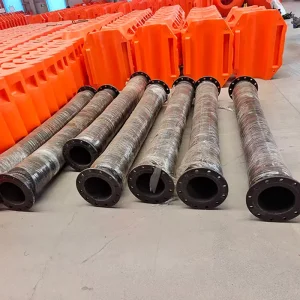
Complete your offshore installations with our tested dredging pipelines, heavy mooring structures, and debris containment systems.




Frequently Asked Questions on Floating Hose & Pipe Systems
In-depth technical answers addressing sizing, hydrodynamics, material selection, and installation.
How does slurry specific gravity affect float requirements?
Slurry specific gravity directly determines the required buoyancy. For clean water (SG 1.0), buoyancy requirements are baseline. In high-density sand, gravel, or iron ore slurry extraction (SG 1.3 to 1.8), internal fluid weight increases significantly. Sizing must calculate total weight based on max operating slurry density plus a 25-30% safety reserve to prevent submergence.
Why use rotomolded polyethylene instead of steel pontoon floats?
Steel pontoon floats suffer from galvanic corrosion, weld cracking under wave cyclic loading, and costly recoating requirements. In contrast, rotomolded UV-stabilised virgin polyethylene floats are rustproof, non-sparking, absorb impact energy elastically, and incorporate closed-cell polyurethane foam that prevents catastrophic water ingress if punctured.
What is the standard warranty and life expectancy of Juhua floats?
Our standard warranty runs 18 months from buyer handover or 12 months from final project commissioning, whichever occurs first. In typical marine environments, the UV20+ stabilized rotomolded outer shell and resilient closed-cell polyurethane infill deliver an operating lifespan of 10 to 15+ years under continuous open-water solar exposure.
How do you configure the cable troughs for dredge instrumentation?
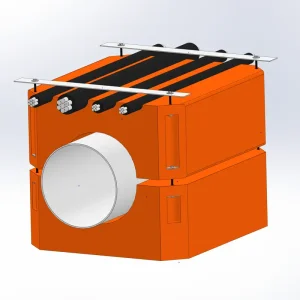
Dredging operations often require power transmission cables, GPS positioning lines, and fiber-optic telemetry to run alongside discharge pipes. We engineer custom-moulded external recessed cable troughs along the float's perimeter, allowing control lines to be secured safely away from flange pinch points and wave impact.
Can float diameters be adapted to existing steel or rubber pipelines?
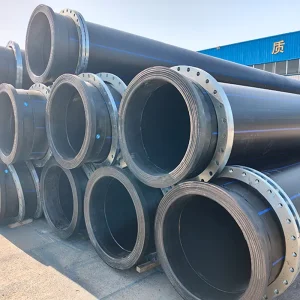
Yes. The internal diameter (ID) of our float shells is machined or moulded to precisely clamp onto standard steel pipe ODs, metric HDPE pipe ratings (SDR 9, SDR 11, SDR 17, SDR 21), or reinforced rubber dredging hoses. Neoprene or rubber friction liners can be fitted to prevent axial slippage during wave motion.
What documentation and test certificates accompany global export consignments?
Every commercial export consignment is provided with a complete Quality Assurance Dossier: raw material Certificate of Analysis (COA), foam core closed-cell density verification reports, dimensional inspection certificates, hot-dip galvanizing mill certificates for fasteners, and Certificate of Origin (CO) documentation.