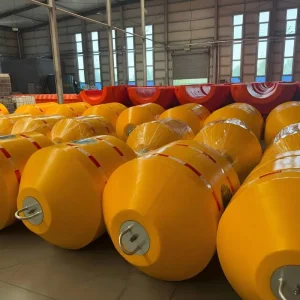
Standard & Heavy-Duty Subsea Float Inventory
Pre-engineered offshore buoyancy units, available for rapid deployment across shallow-water dredging and deepwater pipeline tie-in corridors.

Subsea Pipeline Tie-In Engineering: Physics, Buoyancy & Dynamic Positioning
Understanding the critical hydrostatic equilibrium and submerged landing mechanics required to avoid pipeline buckling during offshore tie-ins.
Bending Moment Control
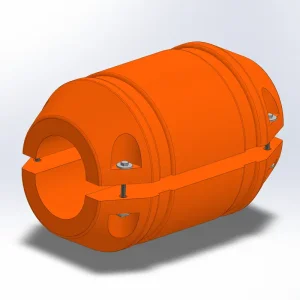
During the tie-in operation of rigid or flexible marine flowlines, deflection at spool connections often introduces severe plastic strain. Modular clamp-on tie-in floats create a calculated neutral-buoyancy curve that prevents pipeline overbending, kink formation, and excessive stress concentrations at the PLET (Pipeline End Termination) or wellhead jumper interface.
Staged Submerged Release
Conventional flotation systems frequently pose hazards during lowering operations. Our specialized tie-in buoyancy assemblies feature dual-shell rotomolded virgin polyethylene shells filled with high-density polyurethane (PU) closed-cell foam or syntactic subsea cores, allowing staged ROV-compatible pin decoupling or controlled ballasting as the line settles into the subsea trench.
Hydrostatic Ingress Prevention
Long-term hydrostatic loading at depth causes microscopic matrix collapse in poor-quality foam cores. By utilizing computer-controlled rotational sintering and impermeable high-density PE outer walls (conforming to ISO 21487 / ASTM D1693 standards), our modules maintain net buoyancy margins under cyclic subsea pressures without water absorption.
Pipeline Float Tie-In Technical Quotations & Parameter Matrix
Standardized industrial reference chart based on continuous production batching. Actual CIF/FOB quotes vary with custom hardware, depth ratings, and order scale.
| Pipe OD Range (mm / in) | Standard Module OD (mm) | Overall Length (mm) | Net Buoyancy (kg / pair) | Core Fill Material | Estimated Cost Index (USD / Set) |
|---|---|---|---|---|---|
| 160mm – 250mm (6" – 10") | 650 – 850 mm | 1,000 – 1,200 mm | 180 – 360 kg | Closed-cell PU Foam (40 kg/m³) | $160 – $280 |
| 280mm – 450mm (11" – 18") | 900 – 1,200 mm | 1,200 – 1,500 mm | 420 – 890 kg | Closed-cell PU Foam (45 kg/m³) | $290 – $580 |
| 500mm – 710mm (20" – 28") | 1,300 – 1,600 mm | 1,500 – 2,000 mm | 1,100 – 2,450 kg | Reinforced Hydrostatic PU / Marine Foam | $620 – $1,350 |
| 800mm – 1200mm+ (32" – 48") | 1,700 – 2,300 mm | 2,000 – 2,500 mm | 2,800 – 6,200 kg | Deep-Density Marine Subsea Syntactic Matrix | Custom Quotation per Drawing |
China Supply Chain Superiority in Rotomolded Flotation Infrastructure
How our Binzhou, Shandong industrial manufacturing cluster unlocks exponential value, faster delivery, and superior resin chemistry for tier-1 EPC contractors.
Automated Sintering Thermal Control
Our Huimin industrial facility utilizes automated variable-frequency speed control and multi-probe infrared temperature monitoring. This eliminates the molecular degradation, brittle walls, and inconsistent wall thickness inherent in manual rotational molding shops.
Virgin Polymers & Marine UV-8 Packages
We strictly utilize virgin high-impact linear low-density polyethylene (LLDPE) combined with specialized hindered amine light stabilizers (HALS UV-8 to UV-15). This prevents environmental stress cracking under intense tropical oceanic sunlight for over 15 years.
Direct Coastal Logistics Hub
Located in Shandong Province close to Qingdao and Tianjin Ports, we reduce inland freight costs to negligible percentages, guaranteeing prioritized maritime container slot loading, direct breakbulk loading for mega-floats, and ultra-reliable export schedule adherence.
Turnkey Integrated Assemblies
Beyond the rotomolded shell, we engineer and supply matched marine-grade hardware: hot-dip galvanized or 316 stainless steel high-tensile fasteners, rubber anti-slip liners, and modular tensioning bands, ensuring flawless drop-in assembly at offshore job sites.
Localized Engineering Compliance & Field Deployments
Meeting rigorous international port authority requirements and offshore safety criteria across dynamic hydrological operational sectors.
Deepwater Harbor Spool Tie-Ins
In mega-port dredging and expansion projects, dredging discharge conduits frequently intersect shipping fairways. Floats are deployed with high-visibility international orange/yellow pigments and retro-reflective nautical tape conforming to IALA guidelines, guaranteeing visual identification day and night.
Tailings Disposal & Saline Mining Plants
Mining tailing pipelines convey abrasive slurries with specific gravities exceeding 1.35 to 1.65 kg/L. Our tie-in float packages are calibrated specifically for slurry density overpressures, ensuring pipeline buoyancy remains resilient even if sedimentation builds up inside the pipe invert during shutdowns.
Subsea Shore Approach Pull-Ins
Where an offshore export pipeline transitions through breaker and surf zones to connect with shore manifolds, lateral surf and wave forces create intense fatigue. Modular tie-in floats with internal ribbed elastomeric friction liners prevent axial slip and axial pipeline rotational torque.
Emerging Technology Trends in Marine Flotation Systems
The convergence of renewable energy offshore tie-ins, circular polymeric economies, and smart subsea monitoring instrumentation.
Floating Offshore Wind & Hydrogen Ties
As offshore wind farms expand into deeper bathymetry, dynamic export subsea cabling and hydrogen transport flowlines demand high-cyclic-fatigue tie-in floats. These modules absorb wave-induced vortex shedding vibrations and prevent destructive sea-bed touchdown chafing.
IoT-Enabled Smart Buoyancy Trackers
Modern project specifications increasingly request integrated transponder housings. Future-ready pipe floats feature embedded recesses for acoustic beacons, satellite telemetry tags, or pressure sensors that transmit real-time submerged depth and tilt telemetry back to the installation barge.
Circular Closed-Loop Polymer Recycling
Global environmental ESG initiatives urge dredging operators to eliminate maritime microplastic shedding. Rotomolded PE shells are 100% recyclable, presenting an eco-compliant alternative to crumbling expanded polystyrene (EPS) blocks or rust-shedding coated steel pontoons.
Frequently Asked Questions on Pipeline Float Tie-Ins
Clear, unvarnished technical answers regarding sizing parameters, chemical compatibility, mooring security, and international warranties.
What primary data is mandatory to calculate float tie-in quantities?
To provide an exact buoyancy model, our engineers require: Pipe Outer Diameter (OD), wall thickness, pipe empty weight per meter, density of the conveyed fluid (e.g., slurry at 1.4 t/m³ vs seawater at 1.025 t/m³), working water salinity/depth, and desired percentage of exposed pipeline freeboard.
Why is rotomolded polyethylene favored over welded steel floats?
Polyethylene is completely impervious to saltwater electrochemical corrosion, eliminating sacrificial anodes or repaint maintenance. PE has high impact elasticity, dampening wave collisions without fracturing or permanently deforming like steel shells do.
How do you prevent float slippage along steel or HDPE pipelines?
Our tie-in float clamp designs incorporate molded internal engagement ribs along with optional high-friction marine rubber traction sleeves. Bolted with tension-calibrated grade 8.8 or 316 stainless bolts, the clamp maintains positive friction grip even under turbulent ocean currents.
What is the standard warranty and life expectancy of Juhua floats?
Warranty coverage initiates upon handover to the project investor and extends 18 months post-handover or 12 months after installation, whichever occurs first. Due to UV-stabilized virgin polymer formulations, expected field service life regularly exceeds 12 to 15 years.
Can float units accommodate power cables and hydraulic umbilical troughs?
Yes. Custom tooling allows top or side cable troughs to be rotationally molded directly into the float halves, enabling subsea dredging pumps or telemetry cables to ride safely without danger of pinching or abrasion against the pipe body.
What quality testing protocols are implemented prior to shipping?
Every production batch undergoes ultrasonic wall thickness measurement, hydrostatic pressure resistance verification, drop-impact testing at low temperatures, and foam density core sampling to verify 100% closed-cell structure and zero water absorption.
Ready to Calculate Buoyancy for Your Subsea Project?
Send your pipe drawings and medium parameters directly to our technical team in Binzhou. We generate buoyancy balance schemes and transparent factory-direct pricing within 24 hours.
Request Engineering Quotation & Sizing SheetAssociated Marine Flotation, Pontoons & Pipeline Accessories
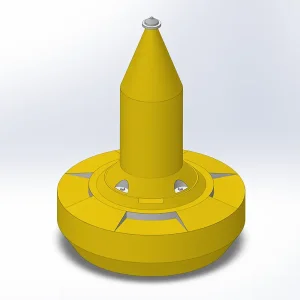
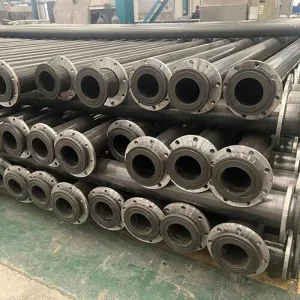
Complete project integration: matched mooring units, marine markers, durable pipelines, and modular floating platforms.