
Primary Flotation Portfolio
Engineered Rotomolded Marine & Infrastructure Units
Browse industrial-grade, rotomolded solutions manufactured using high-accuracy electronic thermal profiling and automated wall distribution systems.
Enterprise Procurement Demands
Global Procurement Imperatives for Rotomolded Industrial Polymers
Modern engineering procurement leaders have shifted beyond basic initial pricing toward lifetime cycle value (LCV), total cost of ownership (TCO), and structural resilience against severe ocean dynamics.
Severe Environment Resilience
Procurement directors in marine dredging and industrial fluid logistics face aggressive environments where conventional steel rusts and welded thermoplastics fracture under cyclic stress. Rotational moulding delivers a 100% seamless, stress-free hull that eliminates localized weld fatigue.
- Zero seam micro-porosity eliminates long-term hydrostatic leaking
- Superior environmental stress crack resistance (ESCR ASTM D1693)
- Inherent chemical inertia against marine organisms, acidic slurries, and salts
Supply Chain Precision & Interchangeability
Global infrastructure contracts require precise component interchangeability across multiple deployment sites worldwide. Using CNC-machined aluminum and fabricated steel molds, our rotomolding tolerances preserve internal diametrical consistency batch after batch.
- Precise clamping fit on standardized dredging steel, HDPE, and rubber lines
- Interchangeable shells allow rapid, tool-less offshore field replacements
- Uniform wall distributions eliminate catastrophic wave impact pinch points
Total Life Cycle Value & Circularity
With tightening ESG benchmarks, rotomolded linear low-density and cross-linked polyethylene provide an extraordinary lifecycle advantage. Operating maintenance costs plummet to zero because no sandblasting or toxic anti-fouling coatings are required.
- 100% recyclable virgin polymer matrix reducing decommissioning footprint
- Extended deployment lifespans surpassing 15 to 20 years in tropical conditions
- Hydrophobic smooth inner/outer surfaces discouraging bio-fouling attachment
System Integrations
Macro-Industry Engineering Solutions
How Shandong Binzhou Juhua Rubber & Plastic Co., Ltd. resolves capital infrastructure risk across dredging, maritime transport, defense, and resource extraction sectors.
Port & Deep-Sea Dredging
Subsea discharge operations subject pipelines to high cyclic hydrodynamic fatigue, abrasive sediment slurry loads, and intense surface wave chop.
Our rotomolded pipeline floats provide buoyancy reserve, preventing line submersion and maintaining line freeboard even at full solids slurry volume (up to 1.6 t/m³ slurry density).
AtoN & Coastal Marine Safety
Navigational channel marks require permanent visibility, unbending mooring integrity, and corrosion immunity against constant seawater immersion.
Engineered navigation buoys feature rotomolded shells filled with closed-cell polyurethane foam, guaranteeing unsinkable operation if punctured by vessel impact.
Defense, Tactical & Airdrop Logistics
Mission-critical gear deployment mandates waterproof, shock-absorbing, and field-repairable field hardware protection.
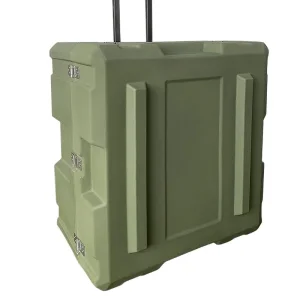
Custom rotomolded military containers withstand high-altitude drop shock, extreme thermal variations (-40°C to +70°C), and airtight ingress protection (IP67).
Municipal Reservoirs & Mining Tailings
Pollution containment, trash boom deflection, and floating platform stabilization require rapid modular deployment without heavy machinery.
Interlinked floating barriers and modular pontoon platforms resist chemical tailings, UV degradation, and sudden hydrodynamic water surges.
Analytical Rule of Thumb
Rigorous Buoyancy Engineering for Slurry Conduits
The catastrophic oversight in flotation sourcing is sizing for empty displacement. An uncalculated shift in slurry sediment weight or sudden ocean current suction pulls the entire floating string subsea, triggering pipe collapse.
- Always compute slurry specific gravity (ρmedium) between 1.3 to 1.65 t/m³
- Maintain an operational safety freeboard factor (Sf) of 20% to 30%
- Integrate galvanic-isolated 316 stainless or hot-dip galvanized fasteners
HYDROSTATIC CRITERIA
Minimum Required Buoyancy
Bnet ≥ (Wpipe + Wslurry + Whardware) × 1.25
Where Bnet represents total displaced water volume multiplied by fluid density. A verified 25% surplus guarantees 1/4 pipe outer diameter (OD) remains visible above water line under severe storm chop.
Technical Roadmap & Polymers
Technological Roadmap: The Evolution of Industrial Rotomolding
Exploring advanced polymer compounding, closed-loop thermal tracking, and automated foaming architectures driving modern rotomolded hardware performance.
Polymer Compounding Advancements
Transitioning from standard powders to metallocene linear low-density polyethylene (mLLDPE) and cross-linked polyethylenes (XLPE). This structural change enhances environmental stress crack endurance and puncture impact strength even at cryogenic temperatures.
Integrated carbon black nano-dispersions and Hindered Amine Light Stabilizers (HALS) ensure UV20 ratings, guaranteeing minimal degradation across 20,000+ continuous solar exposure hours.
Sensor-Driven Thermal Process Cycles
Traditional rotational molding relied on empirical cook cycles leading to warpage or interior under-cure. We use real-time Peak Internal Air Temperature (PIAT) telemetry sensors inside mold cavities to measure polymer fusion stages directly.
Variable-frequency biaxial multi-axis arms ensure precise powder distribution across tight internal corners, eliminating wall thin-spots and maintaining uniform shell thickness.
Automated In-Situ Polyurethane Infill
For unsinkable marine buoyancy, outer PE shells are filled with high-density, closed-cell polyurethane foam (32–45 kg/m³ density). Computer-calibrated high-pressure injection precisely controls the chemical expansion exothermic reaction.
This molecular bond between inner PE skin and rigid PU core prevents water absorption if outer shells are scored or ruptured during deep-sea deployment.
Enterprise Compliance
Quality Verification, Compliance & Global Support
Contractor confidence is reinforced by traceable raw materials, transparent third-party metallurgical and polymer testing, and clear warranty terms.
Standardized Factory Quality Metrics
Every production batch undergoes strict QA testing in line with ISO 9001 and marine safety standards:
- Ultrasonic Wall Thickness Mapping: Verification of uniform nominal thickness across the entire body.
- Low-Temperature Dart Drop Impact: Shell samples conditioned at -20°C withstand rigorous foot-pound impact thresholds.
- Hydrostatic Leak Testing: Air pressure retention tests ensure airtight core seals on hollow and foam-filled units.
Transparent Warranty & Handover Terms
Our industrial project warranty structure directly aligns with EPC infrastructure and contractor milestones:
- Full Warranty Coverage: Begins when the buyer hands goods over to the project investor.
- Coverage Period: Valid for 18 months from the official handover date or 12 months after installation, whichever comes first.
- Guaranteed Compatibility: Batch-controlled dimensional data guarantees exact interchangeability for future expansion.
Export Logistics & On-Site Support
Serving over 80 countries requires specialized export packing, nesting optimization, and technical coordination:
- Container Nesting Strategies: Optimized pipe float nesting cuts ocean shipping freight charges.
- Custom Hardware Packages: Marine-grade 304/316 stainless bolts or hot-dip galvanized fasteners bundled to site specs.
- 24-Hour Engineering Desk: Fast turnarounds for buoyancy calculations, AutoCAD drawings, and step-by-step installation support.
Subsea & Mooring Portfolio
Specialized Flotation & Marine Infrastructure Units
Browse our complete lineup of heavy-duty subsea pipeline floats, navigation buoys, modular pontoons, and cable protection products.





Technical & Commercial FAQ
Frequently Asked Questions
Clear answers to key engineering, sizing, and procurement questions regarding rotomolded marine products.
What are pipeline floats and how do they function?
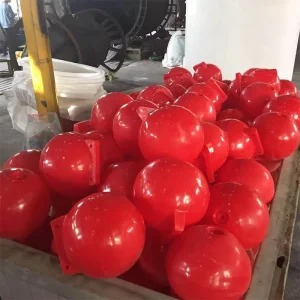
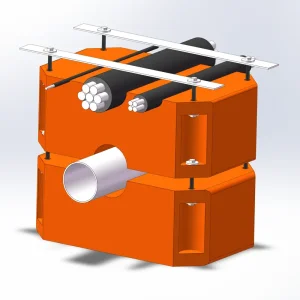
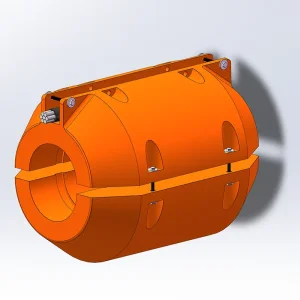
Pipeline floats—also known as dredge floats or modular buoyancy units—are two-piece clamp-on polyethylene bodies engineered around steel, HDPE, or rubber discharge hoses. They keep dredging and industrial slurry pipelines afloat, properly aligned, and visible above the water surface to safeguard vessels and prevent line damage.
How do you calculate buoyancy requirements for a slurry line?
Net float buoyancy must comfortably exceed the combined weight of the pipe shell, internal conveyed fluid (water or heavy slurry mixture), and connecting hardware. As an engineering standard, specify 20% to 30% surplus buoyancy beyond total loaded weight, ensuring roughly 1/4 of the pipe diameter rides safely above the waterline.
Why is rotomolded polyethylene preferred over welded steel in seawater?
Unlike steel floats, virgin high-density polyethylene is chemically inert and completely impervious to saltwater corrosion, electrolytic pitting, and marine micro-organisms. It never requires repainting, anti-corrosion re-coating, or cathodic protection, eliminating hull maintenance costs over decades of open-water exposure.
What are the warranty and handover terms for enterprise orders?
Our standard commercial warranty begins immediately upon the buyer's handover of goods to the primary project investor. It remains in effect for 18 months following handover or 12 months after active installation on water, whichever occurs first, guaranteeing prompt remediation for manufacturing defects.
What parameters must be provided for custom rotomold fabrication?
To deliver rapid, accurate quotations, please provide: pipe outer diameter (OD), pipe wall thickness, medium specific gravity (slurry t/m³), line length, site environment (river, tidal port, offshore), freeboard goals, color or night reflective requirements, total quantity, and destination discharge port.
Can you provide custom-molded parts matching proprietary CAD drawings?
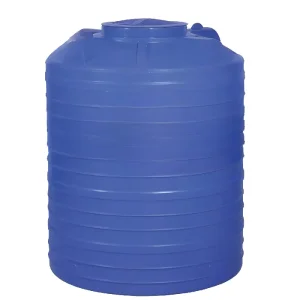
Yes. We specialize in custom OEM/ODM rotomolding. Using dedicated tooling facilities, we produce steel and CNC aluminum molds to build water boat pontoons, airdrop tactical containers, specialized subsea floats, and custom industrial tanks directly from customer STEP, IGES, or DWG drawings.