
Foam-Filled PE
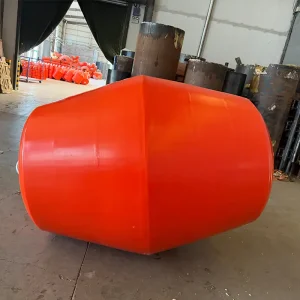
Engineered for high impact resistance, continuous dynamic loading, and extreme weathering in harsh oceanic environments.


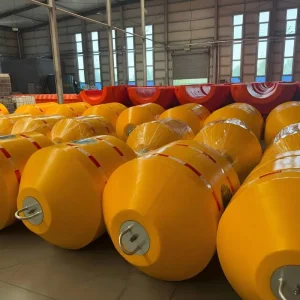
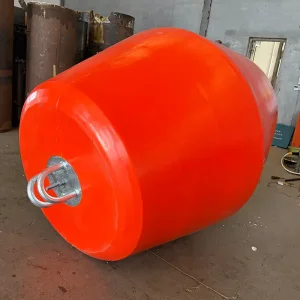

Modern naval architecture and port engineering demand low life-cycle costs, zero electrolytic corrosion, and exceptional energy dissipation upon hull contact.
Traditional fabricated steel mooring buoys suffer aggressive galvanic corrosion, coating delamination, and severe wall thinning under saline mist. Rotomolded virgin polyethylene shells are fundamentally inert to seawater, UV irradiation (UV-20 stabilization), and industrial acidic pollutants, completely eliminating scheduled sandblasting and protective recoating cycles.
Each unit features a monolithic rotomolded outer envelope with uniform wall thickness (8mm to 22mm) filled with pressurized, hydrophobic, closed-cell polyurethane (PU) rigid foam (density 35–45 kg/m³). Even under high-energy vessel collision leading to catastrophic outer skin puncture, water ingress is physically blocked by the foam matrix, preserving 100% reserve buoyancy.
Steel buoys pose severe strike risks to superyachts, service tugs, and commercial workboats, causing thousands in hull dent repairs and paint transfers. Polyethylene elastomeric resilience absorbs kinetic kinetic impact through elastic deformation, cushioning glancing blows without hull marking or structural hull damage to approaching marine craft.
Key parameters for port engineers, marine civil contractors, and EPC project managers evaluating reserve buoyancy, proof loading, and anchoring mechanics.
| Evaluation Parameter | Rotomolded PE / PU Foam Buoy (Juhua Standard) | Traditional Welded Steel Buoy | Elastomeric Foam Coated Polyurea |
|---|---|---|---|
| Corrosion & Cathodic Protection | Zero Rust / No Anodes Required | High Rust Risk / Sacrificial Zinc Anodes | Moderate / Core Mandrel Requires Blasting |
| Weight-to-Buoyancy Ratio | Optimal (Lightweight Handling) | Excessive (Demands Heavy Craneage) | Balanced / Depends on Skin Density |
| Vessel Impact Damage Risk | Zero Scratching / Elastic Cushion | Severe Hull Denting / Scratching | Gentle Hull Contact |
| Internal Tension Member | Central Welded Steel Core / Hawse Pipe (HDG) | Internal Bulkheads & Through-Eye Plates | Through-Chain / Internal Load Frame |
| Operational Maintenance Interval | 5 to 8 Years Visual Inspection | 1 to 2 Years Drydocking & Repaint | 3 to 5 Years Skin Repair Checking |
| Total Cost of Ownership (15 Years) | Extremely Low (-65% vs Steel) | Very High (Continuous Recoating) | Moderate to High (Specialist Repairs) |
Available in through-chain (hawse pipe) configurations where the ground chain passes through the body, or central load-bearing steel tension rod (tie-rod) configurations hot-dip galvanized to ISO 1461 with reinforced pad-eyes.
Precision sizing formulas ensure gross buoyancy exceeds all combined static deadweights (buoy body, suspended riser chain, bridle, and water entrapment) by at least 250% to prevent submersion during peak tidal swells and surge currents.
Manufactured using premium linear low/medium-density polyethylene resins (LLDPE/MDPE) featuring specialized UV stabilizers (grade UV20). Molded in high-visibility safety colors (yellow, orange, white) conforming to IALA maritime recommendations.
All central tension steel assemblies undergo non-destructive magnetic particle inspection (MPI) and 100% proof load testing up to 1.5x Safe Working Load (SWL), witnessed and certified according to offshore marine class rules.
From shallow coastal leisure moorings to harsh open-ocean industrial terminal holding lines, Juhua buoys are customized to site-specific oceanographic regimes.
Crucial support buoys for Catenary Anchor Leg Mooring (CALM) and Single Anchor Leg Mooring (SALM) installations. Serving as pick-up buoys, pipeline intermediate buoyancy compensators, and auxiliary positioning floats for offloading tankers operating in swell conditions.
High-capacity multi-buoy mooring (MBM) spreads engineered for bulk carriers, container ships, and river cargo barges waiting in outer anchorages. The self-fendering attributes of PE eliminate hull damage claims, and high-visibility coloration ensures 24/7 waterway safety.
Grid mooring buoys engineered to withstand prolonged cyclic wave snatch-loads holding submerged fish cages, mussel longlines, and kelp tension arrays. Engineered UV-resistant skin repels bio-fouling and macro-algae colonization, ensuring consistent long-term waterline balance.
Manufactured under ISO 9001, ISO 14001, and ISO 45001 management systems, adhering strictly to global marine authority guidelines.
Product designs and visual chromatics comply with PIANC guidelines for navigation infrastructure and IALA (International Association of Marine Aids to Navigation and Lighthouse Authorities) chromaticity recommendations for maximum day/night visibility.
Materials, welding, and structural load pathways are designed to accommodate third-party verification from major classification societies including DNV, ABS, Bureau Veritas (BV), and Lloyd's Register (LR), with full mill test certs (EN 10204 3.1).
Virgin polyethylene resins undergo ASTM D1693 Environmental Stress Cracking Resistance (ESCR) validation exceeding 1,000 hours, ensuring the shell does not develop micro-fissures in turbulent wave crests or under dynamic cyclical loading.
Backed by our contractual warranty: 18 months from investor project handover or 12 months from final marine commissioning, with lifetime technical support for mooring line inspections, chain shackle sizing, and refurbishment assistance.
How Juhua is pioneering connected ocean infrastructure and eco-sustainable mooring solutions for the global blue economy.
Integrating certified circular polyethylene blends with zero loss in tensile yield strength or impact resilience, mitigating marine lifecycle carbon footprint and microplastic risks.
Embedded strain-gauge transponders in the central tie-rod with low-power satellite/cellular links, providing real-time mooring tension load, water temperature, and GPS breakaway alerting.
Integrated flush solar arrays embedded in the top mold crown powering autonomous marine lanterns, AIS transponders, and oceanographic water clarity monitoring sensors.
Modular quick-release catenary attachments designed for automated vessel disconnect under sudden hurricane or squall conditions, preventing catastrophic anchor dragging.
Direct technical answers addressing hydrodynamics, mechanical load capacities, installation parameters, and operational integrity.
Gross buoyancy is calculated from the total displaced volume of the buoy body multiplied by water density (1,025 kg/m³ for seawater). To determine reserve buoyancy, subtract the dry tare weight of the buoy, internal steel central member, and the submerged submerged weight of the suspended mooring chain at highest astronomical tide (HAT). For safe marine anchoring, the recommended net reserve buoyancy should be at least 150% to 250% over the total suspended deadweight to guarantee high freeboard visibility during severe crest conditions.
Hawse Pipe (through-chain) buoys feature a central vertical pipe passing completely through the buoy body. The mooring anchor chain is pulled straight through this hawse pipe and secured on top with a chain stopper or shackle, transmitting all vertical anchoring forces directly into the chain itself. Tie-Rod (tension bar) buoys incorporate an internal hot-dip galvanized high-tensile steel shaft with heavy-duty forged eyes on both the top and bottom plates, transferring vessel loads directly through the internal spine to the bottom anchor link.
Hollow plastic or un-foamed steel buoys pose a severe sinking hazard if the outer skin is punctured by vessel collisions, floating flotsam, propeller cuts, or vandalism. Juhua mooring buoys are pressure-injected with high-density closed-cell polyurethane foam that chemically bonds to the inner polyethylene walls. Because the foam cells are completely sealed and hydrophobic, the buoy will absorb less than 2% water volume even when cracked or ruptured, remaining completely unsinkable.
In high-salinity, high-temperature, or severe UV environments (such as the Middle East, Southeast Asia, or coastal Australia), steel buoys rust prematurely and require sandblasting every two years. Rotomolded UV-stabilized polyethylene (PE) eliminates electrolytic breakdown and biological fouling adhesion. Furthermore, in commercial harbors with frequent vessel berthing, the elastomeric cushioning of polyethylene prevents costly damage claims associated with rigid steel buoys striking fiberglass or steel hulls.
Tailored buoyancy modules engineered to exact project specifications, anchor handling dimensions, and international maritime safety codes.