
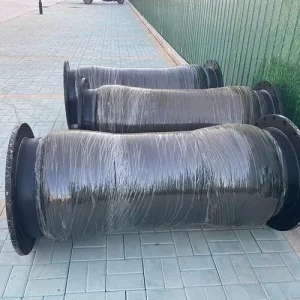
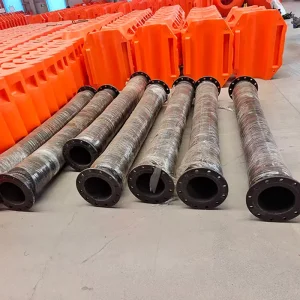
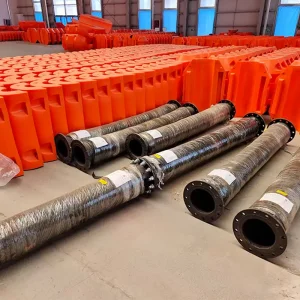
High-Efficiency Dredging & Fluid Slurry Rubber Hoses
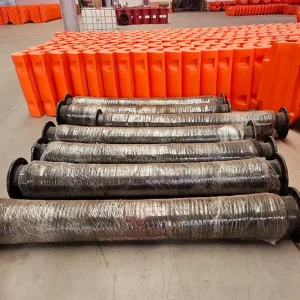
Engineered with multi-ply synthetic tire cord, high-tensile spring steel wire spirals, and ultra-abrasion resistant natural elastomer compounding for prolonged slurry discharge and suction cycles.
Macroeconomic & Infrastructure Drivers in Industrial Rubber Hose Demand
Analyzing global capital expenditures in marine channel deepening, critical mineral tailings slurry conveyance, land reclamation, and the total cost of ownership (TCO) transformation.
Port & Maritime Expansion
Post-Panamax vessel requirements demand continuous harbor basin maintenance and channel deepening across Southeast Asia, the Middle East, and Latin America. Discharge hoses endure cyclonic swell forces and sharp angular sands exceeding 2.2 kg/dm³ slurry density.
Mineral Processing & Tailings
Global mining operations (copper, gold, iron ore, and lithium brines) utilize long-distance hydraulic pipelines. Heavy slurry rubber hoses provide essential vibration damping, thermal compensation, and abrasion endurance across centrifugal booster pump manifolds.
Operational Safety & ESG Standards
Catastrophic line ruptures cause severe marine ecological damage, project stoppage fines, and dredging downtime exceeding $45,000 daily. Modern procurement prioritizes verified burst ratios (min 3:1 to 4:1) and ISO 14001 compliant manufacturing.
Across the worldwide hydraulic solids transport sector, the transition from traditional rigid steel pipes with ball joints to continuous, high-flexibility rubber hose arrangements represents one of the most significant engineering evolutions in modern civil engineering. Heavy-duty rubber dredging hoses absorb multi-axis bending moments caused by ocean swells, tidal variations, and trailing suction hopper dredger (TSHD) movements. Simultaneously, they eliminate the localized mechanical wear and gasket failures characteristic of metallic piping assemblies.
Engineering Information Gain: For hydro-transport applications conveying sharp silica grains or iron ore tailing slurries, high-tensile natural rubber compounds (NR/BR blend) offer up to 4.5 times greater volumetric wear resistance than standard structural carbon steel (ASTM A53/A106) due to the elastic rebound mechanism of cross-linked elastomer matrices.
Multi-Layer Composite Architecture: Engineering Specifications
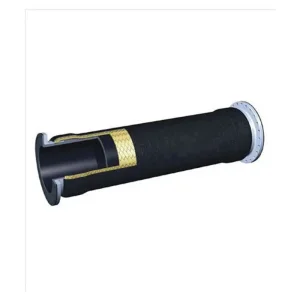
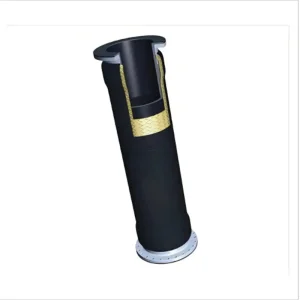
Inside the cross-sectional anatomy of high-performance rubber hoses: Elastomer formulations, reinforcement ply orientation, and integral end terminations.
1. Internal Wear Liner
Compounded with premium cis-1,4-polyisoprene natural rubber and butadiene blends. DIN 53516 abrasion volume loss < 90 mm³. Thickness customizable from 6mm to 35mm depending on grain size distribution (d50) and flow velocities up to 8.5 m/s.
2. Helical Wire & Plies
Double-spiral carbon spring steel wire (SWP-B) provides continuous vacuum resistance (full vacuum -0.09 MPa for suction lines) and kink resistance under tight radius bends, interspersed with multiple synthetic polyester cord plies.
3. Protective Cover
Chloroprene (CR) or EPDM-enhanced outer synthetic elastomer layer engineered to resist ozone cracking, direct ultraviolet degradation, diesel/oil splashes, and severe mechanical abrasion against rocky seabed topography.
4. Integral End Flanges
Fully vulcanized monolithic rubber-faced flanges or forged carbon steel rotating rings (ASME B16.5, EN 1092-1, or AS 2129 Table D/E). The inner rubber liner transitions smoothly over the flange face, eliminating metallic exposure.
Industrial Heavy-Duty Rubber Hose Pricelist & Technical Schedule
Reference factory-gate pricing structure (FOB Qingdao/Tianjin port) calculated against nominal diameter, pressure rating (PN), and reinforcement tier. Custom lengths, ceramic liners, and integrated flotation priced on inquiry.
| Nominal Bore (ID) | Wall Thickness | Working Pressure (WP) | Burst Pressure (BP) | Min. Bend Radius | Avg. Weight (kg/m) | Liner Compound | Est. Price/Meter (USD) |
|---|---|---|---|---|---|---|---|
| DN 150 (6") | 16 mm | 1.6 MPa (16 Bar) | ≥ 4.8 MPa | 750 mm | 18.5 | NR / BR (60 Shore A) | $78 - $115 |
| DN 200 (8") | 18 mm | 1.6 MPa (16 Bar) | ≥ 4.8 MPa | 1,000 mm | 26.0 | NR / BR (60 Shore A) | $125 - $168 |
| DN 250 (10") | 20 mm | 1.5 MPa (15 Bar) | ≥ 4.5 MPa | 1,250 mm | 35.4 | NR / BR (60 Shore A) | $175 - $230 |
| DN 300 (12") | 22 mm | 1.5 MPa (15 Bar) | ≥ 4.5 MPa | 1,500 mm | 48.0 | High-Grit NR (55 Shore A) | $245 - $320 |
| DN 400 (16") | 25 mm | 1.2 MPa (12 Bar) | ≥ 3.6 MPa | 2,000 mm | 72.5 | High-Grit NR (55 Shore A) | $380 - $490 |
| DN 500 (20") | 28 mm | 1.2 MPa (12 Bar) | ≥ 3.6 MPa | 2,500 mm | 105.0 | High-Grit NR (55 Shore A) | $540 - $710 |
| DN 600 (24") | 32 mm | 1.0 MPa (10 Bar) | ≥ 3.0 MPa | 3,000 mm | 148.0 | Heavy Slurry Special | $760 - $980 |
| DN 800 (32") | 38 mm | 1.0 MPa (10 Bar) | ≥ 3.0 MPa | 4,000 mm | 245.0 | Heavy Slurry Special | $1,250 - $1,650 |
| DN 1000 (40") | 45 mm | 0.8 MPa (8 Bar) | ≥ 2.4 MPa | 5,000 mm | 375.0 | Heavy Slurry Special | $1,980 - $2,550 |
*Note: Pricing scales with custom liner thickness, steel flange metallurgy (e.g., 316L, Duplex), burst test certification requirements (CCS, BV, ABS), and global raw natural rubber commodity volatility. Minimum production orders apply for custom non-standard bores.
Engineered Local Applications & Hydrodynamic Adaptation
Real-world integration across coastal infrastructure, tailings reticulation, subsea mining, and river maintenance.
Port Channel Dredging & Silt Bypassing
Installed as stern discharge joints on TSHD and cutter suction dredgers (CSD). Accommodates pitch and roll motions up to ±22° without flow restriction, maintaining volumetric flow efficiency when transferring sediment loads to shore stations through floating pipelines.
Long-Distance High-Density Tailings Reticulation
In high-altitude South American copper mines and Australian bauxite operations, our reinforced slurry rubber hoses absorb water hammer shocks from multi-stage centrifugal pumps, neutralizing axial thermal expansion across extreme day-to-night temperature shifts.
Offshore Desalination & Outfall Diffusers
Custom large-diameter marine suction hoses engineered with synthetic CR compound skins resist hyper-saline brine backwash, marine borer colonization, and harsh wave energy in coastal hypersaline discharge zones without cathodic protection requirements.
China Factory Precision & Vertical Supply Chain Integration
Delivering uncompromised batch repeatability, automated vulcanization, and substantial lead-time advantages from the heart of Shandong's industrial cluster.
Automated Compounding
Internal Banbury mixer systems ensure consistent nano-dispersion of carbon black, accelerators, and anti-aging agents, guaranteeing uniform tensile modulus (≥ 18 MPa) across every square meter of inner tube lining.
Rigid Steel Mandrel Lathes
Continuous building mandrels handling up to DN 1200 ensure exact interior caliber concentricity, uniform wall thickness, and perfectly cylindrical hydrodynamic profiles that minimize boundary layer friction losses.
30-Meter Vulcanization Autoclaves
PLC-managed direct-steam autoclaves ensure controlled thermal cure cycles, completely eliminating intra-ply delamination risks and delivering cohesive polymer molecular cross-linking between textile, steel, and elastomer plies.
Qingdao Port Logistics Corridors
Located in Binzhou, Shandong with express heavy-transport highway corridors connecting directly to Qingdao and Tianjin deepwater ports. Specialized containerized and breakbulk seaworthy packaging guarantees zero shipping deformation.
Testing Regimes & International Compliance Assurance
Every single high-pressure rubber hose unit undergoes exhaustive mechanical and hydraulic verification prior to dispatch.
1.5x Hydrostatic Pressure Proof Test
Each manufactured hose assembly is filled with water, purged of entrained air, and pressurized to 150% of nominal working pressure (WP) for 15 minutes. Electronic transducer logs ensure zero pressure decay, leakage, or axial warping.
Full Vacuum Suction Testing (-0.09 MPa)
Suction dredging hoses are subjected to absolute negative pressure conditions for 10 minutes to verify that the internal rubber liner does not separate from the helical wire carcass under severe dredge pump cavitational surges.
Elastomer Adhesion & Tensile Verification
Destructive sample test coupons from production batches are evaluated for peel strength (> 12 N/mm between plies according to ISO 8033) and tensile elongation at break (> 450% according to ISO 37), ensuring maximum structural toughness.
Technological Roadmap: The Future of Smart Marine Hoses
Developing predictive maintenance technologies, embedded sensor arrays, and advanced nanocomposite linings for next-generation dredging operations.
Embedded IoT RFID & Wear Sensors
Integration of passive RFID chips and continuous electrical resistance wires embedded at the 75% liner wear mark. Real-time telemetry notifies dredge operators when maintenance turnover or hose rotation is needed, preventing catastrophic failures.
Hexagonal Ceramic-Elastomer Hybrids
Vulcanizing 95% high-purity alumina (Al2O3) ceramic mosaic tiles directly into the elastomer substrate for extreme abrasive slurries with high gravel fractions, increasing service lifetime by 600% compared to standard rubber liners.
Bio-Based & Low-VOC Formulations
Developing renewable hydrocarbon tackifiers and low-polycyclic aromatic hydrocarbon (low-PAH) plasticizers that maintain extreme flexural fatigue resistance while aligning with stringent European marine conservation mandates.
Integrated Flotation, Subsea Pipelines & Marine Pontoons
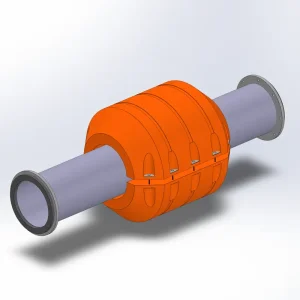
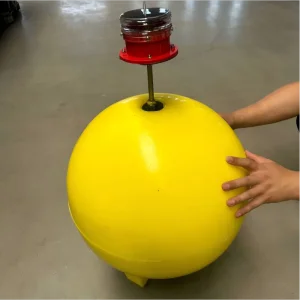
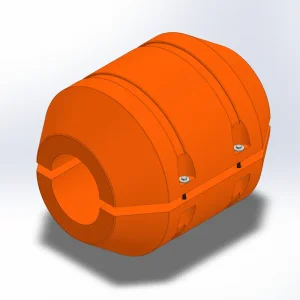
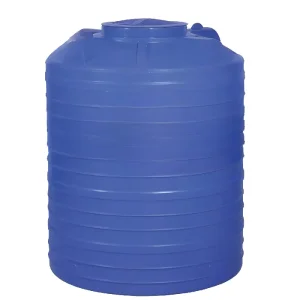
Complementary rotomolded polyethylene pipe floats, modular buoyancy modules, and marine platforms manufactured to support heavy rubber and steel pipelines on open waters.


Frequently Asked Questions: Dredging & Slurry Rubber Hoses
Practical engineering calculations, installation protocols, and lifecycle optimization guidelines.
Need Custom Hydraulic Calculations or a Formal Quotation?
Our senior marine flotation and rubber engineering specialists provide comprehensive pipe-wall calculations, velocity models, and complete export packing schedules within 24 hours.