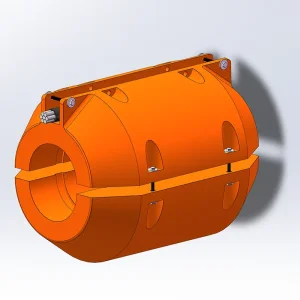
High-Performance Pipe Floats for Dredging & Marine Operations
Explore our heavy-duty marine-grade pipe flotation modules designed for seamless pipeline stabilization, hydrodynamic drag reduction, and maximum reserve buoyancy across rigorous sea states.
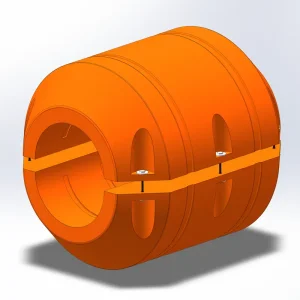
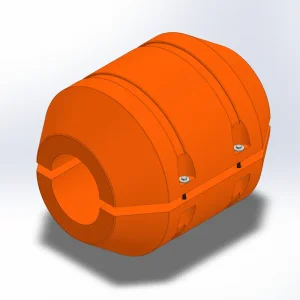
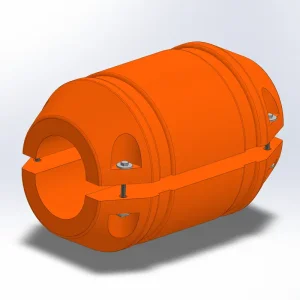
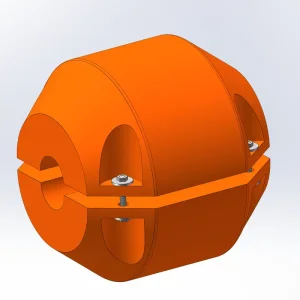
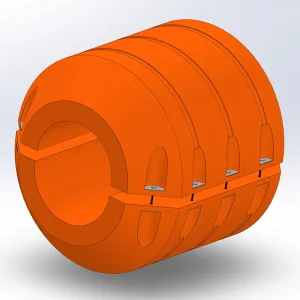
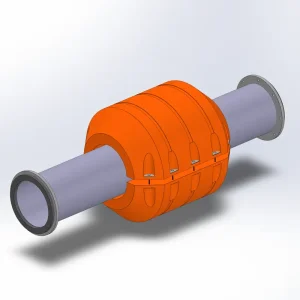
The Evolution of Marine Flotation: From Fabricated Steel to Advanced Rotomolded Polymers
A comprehensive examination of how structural polymers, closed-cell polyurethane foam matrices, and finite element computational modeling redefined pipeline buoyancy dynamics.
Corrosion Immunity
Unlike steel pontoon systems that require costly sacrificial anodes and recurrent re-coating, rotomolded medium-to-high-density polyethylene (MDPE/HDPE) outer shells are 100% chemically inert to saltwater, aggressive mining acids, caustic industrial effluents, and petrochemical spills.
Closed-Cell Polyurethane Infill
Engineered with a high-density, rigid polyurethane foam core (35 to 45 kg/m³) boasting a closed-cell ratio exceeding 95%. Even if external collisions rupture the outer polyethylene skin, water absorption remains under 1%, preventing sudden catastrophic pipeline sinking.
Hydrodynamic Optimization
Modern rotational molding enables hydrodynamic barrel profiles with radiused end geometries. This profile drastically lowers wave slam shock forces, reduces current drag by over 32% compared to rectangular tanks, and prevents premature flange shearing under tidal variations.
| Performance Characteristic | Rotomolded PE Float with PU Foam | Fabricated Carbon Steel Pontoon | Unfoamed Blow-Molded Drum |
|---|---|---|---|
| Seawater Corrosion Resistance | Permanent Immunity (30+ Yrs) | Rapid Rust; Needs Anodic Maintenance | Good Corrosion Resistance |
| Rupture & Puncture Safety | Zero Sinking Risk (Closed-Cell Foam) | Catastrophic Flood Risk Upon Crack | Immediate Sinking Risk Upon Breach |
| Operating Weight & Handling | Ultra-Lightweight; Fast Rigging | Extremely Heavy; Requires Heavy Mobile Cranes | Lightweight but Low Mechanical Rigidity |
| UV Photodegradation Resistance | Class UV15–UV20 Compounded Resins | Requires Repainting Epoxy Barrier | Thin Shell; Brittle After 1–2 Seasons |
| Pipe Axial Clamping Stability | Internal Anti-Slip Friction Ribs | Rigid Welds; High Stress Concentrations | Prone to Slippage Under Wave Thrust |
Global Procurement Criteria: How EPC Contractors & Dredging Operators Evaluate Floats
A rigorous specification framework mapping hydraulic loads, slurry specific gravity, wind-wave cyclic fatigue, and fastening torque margins for mission-critical marine operations.
1. Slurry Gravity Loading
EPC engineers must account for the specific gravity of the pumped media—ranging from 1.05 t/m³ in harbor silt dredging to upwards of 1.6–1.85 t/m³ in copper and iron ore mining tailings pipelines. Standard sizing for freshwater pipelines leads to submerged lines and catastrophic buckling if slurry loading is neglected.
2. Freeboard & Waterline
Proper pipeline buoyancy requires an optimal waterline: approximately 25% to 30% of the pipe diameter must consistently remain above water during peak pumping volume. In open sea channels subject to cross-currents and swells, dynamic reserve buoyancy margins must be elevated to 40%–50% to prevent submersion by wave crests.
3. Hardware Metallurgy
Substandard fasteners represent the most frequent failure point in floating systems. Global contracts specify hot-dip galvanized Grade 8.8 bolts for non-saline river setups, and Marine-Grade AISI 304 or 316 Stainless Steel bolts with nylon lock-nuts for offshore and hypersaline installations to counteract relentless wave vibrations.
4. Wall Thickness & ESCR
Factory wall thickness must remain consistent across corner radii and clamping channels. Resins must satisfy strict Environmental Stress Crack Resistance (ESCR ASTM D1693) testing under 100% Igepal CO-630 conditions for over 1,000 hours without microscopic fissuring under severe pipeline flexure.
Marine Pipeline Buoyancy Engineering Formula: The Juhua Standard
To eliminate catastrophic pipeline submersion under heavy solids flow, calculate total required buoyancy via the verified hydrostatic displacement formula:
Where: W_pipe = Pipe dry weight; D_inner = Inner diameter; L = Total pipeline length; ρ_slurry = Saturated slurry density (kg/m³); W_fittings = Combined mass of steel flanges, stub ends, rubber gaskets, and clamping hardware; and SF_wave = Safety Factor (1.20 for calm lakes/sheltered rivers; 1.35 to 1.50 for exposed tidal estuaries and coastal open sea conditions).
Macro-Industry Engineering Solutions Across Five Critical Sectors
Field-proven flotation architectures adapted to the exact operational dynamics of capital marine construction, high-viscosity mineral transport, municipal bypass, and offshore installations.
1. Capital & Maintenance Dredging
In high-capacity cutter suction dredging (CSD) and trailing suction hopper dredging (TSHD), discharge pipes endure extreme turbulence and high-velocity abrasive slurry. Juhua pipe floats clamp securely over steel, HDPE, and composite discharge lines, ensuring continuous navigational channel clearance, uninterrupted spoil transit, and structural stability against rough port traffic wakes.
2. Mining Tailings & Slurry Transport
Phosphate, copper, bauxite, and gold tailings dams require uninterrupted slurry lines crossing active settling ponds. Floats must withstand harsh process chemicals, solar UV baking, and dense ore gravity without chemical leaching or wall breakdown. Our high-density floats offer high structural load-bearing capacity to support heavy slurry lines without flexural wall deformation.
3. Offshore Desalination & Outfalls
Seawater Reverse Osmosis (SWRO) facilities require long-distance intake pipelines and brine dispersion lines. Juhua engineered floats maintain precise pipeline alignment, provide staged buoyancy during deep-sea pipe pulling operations, and allow controlled bottom placement through engineered water flooding or sequential float detachment procedures.
4. Floating Solar (FPV) & Subsea Cables
Modern floating photovoltaic installations and subsea inter-array cable tie-ins require dual-purpose flotation modules featuring integrated cable conduits. Our custom cable-trough pipe floats prevent high-voltage power conduits and telemetry lines from chafing against heavy steel ballast or slurry pipes, isolating power transmissions from physical abrasion.
5. Municipal Bypass & River Desilting
Civil engineering emergency flood bypasses, reservoir maintenance, and urban river restoration projects require lightweight, rapid-assembly flotation modules. Juhua two-piece clamp systems enable field crews to connect several kilometers of temporary discharge line in hours using basic hand tools, minimizing road closures and maritime disruptions.
Manufacturing Architecture, Material Science & QA Protocols
A zero-defect production methodology governed by variable-frequency rotational control, automated optical thermography, and destructive hydraulic hydrostatic testing.
Automated Bi-Axial Molding
Every float shell is produced on high-precision bi-axial rotational molding machines with computerized multi-zone heat regulation. This delivers uniform polymer melt flow, eliminating microscopic thin-spots in structural corners and ensuring an even wall thickness of 6mm to 18mm depending on nominal pipe diameter.
Compounded UV20 Polymer
Rather than using low-cost dry surface blending, our virgin polyethylene polymers undergo hot-melt twin-screw compounding with specialized light stabilizers (HALS) and antioxidant matrices. This prevents embrittlement, chalking, and environmental micro-cracking even in tropical environments with high UV exposure.
High-Pressure PU Foam Metering
Two-component rigid polyurethane is injected under computer-controlled high pressure directly into the pre-heated hollow shell. This guarantees complete mold cavity fill without air pockets, voids, or density variations, achieving consistent core compressive strength (exceeding 0.2 MPa) across the entire buoyancy module.
Destructive & Hydrostatic QA
Batch sampling protocols include Charpy pendulum low-temperature impact testing at -20°C, axial tensile testing on molded specimens, and sustained water submersion tests under pressure to verify zero water permeation, meeting international marine class certification standards.
Localized Engineering Support, Quality Compliance & Freight Optimization
Ensuring compliance with maritime regulatory guidelines, optimized ocean-freight stowage, and structured field commissioning procedures.
Global Quality Compliance
Every float manufacturing run adheres strictly to ISO 9001:2015 Quality Management Systems, ISO 14001 Environmental Management, and ASTM D1248 standards for polyethylene plastics molding. Products comply with PIANC guidelines for dredging navigation safety and offshore environmental stewardship.
Container Freight Optimization
International freight costs represent a critical component of project expenditure. Our pipe floats are engineered with nesting exterior profiles, allowing paired half-shells to nest compactly within standard 40ft High Cube (40HQ) containers. This packaging design increases shipping efficiency by 28% to 40% compared to non-nesting designs.
Shore-Transition Stress Mitigation
The interface where a floating pipeline transitions to dry land represents the highest mechanical stress zone. Our technical team calculates graduated float spacing—progressively reducing buoyancy intervals to prevent pipe pinching and kink failures during high-tide and low-tide cyclic shifts.
Flotation Technology Roadmap: Smart IoT Telemetry & Sustainable Polymers
A look at the future of marine flotation engineering: real-time telemetry, bio-circular polymers, and advanced composite exterior armor.
Smart Floats with IoT Telemetry
Under development are integrated sensor bays that house low-power LoRaWAN and satellite-linked telemetry nodes. These smart units continuously measure pipeline draft depth, instantaneous ballast weight, wave acceleration shocks, and axial bolt torque, transmitting alerts to harbor management before fatigue ruptures occur.
Bio-Circular Polyethylene Matrices
To support global carbon-neutral infrastructure goals, our material laboratories are validating circular and bio-attributed polymers synthesized from renewable feedstocks. These resins match the tensile, tear, and ESCR characteristics of virgin fossil-based resins while lowering the lifecycle carbon footprint of the pipeline flotation package.
Ultra-Abrasion Composite Coatings
For coral reef trenching and abrasive granite dredging environments, Juhua is deploying co-extruded elastomeric skin formulations. This sacrificial outer armor absorbs repeated scrapes against sharp bedrock and support workboats, protecting the core buoyancy chamber from abrasive gouging.
Frequently Asked Questions: Technical & Procurement Architecture
Comprehensive technical guidance for dredging contractors, port authorities, and hydraulic infrastructure engineers.
Pipe float sizing requires factoring in the maximum slurry density rather than freshwater density. Standard water weighs 1.0 t/m³, while ore tailings slurry can reach 1.4 to 1.85 t/m³. Calculating buoyancy based on freshwater will leave the pipeline sitting too low in the water or dragging on the bottom during full-bore pumping. Freeboard must also be evaluated to maintain 25% to 30% of the pipe diameter above the surface under dynamic operating conditions.
We use computer-regulated multi-axis rotational molding machines with automated thermal monitoring. Unlike manual flame-heated ovens, our automated cycles optimize heating times, mold rotation speeds, and cooling curves. This delivers uniform polymer melt flow into internal corners and clamping channels, preventing thin spots and meeting design wall thickness specifications within ±0.5mm tolerances.
Depending on customer environmental requirements, we supply hot-dip galvanized Grade 8.8 bolts or Marine-Grade AISI 304/316 Stainless Steel bolts. To counter continuous wave-action vibrations, all hardware sets include wide-diameter flat washers, lock washers, and nylon-insert self-locking hex nuts (Nyloc) to maintain specified torque tension throughout project operations.
Yes. We produce custom rotomolded floats with dedicated topside or lateral conduit troughs. These channels securely route submersible electric power cables, hydraulic pilot lines, and fiber-optic dredge telemetry systems, protecting them from pinch points between floating pipe sections.
Our standard international industrial warranty spans 18 months from delivery or 12 months from on-site commissioning, whichever occurs first. Because we compound UV20 class antioxidants and light stabilizers into virgin resin and use high-density polyurethane infill, our floats deliver an expected operational service life of 10 to 15+ years in harsh marine environments.
Our production tooling adheres to standardized dimensional matrices. Every upper and lower half-shell maintains strict tolerance matching. If a contractor needs replacement units for an ongoing project, our replacements match the outer diameter and bolt patterns of units supplied in previous batches.
Engineered Floating Support Systems for Marine Construction & Water Transfer
Select from our heavy-duty marine and industrial pipe flotation systems, manufactured to maintain balance, structural integrity, and buoyancy under challenging sea conditions.