
Heavy-Duty Marine Pipeline Floats & Mooring Buoys
Direct-from-mold rotational casting modules designed for high-abrasion dredging slurry, floating harbor platforms, and offshore marine containment.


Global Commercial & Industrial Landscape of Plastic Buoys
Evaluating technical transformation, material kinetics, and lifecycle cost economics across commercial ports, marine mining, and dredging logistics.
Material Kinetics: PE vs. Steel
For more than half a century, the marine sector relied on carbon steel, fabricated sheet metal, and fiberglass (GRP) for open-water navigation and pipe flotation. However, seawater is an unforgiving electrolytic medium. Steel mooring buoys and pipeline floats experience severe galvanic corrosion, micro-pitting, bio-fouling, and stress fractures, demanding dry-docking and recoating cycles every 24 to 36 months. Virgin rotational-molded linear low-density polyethylene (LLDPE) and high-density polyethylene (HDPE) eliminate oxidation kinetics entirely. Modern polymeric shells maintain exceptional tensile resilience and ductility across thermal extremes from -40°C to +70°C without mechanical degradation.
Operational ROI & TCO Paradigm
When evaluating engineering tenders, procurement professionals frequently make the initial purchase cost (CapEx) error versus Total Cost of Ownership (OpEx). While steel modules may present lower baseline material pricing in certain regional hubs, their maintenance lifecycle cost outstrips the capital expense within four years. Rotomolded plastic buoys require zero sacrificial anodes, zero paint sandblasting, and are immune to rust scale. Furthermore, with polyurethane (PU) closed-cell foam fills (density > 35-45 kg/m³), plastic buoys retain full operational buoyancy even if an external vessel impact punctures the 8mm to 18mm outer skin, eliminating catastrophic marine pipeline sinking risks.
Emerging Technology Trends
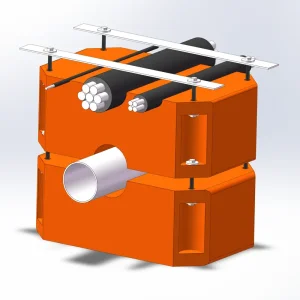
The contemporary marine buoyancy arena is rapidly merging with smart marine telemetry and industrial Internet of Things (IoT). Navigation and mooring buoys are increasingly manufactured with modular sensor recesses, top-mounted photovoltaic panels, marine-grade telemetry transmitters (AIS, 4G/NB-IoT, satellite transceiver), and internal water quality probes. In municipal and mining tailing setups, cable-integrated pipe floats and floating trash barriers serve dual purposes: mechanical pipe stabilization and secure underwater umbilical cable conduit routing, ensuring clean hydrodynamic profiles and minimal hydrodynamic drag.
OEM Plastic Buoys Quotes & Pricelist Structure
Comprehensive pricing matrix derived from resin volume, tooling complexity, foam density, and structural load ratings.
| Classification | Common Dimension / OD | Wall Thickness | Net Buoyancy (kg) | Core Filling | Estimated OEM Price (USD) | Typical Applications |
|---|---|---|---|---|---|---|
| Dredging Pipe Floats (Pair) | Fit Pipe OD 200mm – 315mm | 6.0 – 9.0 mm | 120 – 480 kg | EPS / Closed-Cell PU | $85 – $260 / pair | River desilting, harbor maintenance dredging |
| Heavy Slurry Pipe Floats | Fit Pipe OD 400mm – 800mm | 9.0 – 14.0 mm | 650 – 2,200 kg | High-Density Rigid PU | $320 – $1,150 / pair | Tailings slurry transport, land reclamation |
| Ultra-Bore Dredge Floats | Fit Pipe OD 900mm – 1200mm | 12.0 – 18.0 mm | 2,800 – 5,800 kg | Hydrophobic Rigid PU | $1,400 – $3,600 / pair | Deep-sea capital dredging, maritime mega-projects |
| Aquaculture Mooring Buoy | Dia 600mm – 1200mm (Spherical/Oval) | 7.0 – 10.0 mm | 200 – 850 kg | EPS Pellet / PU Injected | $110 – $480 / unit | Offshore fish cages, mussel farm mooring grids |
| Harbor Navigation Marker | Dia 1200mm – 2400mm (Tower Type) | 10.0 – 16.0 mm | 900 – 3,800 kg | Modular Closed-Cell PU | $850 – $4,200 / unit | IALA maritime channel markings, security exclusion |
| Modular Debris & Security Boom | Unit Length 1000mm – 1500mm | 6.0 – 8.5 mm | 180 – 380 kg | High-Buoyancy EPS/PU | $65 – $190 / meter | Dam reservoirs, water intake security, oil spill |
Hydrodynamic Sizing & Safety Factor Calculation Standard
Under real-world maritime operating conditions, estimating float requirements using dry pipe weight results in critical submergence failures. Slurry specific gravity, tidal shear, wave slamming, and biological encrustation must be factored into net buoyancy calculations.
Design Rule: Maintain a minimum 25% to 30% positive freeboard reserve under full pumping load (conveyed slurry density between 1.3 – 1.6 t/m³) to guarantee pipeline self-righting during swell waves.
Macro Industry Solutions & Localized Deployments
From equatorial port expansions to Arctic-grade dredging corridors, engineered polymer buoyancy handles rigorous industrial workflows.
Capital Port & Harbor Dredging
Modern mega-dredgers move up to 10,000 cubic meters of sand and silt per hour through submerged and floating discharge lines. Our OEM dredging pipe floats provide structural rib geometry to absorb pipe expansion shocks, maintain precise line orientation against strong tidal currents, and deliver bright orange or yellow pigmentation for daytime visual waterway security.
Deep-Sea Aquaculture Grid Systems
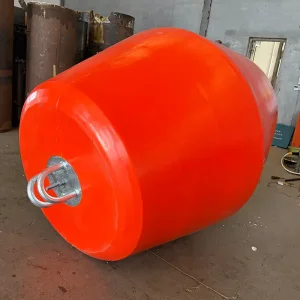
High-energy open-ocean fish farms and shellfish aquaculture require high-tonnage mooring buoys engineered to endure continuous cyclic wave action. Rotationally molded buoys with continuous galvanized or stainless-steel pass-through chains (central core tie-in) transfer mooring strain cleanly into anchoring lines without stressing the polymer skin.
Hydroelectric & Intake Trash Booms
Hydroelectric power facilities and drinking water reservoirs face significant operational downtime from logs, drifting plastic waste, and floating algae mats. Interlinked polyethylene cylindrical or elliptical floating barrier barriers block drifting debris upstream, preventing turbine clogging and simplifying automated mechanical trash collection.
Mining Tailings Dewatering Lines
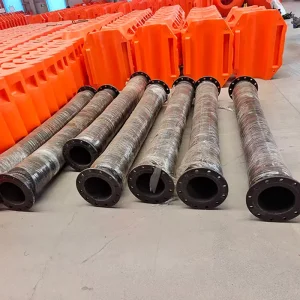
Mineral slurry pipelines carry corrosive acidic or alkaline chemical residues alongside heavy abrasive mineral tailings. Clamped rotomolded pipe floats with chemical-resistant LLDPE shells eliminate galvanic deterioration and keep high-wear steel and HDPE tailings pipelines accessible on tailing pond surfaces for rapid inspection.
Submarine Power Umbilical Floating
Offshore wind farms and subsea civil pipelines require specialized buoyant tethering during installation and pull-in operations. Pipe floats integrated with dedicated top or side cable troughs allow power umbilicals, hydraulic lines, and signal conduits to be deployed alongside heavy slurry pipes safely without pinching or chafing.
Offshore Floating Solar (FPV) Flotation
As floating photovoltaic (FPV) projects migrate to nearshore sheltered bays and marine reservoirs, high-density rotomolded pontoon floats deliver the precise pitch/roll stiffness required to support high-efficiency solar arrays, inverters, and maintenance gangways while enduring salt-spray weathering.
Rotomolding Technology & Quality Roadmap
From raw virgin pellet polymer rheology to electronic temperature measurement and robotic high-pressure PU foam injection.
Virgin Resin & Compounding
100% virgin polymer resin (density 0.935–0.940 g/cm³) blended with masterbatch UV8 to UV20 carbon black or marine pigments, preventing resin embrittlement.
Variable Bi-Axial Molding
Precision CNC molds rotating on dual axes inside computerized convection chambers ensure uniform wall thickness across sharp radius corners and structural ribs.
Controlled Crystallization
Chamber cooling cycles regulate polymer cooling speeds, preventing internal residual stress, micro-voids, and post-cure dimensional shrinkage or warpage.
Core PU Injection
Robotic, temperature-monitored high-pressure injection fills hollow cavities with closed-cell polyurethane foam (≥95% closed cell, water absorption <1.5%).
Hydrostatic & Drop QC
Every production batch undergoes cold drop-impact testing (-20°C), hydraulic leak seals, tensile break testing, and wall-thickness ultrasound verification.
Frequently Asked Technical & Sourcing Questions
Answers provided by senior marine polymer engineers to assist technical buyers, naval architects, and dredging procurement managers.
What are pipeline floats, and what is their primary mechanical function?
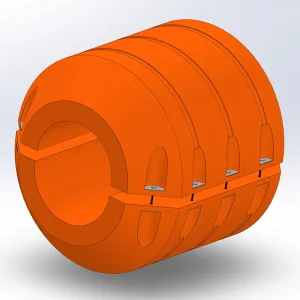
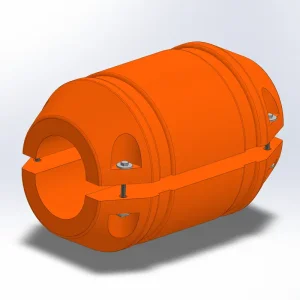
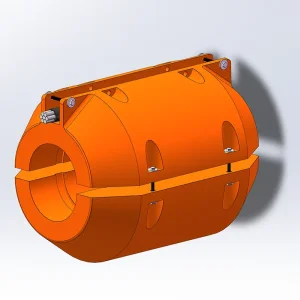
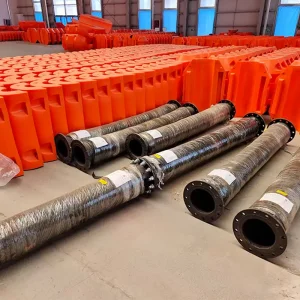
Pipeline floats—also known as dredge floats, pipeline buoyancy collars, or pontoon halves—are modular rotationally molded polyethylene casings filled with closed-cell foam. They clamp symmetrically around steel, HDPE, or flexible rubber discharge pipes to offset the massive weight of slurry and piping, keeping the discharge assembly afloat, hydrodynamically stable, and clearly visible on the sea or river surface.
How do you accurately calculate the number of floats required for a pipeline?
Total buoyancy must exceed total operating weight under peak slurry conditions. Add the deadweight of the pipe, the mass of the internal fluid (calculating with slurry density, typically 1.3 to 1.6 t/m³, rather than clear water), and heavy joint flanges or hardware. Floats must supply at least 20% to 30% surplus reserve buoyancy to maintain approximately one-quarter of the pipe diameter above the water plane.
Are rotational-molded polyethylene floats fully impervious to seawater erosion?
Yes. Virgin linear polyethylene possesses chemical inertness against saline brine, marine fouling, mild acids, and crude oils. Unlike conventional marine steel pontoon systems, polyethylene suffers zero electrochemical corrosion, eliminating sandblasting, repainting, and sacrificial zinc anode replacement entirely over its operational lifecycle.
What specific details are necessary to request an accurate OEM pricelist and drawing?
To finalize an exact technical proposal, please supply: outer diameter (OD) and wall thickness of the pipeline, pipeline material (HDPE, steel, rubber hose), conveyed fluid density (t/m³), environmental conditions (river velocity, sea swell height, wave tidal cycle), target freeboard percentage, required fasteners (galvanized grade 8.8 or 316 stainless steel), and discharge port for CIF logistics modeling.
What warranty terms apply to OEM and custom rotomolded buoyancy products?
Our standard international engineering warranty begins when the buyer formally hands over the completed equipment to the project investor or developer and concludes 18 months following the handover milestone, or 12 months after the initial water installation date, whichever condition is satisfied first, backed by full material test reports (MTR) and traceability certificates.
Can customized molds and integrated cable conduits be engineered for proprietary projects?
Yes. Our in-house engineering and mold fabrication shop develops custom rotational tooling to match non-standard pipe diameters, asymmetric buoyancy profiles, and specialized applications. We frequently manufacture pipe floats equipped with auxiliary cable troughs to accommodate electrical power feeds, hydraulic bypasses, and digital monitoring lines directly along the floating line.
Offshore Anchorage Buoys, Floating Barriers & Marine Accessories
High-integrity containment booms, rotomolded marine sports elements, and specialized subsea pipeline tie-in units engineered to global standards.


Request Direct OEM Plastic Buoy Project Proposals
Eliminate intermediary markups. Communicate directly with our production facility in Huimin County, Binzhou, Shandong. Receive buoyancy engineering assessments, CAD specifications, and factory-direct pricelists within 24 hours.