
Heavy-Duty Marine Pipe Floats & Channel Buoys
Factory-engineered buoyancy modules, navigation aids, and containment barriers built to ISO 9001 and PIANC maritime performance standards.



Global Enterprise Purchasing Mandates for Floating Dock & Dredging Infrastructure
Navigating complex hydraulic loads, localized marine regulatory compliance, dynamic cost optimization, and supply-chain continuity for multi-million-dollar maritime assets.
Balancing High-Density Polymer Elasticity with Hydrostatic Load Capacities
Global civil engineering contractors, offshore dredging conglomerates, and marina concessionaires face severe environmental degradation vectors when selecting floating pipeline and dock substructures. PVC and virgin polyethylene (PE) formulations must exhibit sustained resistance against cyclic wave bending, high-velocity sand abrasive slurry, long-term solar UV oxidation, and biological fouling.
Standard off-the-shelf PVC pipes often crack along brittle molecular seams under storm-surge flexing. To counter structural catastrophic failure, industrial procurement protocols now demand seamless rotational molding with computerized wall-thickness consistency, internal anti-collapse annular ribs, and non-hydrophilic closed-cell polyurethane foam injection.
- Total Cost of Ownership (TCO): Reducing dry-dock replacement cycles from 3–5 years down to 15+ years through high-ESCR (Environmental Stress Crack Resistance) polymers.
- Buoyancy Safety Thresholds: Specifying an operational safety coefficient of at least 1.25x to 1.30x above saturated pipe-and-slurry ballast weight.
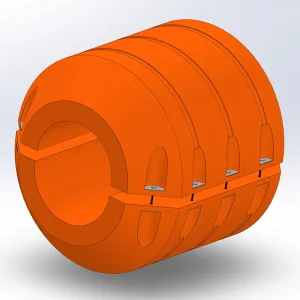
- Standardized Dimensional Interchangeability: Ensuring that split-body shell halves conform to universal ISO dredging flange interfaces.
Procurement Stress Points Solved by Juhua Engineering
1. Freight Consolidation Metrics: Flotation products consume heavy cubic volume relative to deadweight. Our factory employs nesting outer shells and segmented modular geometries that maximize 40-foot High Cube (40HC) container packing densities, slashing trans-ocean freight by up to 34%.
2. In-Situ Clamping Integrity: Galvanized Grade 8.8 or Marine-Grade 316 Stainless Steel fasteners embedded within deep recessed bolt sockets prevent snags on towing cables and eliminate galvanic corrosion hotspots.
3. Anti-Puncture Foam Matrix: Even if high-impact collisions with support workboats puncture the outer polymer jacket, our closed-cell PU core (density 35–45 kg/m³) restricts water penetration to less than 1.5% by volume.
Floating Dock PVC & PE Pipe Flotation Pricelist & Technical Specifications
Wholesale FOB export costing brackets, buoyancy metrics, and structural schedules designed for engineering estimates and capital tenders.
| Outer Diameter (OD / NPS) | Compatible Pipe Range | Total Net Buoyancy | Wall Thickness | Infill Specification | FOB Factory Price (USD) | Production Status |
|---|---|---|---|---|---|---|
| OD 315 mm (12") | 160 mm – 250 mm | 110 kg – 165 kg | 6.0 mm – 8.0 mm | Closed-Cell PU 38 kg/m³ | $45.00 – $78.00 / pair | In Continuous Production |
| OD 500 mm (20") | 280 mm – 355 mm | 280 kg – 420 kg | 8.0 mm – 10.0 mm | Closed-Cell PU 40 kg/m³ | $115.00 – $180.00 / pair | In Continuous Production |
| OD 700 mm (28") | 400 mm – 500 mm | 650 kg – 880 kg | 9.5 mm – 12.0 mm | Closed-Cell PU 42 kg/m³ | $230.00 – $345.00 / pair | In Continuous Production |
| OD 900 mm (36") | 560 mm – 630 mm | 1,200 kg – 1,600 kg | 11.0 mm – 14.5 mm | Closed-Cell PU 42 kg/m³ | $410.00 – $620.00 / pair | In Continuous Production |
| OD 1100 mm (44") | 710 mm – 800 mm | 2,100 kg – 2,800 kg | 13.0 mm – 16.0 mm | Hydrophobic Marine EPS/PU | $750.00 – $1,100.00 / pair | Engineered to Order |
| OD 1200 mm (48") Heavy-Duty | 850 mm – 1000 mm | 3,200 kg – 4,100 kg | 15.0 mm – 18.5 mm | Hydrophobic Marine EPS/PU | $1,250.00 – $1,850.00 / pair | Engineered to Order |
*Note: Unit prices reflect baseline FOB Qingdao/Tianjin container load rates. Final quotes fluctuate according to polymer resin market indices, custom color-coding requirements, customized cable troughs, and marine hardware metallurgy (304 vs 316 Stainless Steel vs Hot-Dip Galvanized).
Material Elasticity & Impact
While standard rigid PVC delivers superior flexural modulus, low-temperature marine conditions can trigger notch embrittlement. Juhua's specialized rotational-molded linear low-density and high-density polyethylene (LLDPE/HDPE) shells achieve an elongation at break exceeding 400%, allowing them to absorb severe wave shocks without fracturing.
UV Photodegradation Chemistry
Bare PVC undergoes chemical dehydrochlorination when exposed to tropical oceanic solar radiation, producing surface micro-cracks. Our marine floating bodies integrate a minimum of UV8 to UV15 light-stabilization masterbatches, guaranteeing a minimum of 15 years of continuous outdoor tropical marine exposure without polymer depolymerization.
Slurry Sloshing Hydrodynamics
Discharging high-density mineral slurry (specific gravity 1.3 to 1.6 t/m³) produces dynamic interior sloshing waves that deform standard floating tubes. Our computer-modeled anti-roll external profile stabilizes lateral trim, restricting pipeline angular yaw to less than ±5 degrees during turbulent flow conditions.
Macro Industry Solutions: Engineered Applications Across Global Marine Sectors
From sovereign harbor capital desilting to utility-scale floating photovoltaic (FPV) arrays and commercial marinas.
Port & Deep-Sea Capital Dredging
High-discharge cutter suction dredgers (CSD) require uninterrupted slurry transfer across busy maritime approaches. Juhua's split pipe floats clamp directly onto steel and HDPE pipelines, maintaining an exact freeboard line that ensures safe vessel passage clearances and protects the line from submarine abrasive scour.
Mining Tailings & Slurry Transport
Open-pit gold, copper, and bauxite extraction creates toxic, high-density tailings ponds requiring continuous desilting. Our chemically inert polyethylene pipeline floats resist extreme acidic (pH < 2) and caustic (pH > 12) flotation waters, preventing structural corroding common to legacy welded steel pontoons.
Commercial Marinas & Floating Docks
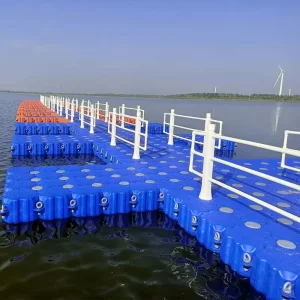
Modern luxury marinas and community waterfronts demand robust, non-polluting floating pontoons. Rotomolded PE and heavy PVC tubular pontoon dock floats resist bilge oils, diesel residues, and blackwater discharge, providing quiet shock absorption during superyacht berthing maneuvers.
Floating Solar PV (FPV) Foundations
Utility-scale reservoir solar installations require 25-year structural float platforms with zero maintenance. Our high-buoyancy modules serve as perimeter wave breakers, cable-conveyance pontoon bridges, and anchoring pylons that withstand sustained wind shears exceeding 140 km/h.
Technical Roadmap: The Future of Smart Marine Flotation & Sustainable Polymers
Integrating IoT edge telemetry, bio-circular raw polymers, and finite element stress analysis for the next era of ocean engineering.
Rotational Molding Precision 4.0
Integration of computerized infrared thermography across our Huimin County ovens. Eliminating interior thin spots and maintaining an exact ±0.5 mm tolerance on skin thickness across all 1200 mm OD dredging floats.
IoT Smart Buoyancy Nodes
Embedded LoRaWAN and NB-IoT strain and tilt sensors built into the inner core of deep-sea mooring and pipeline floats, monitoring freeboard draft variations, pipeline clogging, and structural anchoring stress in real-time.
Closed-Loop Marine Circularity
Deploying 100% mechanically and chemically recyclable marine-grade ocean-bound recovered polymers, cutting embodied carbon emissions by 42% while matching the crack resistance of prime virgin polyethylene.
Self-Healing Polymeric Envelopes
Advanced cross-linked microcapsule coatings designed to autonomously seal small punctures from floating sharp debris and prop impacts, keeping the core foam 100% dry across 30+ year subsea deployments.
Shandong Binzhou Juhua: World-Scale Rotomolding Capacity
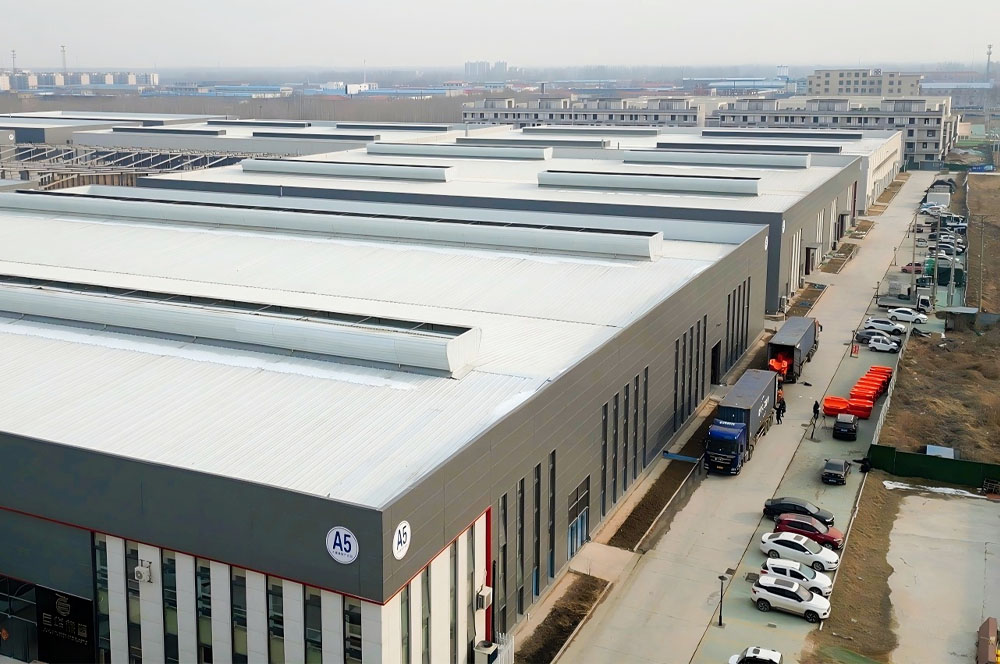
Rooted in Lizhuang Town, Huimin County, Binzhou City, Shandong Province, Shandong Binzhou Juhua Rubber & Plastic Co., Ltd. (Juhua / Giant Rubber) has evolved from a regional specialist into an international maritime engineering exporter serving dredging giants, port authorities, and government contractors across 80+ nations.
Our expansive 1,000 m² rotational molding workshop operates variable-frequency rotational equipment alongside computerized curing chambers. This ensures homogeneous polymer crystal alignment, preventing the localized stress fractures that routinely plague conventional small-workshop rotomolding.
- Total System Capability: Beyond standalone pipe floats, we supply matched dredging discharge HDPE pipelines, heavy armored rubber slurry hoses, float tie-in brackets, and marine navigation aids from a single factory source.
- Standardized Spare Parts: Strict CNC steel mould machining ensures absolute interchangeability — replacement shells purchased years later match original pipeline configurations perfectly.
- Export Port Proximity: Located just hours from Qingdao and Tianjin deepwater ports, allowing expedited multimodal container shipping and breakbulk chartering.
Engineering Laboratory & Stress Testing Protocols
Every production run undergoes strict hydrostatic crush testing, dart impact testing at -20°C, and raw material melt flow index (MFI) verification before leaving the plant.
Localization Support, Regulatory Compliance & Field Engineering Guarantee
Full alignment with international civil maritime benchmarks, ensuring seamless sign-off with third-party inspection agencies.
PIANC Maritime Guidelines
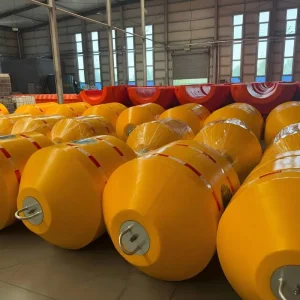
Our navigation buoys, floating markers, and channel barriers comply with the International Navigation Association (PIANC) and IALA visual recommendations for maritime daylight recognition and radar reflective cross-sections.
ASTM Environmental Testing
Resins pass stringent ASTM D1693 environmental stress-crack resistance (ESCR) thresholds (>1,000 hours in 10% Igepal solution), guaranteeing zero stress fractures under aggressive chemical or tidal environments.
Definitive Warranty Protection
Our contractual warranty activates the moment goods are handed over to the project investor and extends 18 months from handover or 12 months from final operational water commissioning, whichever arrives first.
Frequently Asked Technical & Procurement Questions
Clear, engineering-backed answers addressing the calculations, logistics, and material choices that drive marine capital tenders.
What exact formula calculates the required number of pipeline floats?
Total Float Buoyancy ≥ (Pipe Dry Weight + Maximum Saturated Slurry Weight + Hardware & Accessories) × 1.25 to 1.30. Sizing must always be calculated against the slurry density (typically 1.3 to 1.6 t/m³) rather than clean freshwater. This ensures approximately 25% to 30% of the pipe diameter remains visible above the water surface for wave damping and visibility.
Why are rotational-molded PE floats preferred over steel or rigid PVC pipe pontoons?
What parameters must clients provide to receive a finalized engineering quote?
What prevents pipeline floats from sliding along the pipe during strong tidal currents?
How does closed-cell polyurethane foam perform if the outer shell is punctured?
What is your export packaging methodology to prevent shipping damage?
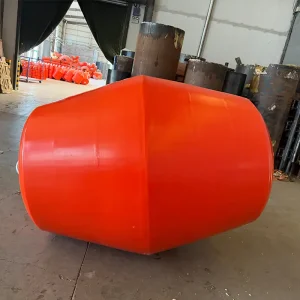
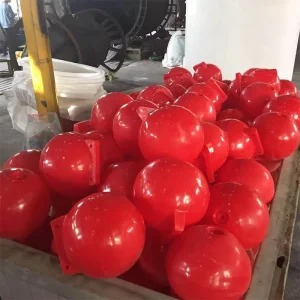
Modular Dock Pontoons, Mooring Buoys & Safety Barriers
High-integrity rotomolded boat pontoons, foam-filled mooring buoys, and containment systems engineered for challenging open-water environments.



Request Complete Flotation Tender Packs & Custom Sizing
Speak directly with Juhua's rotational molding engineers. Submit your pipe specifications, slurry characteristics, and site coordinates to receive a verified buoyancy calculation, 3D mould drawing, and locked-in CIF/FOB wholesale pricelist within 24 hours.