Featured Marine & Industrial Pipeline Deployments
Engineered synergy between nominal 8-inch (219.1mm - 225mm) high-density polyethylene pipelines, rotationally moulded flotation jackets, and offshore anchorage modules.
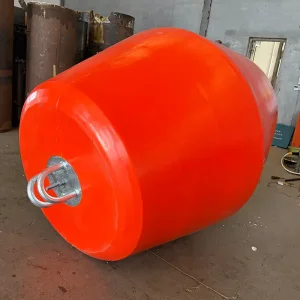
The Strategic Dominance of 8-Inch (200mm / 225mm) HDPE Pipelines
Across global civil hydraulic engineering, maritime dredging discharge, and aggressive mining tailings disposal, the 8-inch nominal outer diameter represents the mechanical "sweet spot" for high-velocity, high-pressure fluid conveyance.
Bimodal Resin Chemistry (PE100 / PE4710)
Modern 8-inch extrusion utilizes high-molecular-weight bimodal hexene/octene copolymers. This chemical architecture gives the pipeline an exceptional Resistance to Slow Crack Growth (SCG > 10,000 hours under PENT testing), completely mitigating brittle rupture modes under continuous dynamic surge pressures.
Hydraulic Optimization & Pumping OPEX
Unlike ductile iron or cast steel, 8-inch HDPE maintains an ultra-smooth interior with a Hazen-Williams C-factor of 150 that never deteriorates from tuberculation or scaling. The resulting drag reduction yields a 22–35% reduction in ongoing pumping station electricity consumption over decades of service.
Surge & Water Hammer Absorption
With an elastic modulus substantially lower than metallic alternatives (approx. 1,000 MPa vs 200,000 MPa for carbon steel), an 8-inch HDPE line organically absorbs hydraulic shock waves, reducing water hammer pressure surges by roughly 75% compared to unyielding metallic conduits.
Technical Procurement Takeaway: In industrial dredging, municipal bypass, and slurry discharge operations, purchasing from certified ODM factories ensures wall thickness uniformity governed by automated ultrasonic gravimetric feedback. A variation of merely 5% in wall concentricity can downgrade the allowable maximum working pressure (MAOP) by up to 20%. Partnering with audited manufacturers ensures strict compliance with ISO 4427-2 and ASTM F714 tolerances.
8-Inch HDPE Pipe Engineering Reference Matrix (IPS & Metric DN225)
Calculated based on virgin PE100 / PE4710 resin at standard 20°C (68°F) operational reference temperature with water medium (Safety Design Factor C = 1.25).
| Standard Dimension Ratio | Nominal OD (IPS / Metric) | Min Wall Thickness (mm) | Internal Diameter (mm) | Working Pressure (Bar / PSI) | Empty Weight (kg/m) | Recommended Industrial Applications |
|---|---|---|---|---|---|---|
| SDR 7.3 | 8.625" (219.1 mm) / 225 mm | 30.8 mm | 157.5 mm | 25.0 Bar / 362 PSI | 18.72 kg/m | High-Pressure Slurry & Deep Subsea |
| SDR 9 | 8.625" (219.1 mm) / 225 mm | 25.0 mm | 169.1 mm | 20.0 Bar / 290 PSI | 15.65 kg/m | Deep Horizontal Directional Drilling (HDD) |
| SDR 11 | 8.625" (219.1 mm) / 225 mm | 20.5 mm | 178.1 mm | 16.0 Bar / 232 PSI | 13.15 kg/m | Potable Water Main & Desalination Intake |
| SDR 13.6 | 8.625" (219.1 mm) / 225 mm | 16.5 mm | 186.1 mm | 12.5 Bar / 181 PSI | 10.82 kg/m | Agricultural Pressurized Irrigation |
| SDR 17 | 8.625" (219.1 mm) / 225 mm | 13.2 mm | 192.7 mm | 10.0 Bar / 145 PSI | 8.81 kg/m | Dredging Tailings & Gravity Sewer Outfall |
| SDR 21 | 8.625" (219.1 mm) / 225 mm | 10.7 mm | 197.7 mm | 8.0 Bar / 116 PSI | 7.24 kg/m | Temporary Low-Head Bypass & Dewatering |
| SDR 26 | 8.625" (219.1 mm) / 225 mm | 8.6 mm | 201.9 mm | 6.3 Bar / 91 PSI | 5.88 kg/m | Low-Pressure Discharge & Intake Screens |
Inside a Tier-1 ODM Factory: Production & Quality Governance
Original Design Manufacturing (ODM) requires far more than generic plastic extrusion. It demands metallurgical control of tool steels, algorithmic temperature zoning, and inline laser scanning.
Barrier Screw & Spiral Die Heads
Extrusion lines utilize 38 L/D barrier screws coupled to spiral distribution die heads. This configuration eliminates flow weld-lines, guarantees uniform thermal melt homogenization at 190°C–210°C, and prevents residual structural stresses that might otherwise cause hoop fatigue.
Ultrasonic Concentricity Scanning
Continuous 360-degree ultrasonic scanning probes measure wall thickness at 8 radial coordinate axes right after the vacuum calibration tank. Any variance beyond ±0.1mm triggers automated servo adjustments to the die-head centering pins in real-time.
PENT & Hydrostatic Validation
Every batch undergo Destructive Hydrostatic Burst testing at 80°C (176°F) for 1,000 continuous hours per ISO 1167, combined with Pennsylvania Edge-Notch Tensile (PENT) testing per ASTM F1473, guaranteeing decades of non-failure in harsh terrains.
Localized Application Scenarios & Case Engineering
From sub-zero permafrost installations to equatorial open-water dredging, 8-inch HDPE functions as the workhorse of regional industrial modernization.
Municipal AWWA C906 Trenchless HDD
Used extensively for crossing rivers, highways, and sensitive urban wetlands without excavation. 8" DR11 pipes withstand extreme tensile pulling loads while eliminating mechanical joint separation.
SWRO Desalination & Brine Discharge
High salinity and 45°C ambient temperatures accelerate steel corrosion within 24 months. 8-inch PE100 with 2.5% carbon black masterbatch offers zero electrochemical corrosion and 50+ year subsea service.
Aggressive Mining Slurry & Tailings
Conveying quartz, copper, and iron ore slurries quickly erodes basalt-lined or rubber-lined pipe. 8" heavy-wall HDPE (SDR 9 / SDR 7.3) delivers superior slurry abrasion resistance, outlasting carbon steel by 4:1.
Maritime Dredging & Land Reclamation
Fitted with matched rotational-moulded polyethylene pipe floats, 8-inch discharge lines transport sand slurry from cutter suction dredgers across dynamic coastal wave channels without structural fatigue.
Co-Engineering 8-Inch HDPE with Marine Pipe Floats
When moving slurry across tidal waters, an unanchored or improperly floated 8-inch pipeline risks premature fatigue failure or catenary sinking.
Buoyancy Margin Calculation (20-30%)
Proper buoyancy sizing calculates the combined displacement weight of the 8" pipe shell (approx. 13.1 kg/m for SDR 11), the heavy solid slurry medium (ρ ≥ 1.35 kg/dm³), plus mechanical flange stubs and hardware, ensuring a 25% safety freeboard above rough swells.
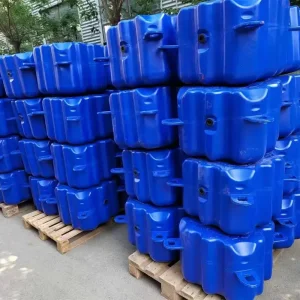
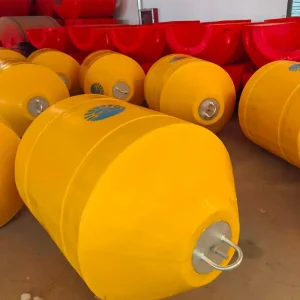
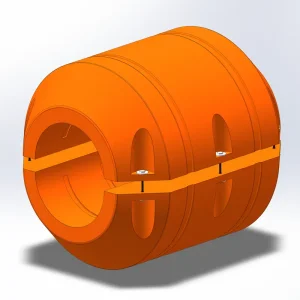
Rotomolded Polyethylene Float Shells
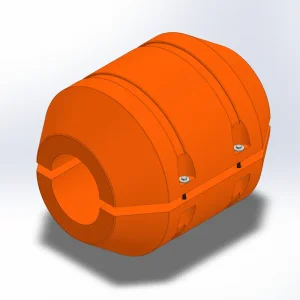
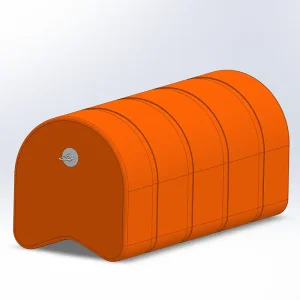
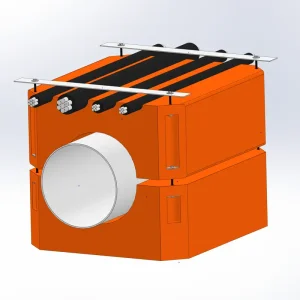
Heavy-duty clamp-on floats manufactured from linear low-density polyethylene (LLDPE) filled with polyurethane closed-cell foam provide resilient impact absorption. Even in the event of vessel collision, closed-cell foam prevents water absorption.
Flexible Rubber Hose Transitions
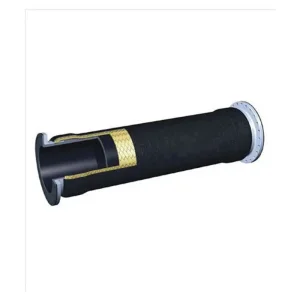
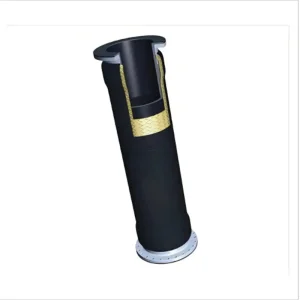
To accommodate wave flexing, floating 8-inch HDPE pipelines are coupled with reinforced rubber suction and discharge hoses every 30 to 60 meters, distributing bending moments and preventing stress concentration at butt-fusion joints.
Future Tech Roadmap (2025–2035) & Total Cost of Ownership
How advanced polymers, smart IoT tracking, and circular lifecycle economics are transforming the financial calculations of global pipeline infrastructure.
Smart RFID & Digital Traceability
ODM manufacturing lines increasingly co-extrude micro RFID tags directly into the outer skin of 8-inch pipes. Field crews instantly retrieve raw resin batch certificates, SDR ratings, and date of manufacture via NFC scanners before field butt fusion.
Multilayer Co-Extrusion Tech
Emerging standards implement a 3-layer co-extrusion profile: a peelable protective skin, a carbon-black UV outer jacket, and an ultra-white low-friction inner core that reflects thermal heat during tropical surface staging and makes internal video inspection clear.
Zero-Cathodic Lifecycle Savings
Steel lines require sacrificial anodes, protective coatings, and recurrent cathodic voltage audits. Over a 50-year horizon, an 8-inch HDPE deployment delivers a 65% total lifecycle cost reduction by entirely removing maintenance and joint leakage repairs.
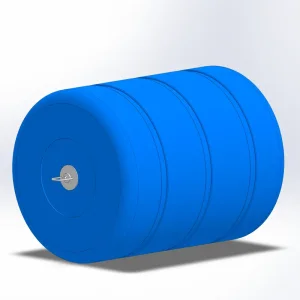
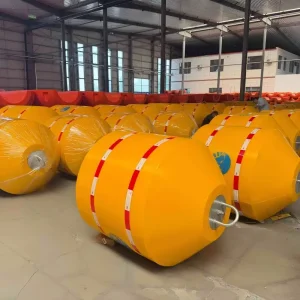
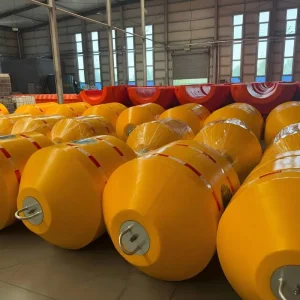
Industrial Flotation & Marine Infrastructure Range
Precision-manufactured accessories designed to seamlessly clamp, couple, and stabilize 8-inch HDPE dredging pipelines and offshore discharge networks.
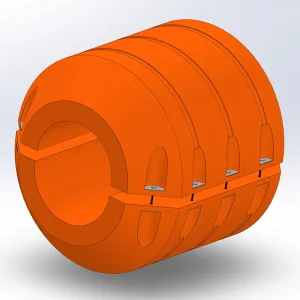
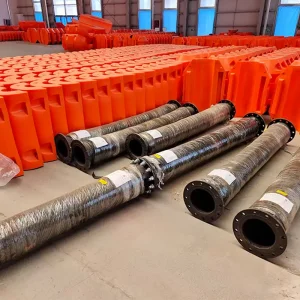
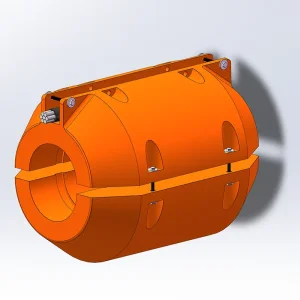
Frequently Asked Questions by EPC Buyers & Engineers
Direct answers to sizing tolerances, butt fusion parameters, pressure derating, and containerized ocean shipping logistics.
What is the difference between 8" IPS and Metric DN225 pipe?
8" IPS (Iron Pipe Size) has a standardized outer diameter of 8.625 inches (219.1 mm) widely used in North American and offshore oil/gas operations. In contrast, European and ISO international standards use DN225, which has an outer diameter of exactly 225.0 mm. While close in size, they require distinct transition adapters and dedicated fusion clamping liners.
How does operational temperature affect working pressure?
HDPE pressure ratings are referenced at 20°C (68°F). When conveying fluids at elevated temperatures, derating factors must be applied according to ISO 4427. At 30°C, multiply nominal pressure by 0.87; at 40°C, by 0.74. Operating continuously above 60°C is generally not recommended for standard PE100 pressure conduits.
What butt fusion standard is used for 8-inch pipelines?
Butt fusion follows ISO 21307 or ASTM F2620. Key parameters include heater plate temperature (200°C–230°C), interfacial pressure (approx. 0.15–0.17 N/mm²), bead-up height monitoring (around 2.0–3.0 mm for 8" SDR 11), soak time, and controlled cooling under pressure. Bead inspection confirms joint integrity.
Can 8-inch HDPE be bent on site without heated fittings?
Yes. HDPE is inherently flexible. The allowable minimum cold bending radius at 20°C ranges from 20 to 25 times the outside diameter for SDR 11–17 pipelines. For an 8-inch pipe (~219mm OD), the minimum bend radius is approximately 4.4 to 5.5 meters, eliminating the need for short elbow fittings in gentle field curves.
How do you calculate pipe float spacing for an 8" line?
Total required buoyancy must equal (Pipe Weight + Slurry Weight + Flange Weight) × 1.25. For example, if an 8" line carries heavy tailings slurry at 1.4 kg/L, total submerged weight reaches roughly 50–55 kg/m. Floats with 150 kg net displacement are placed approximately every 2.7 to 3.0 meters along the line.
How are 8-inch HDPE pipes bundled and loaded for export?
Straight lengths are manufactured in standard 5.8m (for 20ft containers) or 11.8m (for 40ft High Cube containers) lengths. For breakbulk vessel loading, custom lengths up to 18m can be provided. Pipes are nested or strapped in wooden cradles with soft slings to prevent notch formation on the pipe wall.
What is Slow Crack Growth (SCG) resistance and why does it matter?
SCG describes brittle micro-crack propagation under prolonged localized stress, such as rocks pressing into the pipe wall backfill. High-grade PE100/PE4710 resins have PENT values exceeding 10,000 hours, ensuring the pipe yields plastically rather than cracking suddenly under ground shifting or stone impingement.
Can 8-inch HDPE pipelines resist chemical erosion?
HDPE is chemically inert across the full pH spectrum from 1 to 14. It is virtually immune to hydrogen sulfide (H2S), sulfuric acid runoff in mine tailings, soil salinity, and aggressive marine organisms that cause rapid pitting, wall thinning, and failure in metallic pipes.