
High-Tenacity Mooring Systems Ready for Malaysian Waters
Engineered to resist high thermal radiation, heavy tropical squalls, and severe equatorial marine biofouling across Peninsular and East Malaysian fairways.
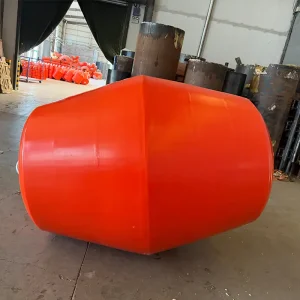
Equipped with internal galvanized steel tension members and marine closed-cell foam. Prevents sinking even if subjected to puncture.
View Technical Specs & RFP
Formulated with UV15+ additives, preventing brittle failure in high ultraviolet tropical settings along offshore oil berths.
View Technical Specs & RFP
Designed for high-energy open waters off Sarawak. Zero repainting required, complete bio-fouling wipe-down capability.
View Technical Specs & RFP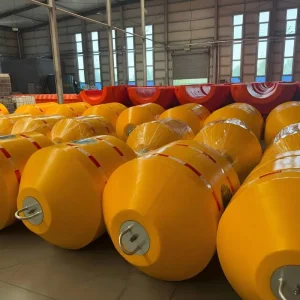
Features high SWL tie-rod through-body cores, heavy padeyes, and customizable modular counterweights for dynamic surge damping.
View Technical Specs & RFPMalaysia's Strategic Marine Infrastructure & Mooring Challenges
Malaysia occupies one of the most critical maritime intersections on earth. Flanked by the busy Malacca Strait on the west and the expansive, cyclonic-influenced South China Sea on the east, marine infrastructure requirements in Malaysia are rigorous and unforgiving. Key hubs like Port Klang, the Port of Tanjung Pelepas (PTP), Pasir Gudang, Kemaman Supply Base, and Bintulu Port require mooring networks capable of handling extreme continuous duty cycles.
Mooring buoys installed across Peninsular Malaysia and Malaysian Borneo (Sabah & Sarawak) face harsh environmental forces: relentless equatorial solar radiation causing rapid degradation of substandard polymers, high salinity levels accelerating galvanic and localized corrosion on metallic surfaces, and extreme seasonal monsoonal swells (Northeast Monsoon) causing severe dynamic loads on catenary ground tackle.
Traditional fabricated steel buoys, while historically ubiquitous, present significant operational liabilities in Malaysian waters. They demand abrasive blasting and recoating every 2 to 3 years to combat tropical oxidation, cause extensive damage to vessel hulls during accidental contact, and risk cataclysmic loss of reserve buoyancy if water enters the shell through stress fractures.
Why Malaysian Ports Prefer Rotomolded Polyethylene Systems
In response to aggressive life-cycle asset management mandates set by port operators, marine contractors, and offshore terminal operators (including PETRONAS Carigali terminal operations), the transition toward rotomolded High-Density Polyethylene (HDPE/LLDPE) mooring buoys has become an industry standard.
Modern polyethylene mooring systems feature an integral seamless outer shell rotationally molded without stress concentrators or welded joints. Internally, our buoys are solid-filled with high-density, closed-cell polyurethane foam (or pressure-expanded polystyrene). This matrix ensures that even under catastrophic vessel collision or deep shell breach, net water absorption remains virtually zero, preserving full operational freeboard.
By eliminating steel maintenance, marine contractors across Selangor, Johor, and Sarawak report operational cost reductions exceeding 65% over a 10-year service life, alongside zero downtime from anti-corrosion sandblasting dry-dock cycles.
| Evaluation Parameter | Advanced Rotomolded PE Buoy (Juhua Specification) | Conventional Fabricated Steel Buoy | Operational Impact in Malaysia (Malacca / SCS) |
|---|---|---|---|
| Corrosion Resistance | 100% Inert to tropical seawater, sulfur & diesel spills | Prone to pitting corrosion; requires periodic sacrificial anodes | No maintenance dry-docking in high-saline Straits of Malacca |
| Impact Mechanics | Elastic deformability; absorbs vessel kinetic energy without denting | Rigid plastic deformation; risks hull gouging and weld fatigue | Drastically lowers damage claims from OSVs at Kemaman & Labuan |
| Unsinkability Integrity | Solid closed-cell PU / EPS foam core (water absorption < 1%) | Hollow or compartmented air chambers; catastrophic loss if breached | Maintains station-keeping even after direct tugboat propeller strikes |
| Thermal & UV Stability | Compounded with UV15+ carbon black or hindered amine stabilizers (HALS) | Polyurethane marine paint peels under intense equatorial UV | Prevents embrittlement and color fading in humid equatorial climates |
| Weight & Handling | Lightweight hull; lower draft; easily lifted with small workboat davits | Heavy tare weight; requires specialized 50T+ crane barges for setup | Reduces marine mobilization charter costs by 40-55% |
Mooring Buoy Reserve Buoyancy & Station-Keeping Calculations
A technical guide for Malaysian marine civil engineers and EPC contractors sizing catenary mooring arrays in tidal estuaries and open sea conditions.
Mathematical Model for Net Buoyancy Sizing
Proper mooring buoy sizing must account for both static self-weight and dynamic forces induced by water currents, wave heave, and chain catenary drag. Sizing a mooring buoy solely based on dry deadweight inevitably causes submersion under peak astronomical tides (such as the 5.5-meter tidal variations in Port Klang or Lumut).
The standard engineering formulation for Required Gross Buoyancy ($B_{gross}$) implemented by Juhua marine engineers is calculated as:
Where:
- W_buoy: Total dry mass of the buoy body, internal steel tie-rod, and counterweight assembly.
- W_chain_sub: Submerged weight of the chain catenary suspended by the buoy at Maximum Astronomical Tide (HAT). ($W_{sub} \approx 0.87 \times W_{air}$ for steel stud-link chain).
- W_hardware: Combined weight of shackles, swivels, bridle rings, and sinkers.
- F_hawser_down: Vertical downward component of hawser line tension during peak gust and surge loads.
- SF (Safety Factor): Typically specified as 1.30 to 1.50 for sheltered harbors (Penang, Kuantan) and 1.60 to 2.00 for offshore open anchorage (Bintulu, Kemaman, Sabah Deepwater).
Through-Chain vs. Central Tension Member Configurations
Depending on the operational demands of the Malaysian client, two core internal load-bearing configurations are engineered:
1. Central Welded Steel Tension Rod (Cruciform SWL Assembly): Ideal for offshore supply vessel (OSV) mooring and high-tonnage anchorages. The load path does not rely on the polyethylene plastic hull. A heavy-duty hot-dip galvanized (HDG) or stainless steel grade Q345/Q355 core passes vertically through the buoy, transferring hawser tensile loads directly into the anchor chain. The PE shell simply acts as an environmental buoyancy chamber.
2. Hawser Pipe (Pass-Through) Configuration: Designed for rapid mooring adjustment and variable water depths. A hollow heavy-wall central hawser tube allows anchor chain to run freely through the core, locked at the upper deck with a quick-release chain stopper or collar. Common in commercial aquaculture, river maintenance, and dredge positioning systems along Pahang and Perak rivers.
All internal steel components undergo mandatory Non-Destructive Testing (MPI/Ultrasonic) and are hot-dip galvanized to ASTM A123 / ISO 1461 specs to ensure superior resistance to seawater corrosion.
Localized Applications Across Peninsular & East Malaysia
Deploying specialized flotation solutions custom-tailored to unique commercial conditions across ASEAN's premier maritime corridor.
Port Klang & PTP Container Anchorage
Handling intense traffic of container feeder vessels, bunker barges, and workboats. Our PE mooring buoys provide high-visibility berthing points that prevent hull friction and withstand constant prop-wash from tug operations.
Kemaman & Labuan Supply Base (Offshore OSV)
Anchor handling and offshore supply vessels (AHTS/OSV) require reliable mooring during crew rotations and logistics staging. Reinforced steel-core buoys resist heavy dynamic jerk loads created by South China Sea swells.
Bintulu LNG & Heavy Industrial Terminals
Critical energy port facilities require spark-proof, explosion-resistant marine equipment. Polyethylene buoys eliminate metal-on-metal spark risks upon vessel contact, vital for volatile petroleum product berthing perimeters.
Reclamation & Capital Dredging Projects
Supporting major land reclamation projects in Melaka, Penang, and Forest City Johor. Buoys act as heavy discharge line anchors and trailing suction hopper dredger (TSHD) dynamic mooring stations.
Sabah & Sarawak Remote Riverways
Logging barges, mining tugs, and passenger ferries along the Rajang and Kinabatangan rivers require rugged, shallow-draft mooring points resilient to submerged timber impacts and high-silt river flow.
Yacht Marinas & Langkawi Eco-Resorts
Pleasure craft and superyacht harbors in Langkawi and Tioman require aesthetic, non-marking mooring buoys that blend into marine eco-sanctuaries while safeguarding sensitive coral reefs from drag damage.
Why Malaysian EPCs Source Mooring Equipment from Juhua China
Combining state-of-the-art rotational molding infrastructure with rapid maritime shipping lanes to all key Malaysian container terminals.
Direct Factory Engineering vs. Local Middlemen Markups
Procuring mooring buoys through regional distributors in Singapore or local middlemen in Kuala Lumpur often adds 35% to 50% in distribution markups without providing direct engineering customization. Shandong Binzhou Juhua Rubber & Plastic Co., Ltd. provides direct access to our manufacturing floor, giving engineering teams complete control over specifications.
Our facility hosts computerized rotational molding ovens with multi-axis indexing capabilities, accommodating buoy diameters ranging from 600mm to 3,500mm in single-piece seamless molding. We precisely calibrate wall thickness from 9mm up to 25mm based on finite element analysis (FEA) of your project's hydrodynamic load cases.
Every mooring buoy undergoes rigorous factory testing prior to container stuffing: raw material melt flow index (MFI) verification, ball drop impact resistance at sub-zero temperatures, ultrasonic shell thickness profiling, and hydraulic pressure testing of the foam-filled body.
Seamless Logistics: Qingdao Port to Port Klang, Tanjung Pelepas & Bintulu
Positioned near major North China shipping hubs, Juhua provides streamlined containerized and breakbulk logistics directly into Malaysia. Regular weekly sailings deliver rapid transit times: typically 8 to 12 days to Port Klang (Northport / Westport) and Tanjung Pelepas, and 14 to 18 days to East Malaysia ports including Kuching, Bintulu, and Kota Kinabalu.
We provide full compliance documentation under the ASEAN–China Free Trade Area (ACFTA). By issuing the official Form E Certificate of Origin, Malaysian buyers enjoy preferential tariff treatment, reducing import duty rates to 0% in most industrial marine categories.
Our export packing protocol utilizes multi-layer protective poly-wrap and heavy-duty timber cradling designed to protect internal steel tension rods and exterior reflective bands from handling abrasion during ocean transit.
PETRONAS & Marine Department Malaysia (Jabatan Laut) Compliance
Our mooring buoys and navigational marker products are manufactured strictly in accordance with International Association of Marine Aids to Navigation and Lighthouse Authorities (IALA) recommendations and can be tailored to meet PETRONAS Technical Standards (PTS) for offshore terminal installations.
Smart Mooring, IoT Telemetry & Circular Polymers
How next-generation mooring assets are reducing carbon footprint and providing real-time telemetry to port control towers in Southeast Asia.
Solar AIS Integration & Real-Time Load Sensing
As Malaysia advances its "Green Port Policy" and smart navigation frameworks along the Malacca Strait, standard passive mooring buoys are evolving into connected digital assets. Juhua's rotomolded buoys can be configured with molded-in battery compartments, marine-grade photovoltaic top-decks, and integrated AIS (Automatic Identification System) Transponders.
Furthermore, internal tension rods can be outfitted with encapsulated load cells and tension sensors. These sensors transmit real-time hawser pull data via 4G/NB-IoT or satellite uplinks directly to port authority operations centers, alerting harbor masters if extreme wind surges or sudden wake events threaten to pull anchor tackle past safe working loads.
100% Recyclable Polyethylene & Eco-Protection
Traditional steel buoys release toxic heavy metals from antifouling coatings (such as cuprous oxide and biocide leachates) into tropical waters. When retired, steel buoys leave rusted flaking hulks requiring energy-intensive scrap recycling.
Our marine-grade virgin linear low-density polyethylene (LLDPE) polymers are completely non-toxic and inert, chemically resistant to bio-leaching. At the end of its 15-to-20-year service life, the outer shell can be mechanically granulated, re-compounded, and recycled into industrial-grade pipe floats or dock bumpers, drastically lowering Scope 3 embodied carbon footprints for environmental ESG reporting.
Industrial Mooring Buoy Portfolio Serving Malaysia
Explore our complete manufacturing series of specialized offshore, marina berth, and heavy commercial anchoring buoys.
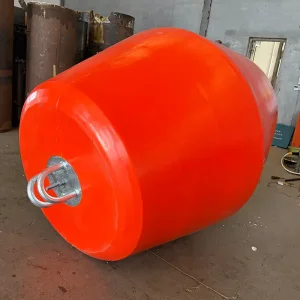
Engineered for commercial shipping anchorages and heavy dredge tender vessels operating in choppy coastal fairways.
Request Quote & CAD
Configurable internal ballast weights provide dynamic upright stability under sudden tidal reverse flow and high current drag.
Request Quote & CAD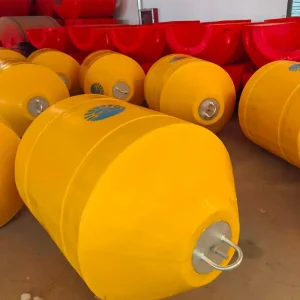
Designed with soft exterior resilience to safeguard pleasure craft, passenger ferries, and patrol vessels from paint abrasion.
Request Quote & CAD
Features high safe working load (SWL) pad eyes certified for continuous dynamic wave loads during seasonal monsoon storms.
Request Quote & CAD
Available in IALA standard maritime colors (Yellow, Red, Green, White) with high-intensity 3M reflective tape bands.
Request Quote & CAD
Manufactured with reinforced internal hawser tubes allowing quick chain height adjustments for deep water mooring catenaries.
Request Quote & CAD
Engineered for extreme longevity in equatorial salt waters; seamless rotomolding completely eliminates stress cracking points.
Request Quote & CAD
Heavy duty mooring buoy supplied complete with certified shackles, safety swivels, and top pick-up marker arrangements.
Request Quote & CADHow to Specify Your Mooring Buoy for Fast Malaysian Delivery
Follow our technical RFQ framework to receive accurate hydrodynamic sizing calculations and a commercial CIF quotation within 24 hours.
Hydrodynamic Inputs
Specify maximum water depth (LAT & HAT), maximum current velocity (knots), and wave significant height ($H_s$) at your anchorage location.
Vessel Parameters
Detail maximum design vessel displacement (DWT), windage area, and vessel type (bunker tanker, offshore support tug, barge, container ship).
Ground Tackle Rig
Confirm anchor chain diameter (grade U2/U3), anchor type (High Holding Power fluke / concrete sinker), and whether a through-rod or hawser-pipe is required.
Port Delivery Logistics
Confirm target Malaysian discharge port (Port Klang, Pasir Gudang, Bintulu, Kemaman) for optimized 40ft High Cube container stuffing and Form E duty exemption.
Mooring Buoys in Malaysia: Technical & Commercial FAQ
Direct answers from Juhua's senior flotation engineers covering manufacturing standards, marine biology resistance, and import customs procedures.
How do Juhua polyethylene mooring buoys withstand aggressive tropical bio-fouling in the Straits of Malacca?
What is the typical shipping lead time and customs duty from China to Malaysia?
Can these buoys handle severe 5.5-meter tidal variations encountered around Port Klang and Lumut?
What grade of internal steel tension core is used, and how is galvanic corrosion prevented?
What happens if a support tug or vessel collides with the mooring buoy?
What warranty terms apply to international deliveries to Malaysian ports?
Ready to Order or Request a Tender Quotation for Malaysia?
Send your project parameters—including water depth, target vessel DWT, hawser configuration, and required delivery port (Port Klang, Tanjung Pelepas, Kemaman, or Bintulu)—for a full engineering sizing report and commercial price schedule.
Send Inquiry Now