

Milan Marine Spec
Engineered high-density rotomolded polyethylene pipe floats for dredging operations, industrial effluent bypasses, sand quarry extraction, and hydraulic canal rehabilitation throughout Lombardy and international EPC sites.
Pre-configured, closed-cell polyurethane-filled rotomolded modules matched to steel, HDPE, and composite discharge pipelines.

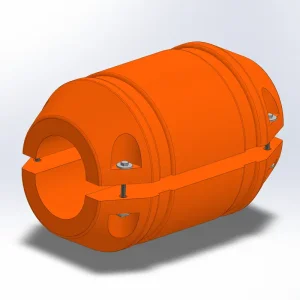
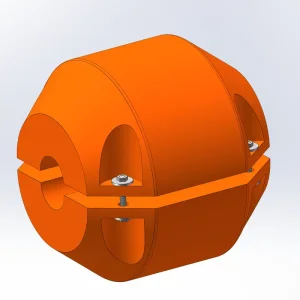
Milan, as the economic engine of Northern Italy and the central hub of Lombardy's industrial cluster, possesses a unique hydro-engineering identity. While landlocked, the metropolitan area and its surrounding territories—encompassing the historical Navigli waterway network, the Ticino and Adda river watersheds, and the extensive Po river basin—demand sophisticated floating pipeline systems. Furthermore, Milan serves as the corporate and engineering headquarters for some of the world's most prominent EPC (Engineering, Procurement, and Construction) conglomerates, such as Saipem and major multidisciplinary engineering firms in San Donato Milanese. These entities manage massive international offshore land reclamation, port dredging, and subsea tie-in projects across the Mediterranean, North Africa, and the Middle East from their Milanese operations bases.
Locally, Lombardy's heavy industrial demands generate consistent requirements for clamp-on polyethylene pipe floats across three main sectors:
Procurement teams based in Milan operate under strict Italian and European technical regulations, requiring compliance with EN 12201 hydraulic pipe float integration, CE conformity, and REACH-compliant rotomolded polymers. Projects along the Po River basin and Natura 2000 protected areas forbid leaching materials, demanding 100% chemically inert, virgin LLDPE shells that will not contaminate sensitive irrigation aquifers.
The global transition away from fragile welded steel buoyancy pontoons to seamless rotationally molded polyethylene floats is nearly complete. Contemporary pipeline engineering mandates internal foam filling with impermeable, closed-cell polyurethane to prevent catastrophic sinking in the event of accidental hull puncture by dredging equipment, river debris, or rock impacts.
A frequent point of failure in pipeline flotation design is under-sizing buoyancy capacity by basing calculations solely on clear-water conveyance. In practical Lombardy sand-dredging or municipal desiltation projects, the specific gravity of the pumped medium frequently ranges between 1.3 t/m³ and 1.8 t/m³. To guarantee safe freeboard (typically maintaining 25% to 30% of the pipe diameter above the water surface) and avoid pipeline swamping during sudden pump shutdowns, engineers must adhere to the reserve buoyancy protocol:
Where: Btotal is the combined net buoyancy of the float pair; Wpipe represents the unladen pipe weight; Vinternal × ρslurry accounts for the dynamic mass of the slurry payload; and Waccessories integrates flange collars, coupling bolts, and electric cabling weights.
For example, when operating an OD 500mm PN10 HDPE dredging line conveying a 1.6 t/m³ quartz-sand slurry from a quarry near the Adda River, the combined operational payload exceeds 380 kg per linear meter. Using un-reinforced or under-specified floats will result in negative freeboard, accelerating pipeline abrasion against the riverbed or quarry bottom and creating acute operational hazards.
Engineered for corrosive effluents, river currents, and high-frequency cyclical stress.
| Performance Parameter | Juhua Rotomolded LLDPE / PU Core | Fabricated Welded Steel Pontoon | Fiberglass Reinforced Plastic (FRP) |
|---|---|---|---|
| Corrosion & Seawater Resistance | Impervious to salt spray, industrial acids (pH 2–12), and bio-fouling. Zero rust. | Severe galvanic and oxidation risk; requires continuous anti-fouling recoating. | Good chemical resistance; vulnerable to micro-cracking and osmotic blistering. |
| Impact Toughness & Resiliency | High elastic recovery; absorbs kinetic collisions from barges and drift timber without cracking. | Dents easily; weld seams prone to stress fatigue and progressive rupture. | Brittle; shattering occurs upon acute impact with dredging buckets or rock outcroppings. |
| Weight & Handling on Milan Sites | Ultra-lightweight; two-piece interlocking clamp design installed with basic hand tools. | Extremely heavy; requires high-capacity cranes and specialized rigging crews. | Moderate weight; requires delicate handling to prevent delamination along edge flanges. |
| Integrity Upon Shell Puncture | Zero water penetration; 100% closed-cell hydrophobic polyurethane core retains full buoyancy. | Catastrophic sinking once the hollow air chamber is breached. | Rapid interior flooding unless custom filled with expensive secondary foam cores. |
| Operational Lifespan (Milan Climate) | 15 to 25+ years (UV20+ stabilized for intensive Mediterranean solar irradiance). | 5 to 8 years before structural corrosion necessitates replacement. | 8 to 12 years before resin degradation occurs under intense UV exposure. |
Specialized compact profile floats tailored for tight clearances along the Naviglio Grande and Pavese, minimizing surface wake while providing smooth bypass for sediment dredging pipelines.
Heavy-duty buoyancy rings sized for specific slurry gravities up to 1.75 kg/L in aggregate pits across San Giuliano Milanese, providing vibration damping during heavy pumping.
Chemical-resistant polyethylene floats deployed during primary and secondary treatment basin refits in Milan's municipal sanitation centers, supporting discharge lines over active tanks.
High-altitude, freezing-resistant floats deployed in Alpine reservoir desilting lines feeding downstream Lombardy hydroelectric turbines, remaining resilient in thermal swings.
Turnkey containerized shipments customized to Milan engineering firms managing deep-sea terminal dredging, marine outfall pull-ins, and port building contracts worldwide.
Specialized floats with integrated top troughs carrying electric high-voltage power lines and control telemetry alongside slurry conduits to dredgers operating remote from shore.
As Italy accelerates its ecological transition under the EU Green Deal and regional Lombardy environmental mandates, the pipeline flotation sector is undergoing a profound technological transformation. Traditional passive floats are rapidly evolving into intelligent, sustainable hydraulic support systems designed to minimize ecological footprints while eliminating unexpected downtime.
Contemporary pipeline installations face dynamic wave action, cyclic hydrodynamic fatigue, and dangerous slurry plugging events. In collaboration with smart-monitoring initiatives across Italian infrastructure, modern pipe floats can now be equipped with low-power wireless IoT telemetry sensors. Encapsulated directly within the rotomolded shell during production, these sensors measure:
In adherence to European circularity targets, high-end LLDPE pipe float shells are engineered for end-of-life circular processing. Unlike steel pontoons which generate heavy slag during thermal cutting or composite FRP materials that cannot be melted down, rotomolded PE shells can be shredded, micronized, and repurposed into industrial pipe protectors and non-structural buoyancy components, minimizing municipal landfill burdens across Northern Italy.
Direct answers from our hydraulic flotation engineers regarding sizing, delivery, and installation.
Standard diameter pipe floats (matching OD 110mm up to OD 1200mm) receive formal technical and commercial proposals within 24 hours. For projects in Milan or Lombardy, sea freight arrives via the Port of Genoa or La Spezia, followed by bonded road transport directly to your project yard or dredging berth within 25–35 days from manufacturing completion.
Each pipe float pair features interlocking locating pins and matching bolt channels. The modules are secured using hot-dip galvanized (Class 8.8) or marine-grade AISI 316 stainless steel high-tensile bolts, accompanied by heavy-duty flat washers and locking nylon nuts. Internal ribbing grips the pipe exterior securely, eliminating axial slippage under hydraulic thrust.
Even if the outer LLDPE shell experiences a catastrophic gouge or penetration, the float will not sink. The entire inner cavity is high-pressure injected with closed-cell polyurethane foam (density 35–40 kg/m³) that exhibits less than 1% water absorption by volume under immersion. The assembly preserves 98%+ of its original buoyancy rating.
Yes. In our dedicated rotomolding tool-making facilities, we develop customized molds tailored to any steel, HDPE, or PVC pipe outer diameter. We regularly cast integrated top-side troughs designed to route submersible power cables, air hoses, or telemetry lines along the floating pipeline string.
Fully certified, interchangeable spare units and turn-key buoyancy systems engineered for extreme hydraulic endurance.
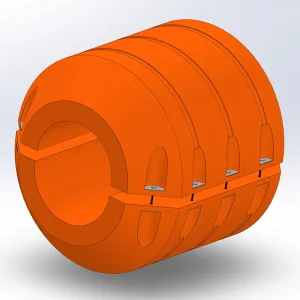
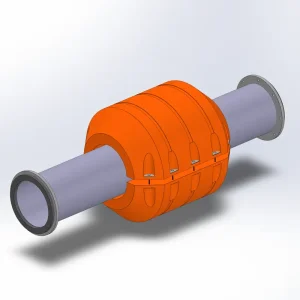
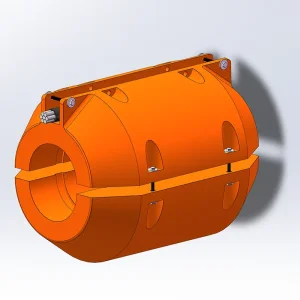
Send your pipe outer diameter, wall thickness, slurry specific gravity, and total pipeline length. Our hydrodynamic engineering team will calculate your buoyancy requirements, furnish technical 3D CAD drawings, and supply competitive direct-manufacturer CIF/DAP Milan pricing within 24 hours.
Send Inquiry Now