
Heavy-Duty Mooring Buoys Engineered for Oman Offshore Demands
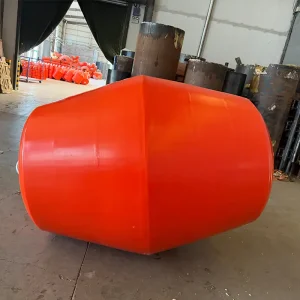
Precision-moulded virgin polyethylene modules integrated with hot-dip galvanized steel load-bearing structures. Specifically deployed across port expansion basins and outer anchorages in Sohar and Salalah.


Industrial Maritime Expansion in Oman & Global Procurement Demands
Positioned outside the Strait of Hormuz along prime East-West intercontinental shipping lanes, the Sultanate of Oman is executing an aggressive maritime expansion under Oman Vision 2040, transforming the procurement landscape for offshore mooring buoys.
Port of Salalah Deepwater Operations
As one of the world's highest-volume transshipment hubs, Salalah experiences intensive Indian Ocean swells during the annual Khareef monsoon season. Mooring systems here require extreme reserve buoyancy, energy-absorbing elastomeric bumpers, and high-tensile internal steel load lines capable of handling continuous cyclic stress from ultra-large container vessels (ULCVs) and bunkering support craft.
- Dynamic tension resistance up to 650 kN
- Monsoon swell impact absorption
Duqm SEZ Offshore Expansion
The Special Economic Zone at Duqm (SEZAD) represents the cornerstone of Oman's non-oil industrial diversification. Offshore installations, heavy ship-repair drydocks, and crude export anchorages necessitate multi-leg catenary mooring systems and single point mooring (SPM) pick-up buoys fabricated from chemically inert polyethylene that resist intense marine fouling and high salinity.
- Seamless rotomolded virgin LLDPE skin
- Non-toxic zero-leaching materials
Sohar & Mina Al Fahal Hydrocarbons
Refineries and petrochemical terminals in Sohar and PDO Mina Al Fahal require explosion-proof safety accessories, non-sparking hawser guides, and rapid-release hook integration. Traditional steel mooring buoys face catastrophic electrochemical degradation in the Arabian Gulf's 42‰ salinity, shifting engineering preference decisively toward polyethylene composites.
- Corrosion-proof lifetime operation
- ATEX / OCIMF compliant hawser hardware
Engineering Architecture: Why PE Mooring Buoys Outperform Steel in Oman
Comparing the thermodynamic and electrochemical lifecycle of rotomolded cellular polymer structures against conventional marine steel fabrication under Gulf environmental stressors.
Material Degradation & Thermal Shock Control
Omani surface waters fluctuate between extreme thermal highs exceeding 36°C in summer and high-UV exposure rates reaching UV Index 12+. Conventional painted steel undergoes cathodic delamination and rapid chalking, requiring drydock sandblasting every 36 months.
Our mooring buoys use virgin linear low-density polyethylene (LLDPE) compounded with molecularly dispersed carbon black and organic Hindered Amine Light Stabilizers (HALS UV20+). The shell retains over 85% of its original elongation and tensile properties after 25,000 continuous hours of accelerated xenon arc weathering.
Hydrophobic Matrix Core & Tension-Through Engineering
A common failure mode in hollow marine flotation is accidental breach through vessel hull collision. Our modular systems are injected with high-density (38-45 kg/m³) closed-cell polyurethane or expanded polystyrene (EPS) foam with water absorption rates of less than 1.5% by volume under hydrostatic pressure.
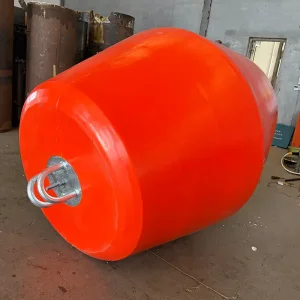
Load transmission does not rely on the plastic skin. An internal centralized hot-dip galvanized steel tie-rod assembly (certified to ASTM A123 / ISO 1461) links top mooring cleats directly to bottom anchor pad-eyes, transferring 100% of the vessel bollard pull directly to the ground tackle.
Mooring Buoy Reference Specifications & Indicative Pricing for Oman
Standard dimensional envelopes, reserve buoyancy calculations, and indicative CIF rates for major Omani commercial discharge points (Sohar / Salalah / Sultan Qaboos / Duqm Ports).
| Model Code | Outer Diameter (mm) | Net Buoyancy (kg) | Safe Working Load (SWL) | Recommended Application | Indicative Price (USD / Unit CIF Oman) |
|---|---|---|---|---|---|
| JHM-1200-OM | 1,200 mm | 850 kg | 150 kN (15 Ton) | Workboats, Marinas, Light Patrol Vessels | $980 - $1,450 |
| JHM-1500-OM | 1,500 mm | 1,800 kg | 250 kN (25 Ton) | Bunkering Barges, Tug Support, Coastal Anchorages | $1,650 - $2,300 |
| JHM-1800-OM | 1,800 mm | 3,200 kg | 400 kN (40 Ton) | Commercial Berth Marking, Dredging Pontoons | $2,600 - $3,750 |
| JHM-2200-OM | 2,200 mm | 5,800 kg | 600 kN (60 Ton) | Offshore Supply Vessels (OSVs), Duqm Drydock Wait Areas | $4,200 - $5,900 |
| JHM-3000-OM | 3,000 mm | 12,500 kg | 850 kN (85 Ton) | Tanker Waiting Basins, Deepwater Cat-Mooring Arrays | $7,800 - $11,500 |
*Disclaimer: Pricing fluctuates based on raw polymer resin index (ICIS), steel price, and ocean freight rates. Volume discounts available for full container load (FCL) orders. All units include complete hot-dip galvanized internal steel framework and stainless steel hardware.
Technological Roadmap: The Next Generation of Smart Mooring in Oman
Integrating real-time telematics, sustainable polyolefin recyclability, and autonomous oceanographic telemetry to align with the digital twin port initiatives at Salalah and Sohar.
Smart Tension Telemetry
Embedding wireless piezoelectric tension pins directly inside the mooring through-chain assembly, relaying real-time mooring loads to port master consoles via LoRaWAN/NB-IoT.
100% Recyclable Marine Resins
Transitioning to mono-material rotomoulded compounds allowing 100% molecular re-granulation at end of service life, supporting Oman's Net-Zero 2050 decarbonisation roadmap.
Integrated AIS & Metocean Buoys
Self-powered multi-sensor buoys equipped with solar monocrystalline panels, micro-radar reflectors, and IALA-compliant Class B AIS transponders to prevent vessel collision in heavy fog.
Biomimetic Micro-Texture
Rotomoulding outer skin surfaces with biomimetic hydrophobic textures that naturally resist barnacle and macro-algal adhesion without the application of toxic biocide paints.
Localized Support, Customs Clearance & Port Compliance in Oman
Seamless international procurement engineered to satisfy the rigorous technical specifications of the Ministry of Transport, Communications and Information Technology (MTCIT) and Omani Royal Navy maritime boundaries.
Bayan Customs Streamlining
Complete pre-shipment documentation managed directly through Oman's Bayan Customs Single Window system. Every shipment includes certified Chamber of Commerce Certificates of Origin, SASO/Omani conformity inspection reports, and compliant HS code classifications (392690 / 890790) for zero border delays.
Full IALA & PIANC Alignment
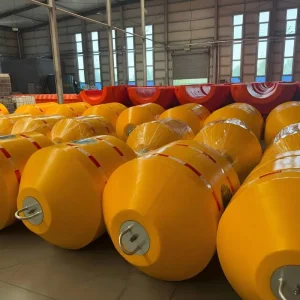
Buoy chromaticity conforms strictly to IALA Guideline 1078 (Region A buoyage system, as mandated across all Omani coastal waters). Surface colors (Canary Yellow, Signal Red, Maritime Green) are integrated directly into the polymer matrix during molding, ensuring zero paint peeling and persistent daytime color visibility.
On-Site Engineering Supervision
We supply complete catenary mooring calculation packages, ground tackle sizing charts (stud-link chains, high holding power anchors, and swivel shackles), and remote or on-site deployment guidance for port contractors across Salalah, Sohar, and Khasab.
Comprehensive Mooring Buoy Portfolio Available for Oman Maritime Infrastructure
Precision-manufactured units covering utility workboat moorings, marina berths, commercial anchorage systems, and offshore transfer terminals.

Frequently Asked Questions on Mooring Buoy Supply to Oman
Direct engineering answers to clarify procurement specifications, shipping timelines, customs procedures, and mooring calculations.
What is the standard lead time for CIF delivery to Omani ports (Salalah, Sohar, Duqm)?
How do your buoys handle the intense UV index and heat in the Arabian Gulf and Sea of Oman?
Can your engineering team calculate catenary mooring lines for local seabed conditions in Oman?
Are the buoys compliant with IALA Region A standards used in the Sultanate of Oman?
What documentation is provided for customs clearance via Oman's Bayan system?
Equip Your Omani Maritime Project with Certified Flotation Systems
Connect directly with our senior marine flotation engineers to receive customized mooring buoyancy calculations, 2D/3D CAD submittal packages, and formal CIF Oman price quotations within 24 hours.