High-Integrity Pipeline Float Systems Serving Indian Projects
Engineered modular pipeline floats certified for deepwater deflection, shore pull landings, and underwater spool tie-in operations across Indian offshore basins.

The Commercial and Technical Landscape of Pipeline Float Tie-Ins in India
Strategic maritime infrastructure, ultra-deepwater exploration in the Bay of Bengal, and cross-peninsular LNG expansions are demanding advanced, rotomolded buoyancy solutions.
Driven by the Government of India's flagship Sagarmala Programme, deep-draft port modernization across major hubs such as Paradip, Visakhapatnam, JNPT (Nhava Sheva), and Mundra requires hundreds of kilometers of capital and maintenance dredging. Concurrently, public and private energy giants—including the Oil and Natural Gas Corporation (ONGC), Reliance Industries Limited (RIL), and Indian Oil Corporation (IOCL)—are heavily investing in brownfield rejuvenation at the mature Mumbai High basin and greenfield deepwater exploration across the Krishna Godavari (KG-DWN-98/2) offshore blocks.
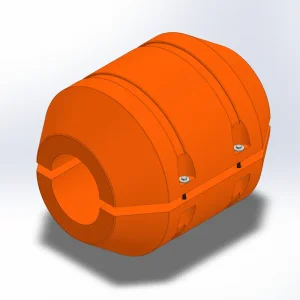
In these challenging underwater environments, a Pipeline Float Tie-In system serves as the foundational hydrodynamic support. During pipeline towing, S-lay or J-lay deployment, and underwater PLET (Pipeline End Termination) spool alignment, the buoyancy modules mitigate seabed touchdown stresses, eliminate critical buckle loads, and provide micro-adjustable trimming forces for ROV-guided diverless tie-in couplings.
Demanding Hydrodynamic Loads
Indian coastal waters experience aggressive Arabian Sea monsoon wave regimes and cyclonic storm surge phenomena in the Bay of Bengal. Tie-in floats must withstand elevated current drag while preserving structural hoop-stress resistance against dynamic seabed pounding.
Stringent PSU EPC Compliance
Major Indian operators enforce stringent quality vetting matching EIL (Engineers India Limited) and OISD (Oil Industry Safety Directorate) frameworks. Flotation hardware must furnish full material traceability, hydrostatic test logs, and third-party Lloyd's or DNV verification.
Localized Buoyancy Applications Across the Indian Peninsula
Detailed analysis of operational hydrodynamic configurations deployed across shallow tidal flats, coral ecosystems, and ultra-deep continental shelf drop-offs.
Deepwater Spool Tie-In (KG Basin)
In deep offshore blocks reaching depths of 400m to 1,800m, connecting subsea production manifolds to export pipelines requires zero-diver operations. Syntactic foam and heavy-duty copolymer tie-in floats create a buoyant "lazy S" catenary profile, drastically reducing effective spool submerged weight so lightweight ROVs can mate pipeline flanges safely.
- Hydrostatic pressure endurance up to 180 bar
- Non-compressible closed-cell buoyancy matrices
- ROV-operated quick release strap integration
Shore Pull & Coastal Landfall (Gujarat & Odisha)
Pulling heavy carbon steel or concrete-coated gas pipelines across soft coastal mudflats (such as the Gulf of Khambhat or Dhamra Port) generates catastrophic seabed friction if unsupported. Pipeline floats are clamped at pre-calculated pitch intervals, ensuring precise negative buoyancy of less than 20 kg/m during the shore-winch pull.
- UV 15+ stabilized outer shells resisting 45°C ambient heat
- Impact-resistant virgin rotomolded LLDPE casing
- Corrosion-proof marine-grade SS316 fast-tighten hardware
Harbor Dredging & SBM Offloading Tie-In
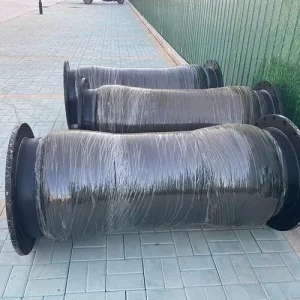
Connecting Single Buoy Mooring (SBM) installations to crude refinery trunklines at ports like Cochin or Deendayal involves floating flexible pipelines subject to non-stop cyclical wave action. High-buoyancy modular collars prevent hose kinks, dampen fatigue failure, and allow seamless bypass maintenance.
- Dynamic flex-fatigue dampening profiles
- Zero-rust construction impervious to high salinity
- Compatible with standard dredge/slurry pipe ODs up to 1200mm
Chinese OEM Factory Supply Chain Advantages for Indian EPCs
Combining world-scale polymer rotomolding capacities with streamlined multimodal transit to Nhava Sheva, Mundra, and Chennai ports.
Overcoming Critical Procurement Bottlenecks
Indian offshore and marine dredging contractors often grapple with excessive project lead times and inflated costs imposed by European suppliers. By partnering directly with our high-volume Chinese manufacturing hub in Shandong, Indian EPCs secure direct-from-factory economies of scale without technical compromises.
1. Automated Rotomolding Precision: Our continuous ovens utilize electronic thermal management and variable frequency rotation, ensuring uniform wall thickness across every half-shell. This eliminates weak internal stress planes that lead to hydrostatic collapse under subsea hydrostatic head.
2. Tailored Polyurethane Cores: Internal buoyancy cores are filled with high-density, closed-cell polyurethane foam (35 kg/m³ to 80 kg/m³ for shallow applications) or syntactic microsphere blends for subsea tie-ins. Even in the event of an accidental shell breach by anchor contact, water absorption is limited to less than 0.05% by volume.
3. Comprehensive Indian Regulatory Compliance: We furnish all mandatory testing deliverables required by Indian project engineering auditors—including factory acceptance test (FAT) reports, tensile elongation verifications according to ISO 527, and full MTCs (Mill Test Certificates) for raw polyethylene resins.
Optimized Freight & Breakbulk Shipping
Nest-design modular float halves maximize container cubic capacity (40ft HQ), reducing per-unit sea-freight tariffs into Mumbai Port, Hazira, and Visakhapatnam to negligible project percentages.
Custom Fastener Metallurgies (Super Duplex & SS316)
Configured specifically for tropical Indian marine environments prone to bio-fouling and pitting corrosion. All tie-in clamps can be supplied with Super Duplex 2507, Monel 400, or heavy hot-dip galvanized Grade 8.8 bolting kits.
Reference Specification & FOB / CIF Indian Ports Pricing Framework
Baseline budgetary pricelist for procurement planners. Final landed cost varies depending on working depth, core foam density, and Indian destination port (Nhava Sheva / Mundra / Chennai).
| Internal Diameter (Pipe OD) | Outer Float OD & Length | Reserve Net Buoyancy | Shell / Core Spec | Depth Rating (MSW) | Indicative Price Range (USD) |
|---|---|---|---|---|---|
| DN200 - DN300 (8" - 12") | Ø750mm × 1000mm | ~320 kg to 480 kg | 10mm LLDPE / Closed-cell PU | 0 - 150m (Shallow/Coastal) | $180 - $280 / pair |
| DN400 - DN500 (16" - 20") | Ø1100mm × 1200mm | ~750 kg to 1,100 kg | 12mm UV-PE / High-density PU | 0 - 300m (Intermediate) | $390 - $590 / pair |
| DN600 - DN800 (24" - 32") | Ø1400mm × 1500mm | ~1,600 kg to 2,400 kg | 14mm LLDPE / Reinforced matrix | 0 - 600m (Subsea Tie-In) | $850 - $1,350 / pair |
| DN900 - DN1200 (36" - 48") | Ø1800mm × 2000mm | ~3,800 kg to 5,500 kg | 16mm Co-polymer / Syntactic hybrid | Up to 1,500m (Deepwater KG Basin) | $1,900 - $3,200 / pair |
| Custom PLET / Spool Modules | Engineered to Project Drawings | Up to 12,000 kg / unit | Syntactic microspheres / Kevlar strap | Up to 3,000m (Ultra-Deep) | Project Tender Custom Quote |
Emerging Technology Trends in Marine Flotation Systems
How the transition toward ultra-deep exploration and sustainable port operations is reshaping flotation polymer science.
Syntactic Nanosphere Polymer Blends
Traditional rigid polyurethane experiences hydrostatic cell breakdown beyond 300 meters depth. Contemporary R&D incorporates hollow glass microspheres within an epoxy resin matrix, achieving high buoyancy-to-weight ratios capable of enduring continuous 3,000-meter hydrostatic loads without water migration.
Integrated Acoustic & RFID Asset Tracking
Indian EPC operators are increasingly requiring digital traceability for submerged assets. Our pipeline float modules can be factory-molded with embedded RFID transponders and sonar reflector transponders, simplifying ROV subsea inventory auditing and post-installation positioning inspections.
Bio-Inert & Circular Polymer Shells
Environmental scrutiny in sensitive maritime corridors—including the Gulf of Mannar Biosphere Reserve and Chilika Lagoon—demands zero-leach polymer casing. Our high-density polyethylene shells use Virgin Grade virgin food-grade PE with zero heavy metal additives, resisting marine organism attachment while remaining 100% recyclable post-decommissioning.
Engineering & Procurement FAQ for Indian Operations
Detailed technical, regulatory, and logistics answers for engineering buyers and project leads.
How does a Pipeline Float Tie-In differ from a standard dredging pipe float?
What specific technical data is needed to generate a formal buoyancy calculation for India?
Can these floats withstand high tropical temperatures during outdoor storage on Indian jetty yards?
How do you handle Indian customs clearance, BIS certifications, and shipping documentation?
What fastening mechanisms are supplied to prevent slippage on wet corrosion-coated subsea pipelines?
Comprehensive Flotation, Piping & Mooring Catalog Serving India
Explore our complete manufacturing spectrum of modular deepwater floats, dredging sleeves, navigation infrastructure, and commercial marine buoys.