
Primary Industrial Pipe Float Systems
Rapid-deployment, rotomolded UV-stabilized solutions specifically hardened for the maritime and industrial requirements of New Zealand.



Commercial Landscape & Infrastructure Demands in New Zealand
A technical assessment of maritime conditions, dredging developments, and aggregate extraction needs across the North and South Islands.
Port & Channel Maintenance
Key transport hubs such as the Port of Tauranga, Ports of Auckland, and Lyttelton Port undergo continuous channel deepening and sediment control. Subtropical tidal velocities, combined with heavy maritime traffic, necessitate hydrodynamically profiled pipeline floats that demonstrate zero-rot crack resistance under prolonged sea-surge torsion.
Severe Southern Ocean UV Exposure
Due to atmospheric variations over the Southwestern Pacific, New Zealand endures extreme ultraviolet index (UVI) levels during operational months. Standard grade polyethylene deteriorates rapidly without precise compounding. Our floats incorporate certified UV-8 to UV-15 carbon and organic stabilizers, extending operational life cycles past 15 years.
Mining Tailings & Aggregate Recovery
From Waikato riverbed sand recovery to South Island alluvial gold operations, industrial slurries feature high specific gravity values (often reaching 1.4 to 1.7 t/m³). Maintaining precise freeboard elevation requires engineered buoyancy ratios exceeding standard fresh-water benchmarks by 25% to 35%.
Engineering Roadmap: Structural Integrity & Buoyancy Science
Advanced rotational molding chemistry, volumetric calculation methodologies, and hydro-mechanical resistance.
Rotomolding Wall Uniformity
Conventional blow-molded or low-tier rotomolded variants suffer from thin radius sections prone to impact punctures. Our computerized multi-axis rotational ovens utilize digital thermal monitoring to guarantee uniform wall thicknesses from 6mm to 18mm, preventing deformation under wave-slam slamming forces.
Hydrophobic Polyurethane Core
Even in the unlikely event of high-impact shell penetration caused by offshore support vessels or sharp aggregate, our dense closed-cell polyurethane foam interior absorbs less than 1% water by weight. The float retains over 99% of its original buoyancy rating under sustained hydrostatic pressure.
Precision Fastening Mechanics
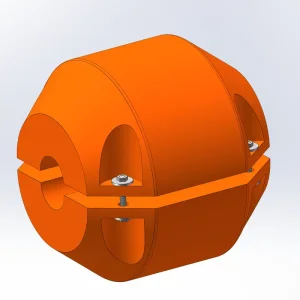
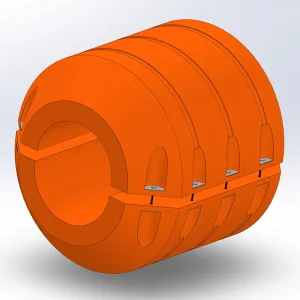
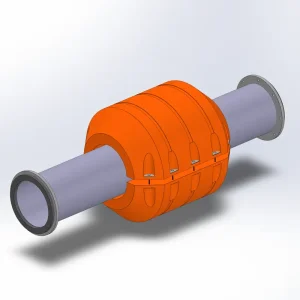
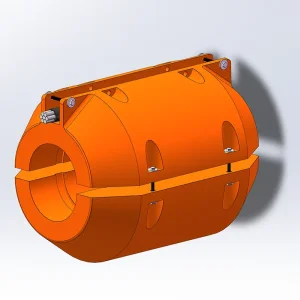
Equipped with marine-grade 316 stainless steel or hot-dip galvanized Grade 8.8 bolting kits, the split-half casing grips HDPE, steel, or rubber hoses securely. Molded anti-slip ribs eliminate lateral line displacement during surging currents without damaging outer pipe linings.
Local Compliance, Biosecurity & Global Procurement
Seamless procurement channels for Tier-1 contractors, EPC firms, and local council marine projects.
MPI Biosecurity & Clean Transport
Shipments directed to Auckland, Lyttelton, or Tauranga comply rigorously with New Zealand Ministry for Primary Industries (MPI) phytosanitary regulations. All timber dunnage and packaging undergo ISPM-15 certified thermal heat treatments, eliminating clearance delays at port customs.
Resource Management Act (RMA) Compliance
Constructed from inert food-grade polyethylene, our pipe floats do not leach toxic additives, microplastics, or anti-fouling poisons into pristine aquatic habitats. This clean design aids operators in satisfying strict regional council discharge permits.
Container Optimization Logic
Nesting architectures and split-casing configurations maximize volumetric packing ratios in 40ft High Cube containers. This drastically reduces per-unit sea freight rates from factory staging directly to New Zealand deepwater discharge terminals.
Specialized Pipeline Float Portfolio
Comprehensive engineering choices designed for tailings transfer, high-volume reclamation lines, and dynamic marine environments.
Engineering Questions & Technical Consultation (FAQ)
Crucial factors to verify before finalizing procurement specifications for New Zealand maritime works.