

Custom Pipe Floats – Reliable Buoyancy for Uruguay Marine Pipeline Projects
View Engineering Specs
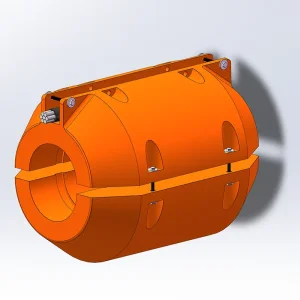
Featured marine buoyancy modules specifically configured for slurry discharge pipelines, sand reclamation lines, and coastal infrastructure projects across Montevideo, Nueva Palmira, and the Río Uruguay corridor.

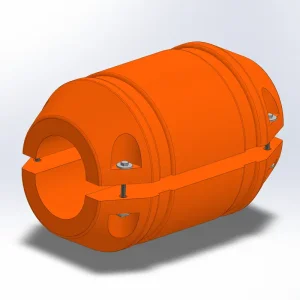
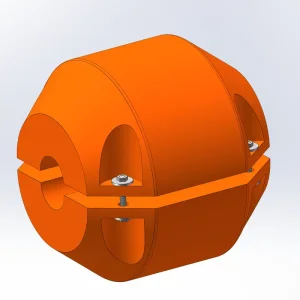
Navigating the complex hydrological realities of South America’s pivotal transshipment hub requires engineered buoyancy solutions capable of withstanding shifting riverbed sediments, dynamic tidal currents, and intense maritime operations.
Montevideo’s ambition to deepen its access channel from 13 meters to 14 meters establishes Uruguay as the definitive deep-water gateway for the Southern Cone. This continuous capital and maintenance dredging demands robust floating HDPE pipelines that can withstand high maritime traffic, heavy swell from the outer estuary, and rigorous cutter suction dredger (CSD) cycles without pontoon displacement or mechanical stress fractures.
The 3,442-kilometer navigable river network funnels agricultural commodities from Brazil, Bolivia, and Paraguay directly through Nueva Palmira and Uruguayan transshipment terminals. Managing sediment aggregation at the confluence of the Uruguay and Paraná rivers necessitates agile trailing suction hopper dredge (TSHD) operations and discharge pipelines equipped with lightweight, impact-absorbing rotomolded PE floats.
World-scale pulp production complexes along the Río Uruguay (Fray Bentos) and Río Negro (Paso de los Toros) maintain dedicated industrial water intake, cooling pipelines, and environmental effluent dispersion lines. These installations demand marine-grade buoyancy units that resist harsh industrial runoff, continuous solar UV exposure, and seasonal river flood surges.
Floating pipelines operating under heavy slurry pressures require an exact balance of shell hoop tensile strength, cellular core hydro-repellency, and flexible clamping geometries to prevent pipe ovalization and subsea fatigue.
Our pipe float shells are rotomolded as a single, seamless stress-free monolith utilizing 100% prime-grade Linear Low-Density Polyethylene (LLDPE) or High-Density Polyethylene (HDPE). The resin is pre-compounded with carbon black or micronized UV stabilizers (minimum Class UV8 up to UV16). This chemical barrier prevents polymer chain scission, embrittlement, and surface cracking under the intense solar radiation encountered across Uruguayan coastal and riverine summers.
The interior void of each semi-circular float section is pressure-injected with closed-cell polyurethane foam having a density of 35 kg/m³ to 45 kg/m³. With a closed-cell structural ratio exceeding 92%, the foam retains zero hygroscopicity. Even if an errant barge collision or floating debris compromises the outer thermoplastic skin, the buoyancy module will not ingest water, maintaining safe pipeline freeboard throughout emergency recovery operations.
Selecting the correct float model cannot rely on dry-pipe estimates. In the volatile currents of the Río de la Plata and seasonal spate conditions of the Río Uruguay, slurry mixtures carry variable volumetric weights. Marine engineers sizing floating pipelines must apply our verified buoyancy formula to prevent pipeline sinking caused by sediment settlement:
Our engineering bureau provides comprehensive buoyancy calculations, center-to-center float spacing models, and clamping torque recommendations for nominal pipe diameters ranging from 110mm (4") up to 1200mm (48") to guarantee smooth bending curvature without joint pinching.
Global dredging contractors, port developers, and civil engineering consortiums are shifting procurement strategies toward precision-automated rotomolding facilities capable of rapid scaling, traceable metallurgy, and competitive logistics.
Our Industry 4.0 production base in Binzhou, Shandong incorporates dual-axis robotic arm carousels equipped with real-time infrared mold wall thermography. Electronic micro-tuning ensures constant rotational sintering temperatures, eliminating wall thinning around curvature corners and ensuring repeatable shell thickness across thousands of identical units.
Every single batch of pipe floats is submitted to non-destructive ultrasonic wall thickness verification, Charpy impact toughness testing at -20°C, and accelerated Environmental Stress Crack Resistance (ESCR ASTM D1693) exceeding 1,000 hours. Mill test certificates and dimensional QA documents accompany all ocean shipments directly to Uruguay.
Leveraging direct intermodal rail-to-port connections via Qingdao and Tianjin maritime terminals, we ship containerized High-Cube (40HQ) and breakbulk configurations directly to Terminal Cuenca del Plata (TCP) in Montevideo. Optimized nesting mold designs maximize container space utilization, driving down per-unit ocean freight costs for regional EPC contractors.
From brackish estuary dredging to inland agricultural water conservation, our pipe floats deliver dependable surface flotation across diverse ecological zones.
Operating in the Río de la Plata estuary requires flotation capable of sustaining high flow velocities and abrasive fine silt. Sized to match 450mm to 800mm steel or HDPE discharge pipes, our floats prevent pipeline sagging and minimize flow turbulence, enabling uninterrupted sediment pumping to offshore reclamation containment cells.
Uruguay's extensive rice paddies and agricultural zones in Treinta y Tres and Rocha rely on intensive seasonal water pumping. Our clamp-on polyethylene floats support flexible suction hoses and floating intake stations in irrigation reservoirs, preventing foot valves from burying themselves in bottom mud and ensuring clean water transfer.
Pulp mills, chemical processing plants, and municipal water treatment plants in Canelones, Colonia, and Maldonado use our floats to support temporary bypass pipelines, aeration supply conduits, and subsea outfall alignment assemblies, featuring marine-grade AISI 316 stainless steel fasteners that remain immune to acidic or saline corrosion.
As Uruguay leads investments into renewable green hydrogen and offshore maritime fuel hubs near Punta del Este and Rocha, our engineering team produces specialized pontoon assemblies with molded-in cable troughs, allowing the simultaneous routing of floating water transfer pipes and subsea electrical power umbilicals.
Explore our certified series of rotomolded pipeline buoyancy modules. Fully customizable in internal diameter, outer wall thickness, core density, and international identification colors.
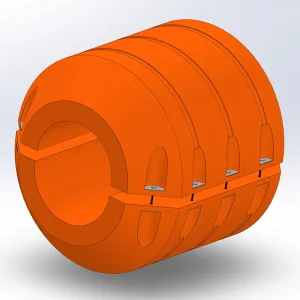
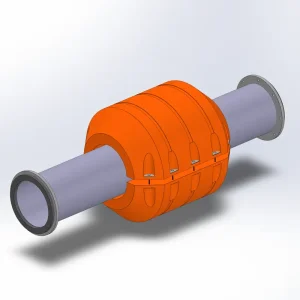
In-depth responses to the engineering, hydrodynamic, and commercial logistics criteria raised by Latin American maritime buyers and dredging contractors.
Unlike steel cylindrical pontoons that suffer rapid galvanic pitting, weld fatigue, and bio-fouling degradation in the brackish waters of the Río de la Plata, rotomolded polyethylene is completely inert to chemical oxidation and marine growths. PE floats are also 60% lighter, absorb heavy ship impacts through elastic deformation without permanent denting, and eliminate the need for costly sandblasting and cathodic epoxy repainting over their 15+ year operational life.
For standard nominal outer diameter float molds (e.g., 200mm, 315mm, 450mm, 560mm, 710mm, 800mm), typical production turnaround is 12 to 18 calendar days for up to two 40HQ container loads. Ocean transit from Qingdao or Shanghai to the Port of Montevideo (Terminal Cuenca del Plata) runs 32 to 38 days via direct liner services, accompanied by complete bill of lading (BOL), certificate of origin, and certified third-party inspection dossiers.
We strictly utilize a closed-cell polyurethane density formulation of 35-45 kg/m³. Under violent wave action outside Montevideo Bay, lower density foams (e.g., 20-25 kg/m³) suffer internal cell collapse, crumbling, and progressive water permeation through micro-fissures. Our closed-cell threshold (>92%) preserves rigid buoyancy integrity and provides structural backing to the PE shell under hydrodynamic surge pressures.
Yes. When HDPE discharge lines flex in high currents, thermal expansion and axial elongation can cause smooth-walled floats to slip along the pipeline axis. We supply precision-grooved EPDM anti-slip inner ribs or vulcanized rubber friction pads molded into the inner diameter of each half-shell. This ensures mechanical lock onto the host pipe without requiring welded stop rings that introduce stress concentrations.
Each pair of pipe floats is supplied with hot-dip galvanized (HDG Class 8.8) or marine-grade AISI 304 / AISI 316 stainless steel high-tensile bolts, self-locking nylon insert nuts, and heavy oversized flat washers. The bolt recesses are counter-sunk into the rotomolded body to prevent rope snagging and hull abrasion during side-by-side dredge tender vessel maneuvers.
Our marine pipe floats carry a full structural warranty covering 18 months from delivery or 12 months from on-site deployment, against environmental stress cracking, deliberate rotomolding delamination, and foam disintegration. In addition, our naval architects provide continuous CAD spacing layout support and load verification throughout your project life cycle.
Connect directly with our rotomolding engineering division. Send your pipe outer diameter, slurry density metrics, operational environment details, and destination schedules to receive an exhaustive buoyancy layout, certified 3D CAD drawing, and competitive FOB/CIF quotation within 24 hours.