Industrial Floating Pipe Systems & Offshore Buoys
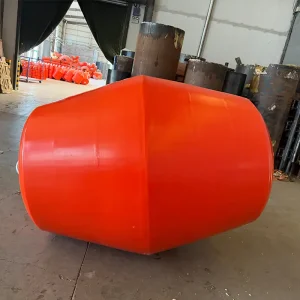
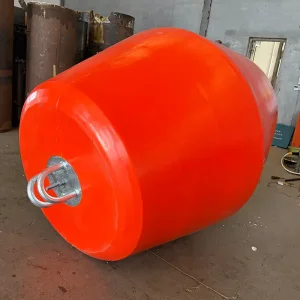
High-density polyethylene (HDPE/LLDPE) buoyant modules fabricated for high-stress slurry transfer, marine navigation, offshore anchoring, and marine civil engineering.



The Commercial Landscape of Industrial Floating Pipelines
Modern oceanic dredging, offshore oil & gas reclamation, deepwater tailing disposal, and municipal desalination facilities demand higher mechanical resilience than ever before.
Hydraulic Dredging & Silt Disposal
Global capital dredging projects require cutter suction dredgers (CSD) and trailing suction hopper dredgers (TSHD) to discharge abrasive slurries over kilometers of open water. Traditional steel pontoons have been systematically phased out due to rust vulnerability, catastrophic seam failure, and excessive tugboat towing drag.
- High slurry densities (1.3 to 1.8 t/m³)
- Suppression of cyclical surge impact fatigue
- Quick disassembly clamp configurations
Tailings Transfer & Acid Leach Mines
Mining operations across Australia, South America, and Africa must float slurry tailings across massive containment ponds. In chemically hostile conditions containing sulfuric leachates or hyper-saline processing brines, rotomolded polyethylene float shells deliver completely non-reactive chemical resistance.
- pH resistance spectrum from 1.5 to 13.5
- Zero oxidation or wall thickness erosion
- Integrated electrical cable raceways
Desalination Brine & Municipal Intake
Seawater Reverse Osmosis (SWRO) facilities and coastal power generation facilities utilize floating HDPE pipelines for brine effluent dispersion and deepwater cooling intake. Precise buoyancy positioning prevents seabed scouring while protecting marine benthic habitats from concentrated thermal plumes.
- Precision immersion depth balance
- High UV-8 colorfast pigments (RAL1023)
- Anti-fouling hydrophobic PE outer skins
Why Binzhou, Shandong Dominates Global Flotation Manufacturing
The synergy of localized petrochemical polymer compounding, high-tonnage multi-axis rotational molding machines, and advanced robotic PU injection achieves world-leading lead times and cost-efficiency.
Variable-Frequency Rotomolding
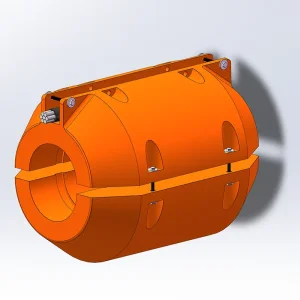
Our facility operates large biaxial rotational molding carousels equipped with automatic internal thermocouple temperature probes. Real-time control eliminates wall thickness variations, delivering isotropic tensile strength across corner radii and bolting flanges.
Polyurethane Core Integrity
Closed-cell PU foam (≥35-38 kg/m³) is injected using computer-monitored high-pressure dispensing units. The expansion chemistry binds chemically with the PE shell inner wall, ensuring zero internal water penetration even if punctured by sharp debris.
Modular Standardization
With thousands of active CNC steel and aluminum molds in stock, replacement float halves manufactured years later maintain 100% bolt-hole alignment and dimensional interchangeability with existing deployed strings.
Container Nesting Logistics
Engineering geometries are calculated to nest efficiently inside 40ft High Cube shipping containers. Standard pipe floats achieve maximum volumetric utilization, drastically minimizing ocean freight expenses per cubic meter of effective buoyancy.
Pipeline Buoyancy Hydrodynamic Formula
Accurate flotation design must account for total laden operating weight, water salinity, hydrodynamic drag, and a safety margin to prevent submergence under surge wave crests.
Where S_f (Safety Factor) is strictly specified between 1.25 and 1.35 for open ocean, ensuring that roughly 25% of the outer pipeline diameter stays positioned safely above the dynamic waterline.
Engineering Verification Checklist:
- ✓ Ultrasonic ultrasonic thickness scanning of shell walls
- ✓ ASTM D1692 closed-cell water absorption under 0.05 kg/m²
- ✓ Tensile yield strength ASTM D638: ≥21.5 MPa
- ✓ Bolting hardware: Hot-Dip Galvanized Grade 8.8 or SS316
Critical Field Applications & Case Scenarios
From sheltered riverine navigation channels to turbulent offshore maritime berths, every project requires specialized flotation tailoring.
Port & Harbor Berth Deepening
Berth expansion operations demand zero interference with active commercial navigation. Polyethylene floating pipe lines equipped with reflective band wraps and solar warning beacon mounts allow dredge spoil transfer lines to cross active harbor waterways safely.
- High visibility orange/yellow pigmented outer shell
- Integrated mooring ears for dynamic anchoring
- Low drag coefficient under tidal current reversals
Offshore Land Reclamation Pipelines
Modern mega-airports and deepwater port expansions pump million-cubic-meter sand matrices over extended lines. Our dredging pipe floats provide balanced torsional rigidity to prevent discharge pipes from twisting or kinking during heavy sea swell events.
- Matched to outer diameters from 110mm to 1200mm
- Reinforced bolt fastening slots preventing slippage
- Cushioned internal ribs safeguarding HDPE pipes
Reservoir Desilting & Eco-Remediation
Hydroelectric power dams and urban municipal reservoirs suffer from severe silt accumulation. Using modular rotomolded pontoons, electric desilting dredgers transfer organic mud through quiet, lightweight lines that leave water quality completely uncontaminated.
- Zero toxic leaching into municipal drinking sources
- Lightweight sections assembled by two operators
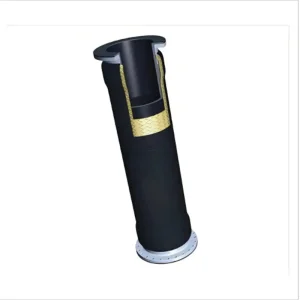
- Compatible with flexible rubber dredging hoses
Rotomolded PE Floats vs. Steel Pontoons vs. GRP (Fiberglass)
Comparative empirical performance data based on 10-year accelerated field lifecycle tracking in tropical saltwater conditions.
| Evaluation Parameter | Juhua Rotomolded PE Floats | Fabricated Steel Pontoons | Glass-Reinforced Plastic (GRP) |
|---|---|---|---|
| Corrosion & Rust Resistance | Immune (100% Non-Metallic) | Severe Corrosion (Requires Periodic Blasting) | Osmotic Blistering in Continuous Submersion |
| Impact Resistance (Collision) | High Elasticity (Dents without cracking) | Permanent Deformation & Weld Failure | Brittle Catastrophic Fracture |
| Dry Weight / Handling Ease | Ultra-Lightweight (Quick Crane Rigging) | Extremely Heavy (Demands Heavy Cranes) | Moderate Weight (Delicate Rigging Required) |
| Unscheduled Maintenance | Zero Maintenance Over 10-15 Years | Cathodic Anodes & Recoating Every 2 Years | Gelcoat Resealing & Crack Patches |
| Puncture Consequence | Zero Sinkage (Closed-Cell Polyurethane) | Compartment Flooding & Rapid Sinking | Capillary Water Ingress & Foam Delamination |
| Lifecycle Capital Expenditure | Lowest Total Cost of Ownership (TCO) | High Initial Cost + Escalating Maintenance | High Initial Mold & Tooling Expenses |
Technological Innovations & Procurement Insights
Key trends revolutionizing marine pipeline flotation equipment and how multinational EPC contractors evaluate suppliers.
IoT-Enabled Buoyancy Telemetry
Next-generation pipe floats integrate low-power wireless NB-IoT and LoRaWAN strain and orientation sensors. These modules alert dredge masters instantly via cloud dashboards if dynamic pipeline sag, torsional twisting, or joint decoupling exceeds safety thresholds.
- Real-time immersion depth monitoring
- Integrated geo-fencing GPS beacons
- Structural fatigue predictive maintenance
Bio-Based & Circular Polymers
Environmental requirements enforced by international maritime authorities have accelerated the demand for ocean-grade flotation made from 100% recyclable polyethylenes compounded with non-heavy-metal stabilizers, ensuring zero microplastic shedding.
- RoHS and REACH compliant raw materials
- Zero lead, cadmium, or toxic plasticizers
- Closed-loop post-project scrap recycling
Streamlined EPC Procurement
Global engineering, procurement, and construction (EPC) conglomerates prioritize one-stop suppliers capable of manufacturing matching sets: rotomolded pipe floats, ultra-high-molecular-weight PE dredging pipes, heavy suction hoses, and anchoring buoys under a unified quality assurance guarantee.
- Single point of warranty accountability
- Matched pipeline-flange tolerances
- Comprehensive third-party inspection (SGS/BV)
Frequently Asked Questions: Sizing, Installation & Durability
Practical engineering answers to frequent technical inquiries submitted by coastal dredging contractors and project managers.
How do you calculate the exact number of floats for a pipeline?
Total buoyancy must equal the dry weight of the steel or HDPE pipe, plus the full weight of the conveyed slurry (calculate using highest anticipated specific gravity, e.g., 1.6 kg/L for dense sand), plus flanges and hardware. Multiply this total weight by a safety factor of 1.25 to 1.30. Divide this resulting buoyancy demand by the rated net buoyancy of one pair of floats to determine the quantity and spacing.
Why is closed-cell polyurethane foam filling mandatory?
While unfoamed hollow shells cost less initially, collisions with workboats, jagged boulders, or floating logs will puncture hollow plastic, causing the float to take on water and leading to catastrophic sinking of the discharge line. Closed-cell PU foam (ASTM D2842) absorbs less than 2% water by volume under prolonged hydrostatic submersion, ensuring positive buoyancy throughout its operational life.
What prevents floats from slipping along smooth HDPE pipe lines?
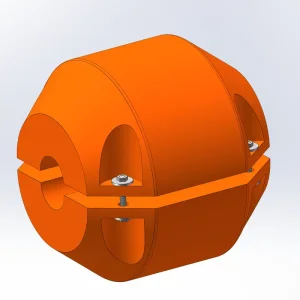
Our rotomolded float halves feature precision internal anti-slip friction grooves and ribbed contours that compress firmly onto standard HDPE outer dimensions. Furthermore, installation spacing is planned with designated float clamps situated directly against welded pipe stub-ends or flanged backing rings to lock the line mechanically against surge forces.
What is the standard warranty and life expectancy in tropical conditions?
Standard warranty begins upon project commissioning, covering 18 months from factory handover or 12 months from final operational installation. By compounding virgin resin with CIBA UV-8 stabilizers and carbon black masterbatches, our rotomolded floats achieve an operational lifespan exceeding 10 to 15 years even in intense tropical solar irradiance.
Specialty Marine Floats, Barriers & Pontoon Modules
Engineered solutions for maritime navigation, aquatic pollution control, workboat platforms, and flexible slurry transport lines.