
Commercial Buoyancy & Marine Flotation Inventory
Engineered with virgin-grade LLDPE/HDPE polymer resin shells filled with closed-cell polyurethane foam to maintain structural integrity under extreme ocean swell pressures.


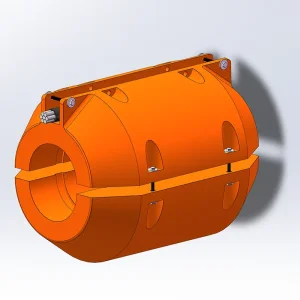
The Global HDPE Marine Pontoon Architecture
Analyzing the paradigm shift from corroding steel barges and timber docks to rotational-molded high-density polyethylene pontoon platforms in coastal engineering, deep-sea mining, and marine renewables.
Corrosion Immunity in Hypersaline Basins
Unlike steel or concrete floats that suffer electrochemical oxidation, chloride attack, and cathodic breakdown, high-molecular-weight HDPE provides complete chemical inertness across pH 1 through pH 14, delivering an unmaintained service life exceeding 30 years in harsh marine splash zones.
High Impact Plastic Deformation Resilience
Engineered using rotational molding processes with zero internal residual weld stress, the outer shell yields high elastic memory. Workboats, service tenders, and drifting heavy debris impact the pontoon without cracking or buckling, absorbing kinetic energy via controlled elastic rebound.
Low Carbon Circular Marine Infrastructure
With global maritime projects prioritizing carbon abatement, 100% recyclable HDPE matrices dramatically lower lifecycle Scope 3 carbon footprints versus heavy cast concrete pontoons. Pontoon shells are zero-leaching, non-toxic, and free of persistent biocides, protecting benthic ecosystems.
Buoyancy Safety Factors & Hydrodynamic Load Metrics
Detailed structural guidelines for marine contractors, dredging engineers, and port authorities calculating pontoon sizing under wave, tidal, and slurry transport loads.
Naval Architecture Rule of Sizing: Slurry & Live Load Reserve Factor
A catastrophic oversight in marine pipeline design is sizing buoyancy against empty steel or HDPE pipelines. Buoyancy must accommodate maximum slurry density (frequently exceeding 1.6 to 2.1 t/m³ during sand/gravel dredging), wind shear, tidal drag, and sediment accumulation.
Total Net Buoyancy (F_b) ≥ (W_pipe + W_slurry_max + W_accessories + W_live) × K_safety
Where K_safety is the designated hydrodynamic reserve factor (minimum 1.25 for sheltered waterways, 1.40 for open ocean and high wave environments). The pontoon arrangement must guarantee a minimum working freeboard equivalent to 25% to 30% of total module outer diameter under continuous dynamic operation.
| Pontoon / Float Parameter | Industrial Standard HDPE | Rotomolded PE100 Virgin Matrix | Steel Floating Pontoons | Fiberglass (FRP) Modules |
|---|---|---|---|---|
| Raw Density (g/cm³) | 0.935 – 0.945 | 0.950 – 0.960 (High Tensile) | 7.85 (Heavy ballast) | 1.60 – 1.85 |
| Tensile Strength at Yield | 18 – 21 MPa | 24 – 28 MPa | 250 – 355 MPa | 80 – 120 MPa |
| ESCR (Environmental Stress Crack) | 500 hours (ASTM D1693) | > 1,500 hours F50 | N/A (Prone to fatigue) | Delamination risk |
| Core Buoyancy Medium | Air or Low Polyurethane | 35-40 kg/m³ Hydrophobic PU Foam | Air chambers (Baffle sealed) | Styrofoam / Honeycomb core |
| Salt Spray Corrosion Rate | 0.00 mm/year (Inert) | 0.00 mm/year (Zero leeching) | 0.15 – 0.40 mm/year | Osmotic blistering risk |
| Expected Service Lifespan | 12 – 15 Years | 25 – 35+ Years | 8 – 12 Years (Requires painting) | 10 – 15 Years |
Engineered Deployments Across Critical Water Sectors
Juhua HDPE pontoon platforms and pipe flotation units solve severe environmental challenges in international mega-projects.
Land Reclamation & Capital Dredging
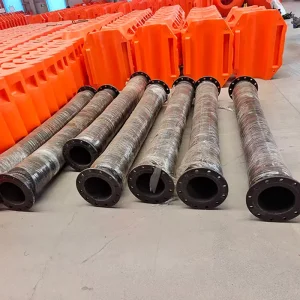
Supporting heavy-gauge discharge slurry pipelines connecting cutter suction dredgers (CSD) to shoreline reclamation basins. Resistant to high-velocity interior abrasion and exterior shoreline grounding during severe low-tide cycles in Dubai, Singapore, and Rotterdam port operations.
Floating Solar Arrays (FPV) & Hydro-Power
Modular pontoon pathways and inverter raft assemblies designed with carbon black UV inhibitors (UV8/UV12). Maintains dimensional stability without micro-cracking across artificial reservoirs, hydroelectric dams, and desert retention ponds subjected to blistering thermal variations.
Mining Tailings & Corrosive Acid Ponds
Acid mine drainage (AMD) and aggressive process ponds destroy conventional pontoons. Juhua's continuous PE100 shells withstand sulfuric acid residues, abrasive copper slurry, gold cyanide tailings, and high-solids bypass pumping across Australian, Chilean, and South African mine concessions.
Deep Offshore Open-Ocean Aquaculture
Custom cylindrical and multi-chamber pontoon collars delivering reliable reserve buoyancy for submersible sea cages. High flexibility allows pontoons to dissipate cyclic cyclic fatigue from 4-meter ocean swells without structural seam separation in Norwegian and Chilean fjords.
Intake Security & Hydrodynamic Trash Booms
Protecting hydroelectric turbine headworks and municipal desalination water intakes from heavy log drift, floating debris, and water hyacinth blooms. Paired with high-strength underwater curtain screens and galvanized ballast assemblies.
Modular Commercial Marinas & Work Platforms
Anti-slip interlocked modular pontoon platforms configured for heavy cargo offloading, marine piling crew platforms, dive stations, and military naval patrol docking. Easily reconfigured as site geometry changes.
Shandong Binzhou Manufacturing Ecosystem & Cost Superiority
How Juhua Rubber & Plastic Co., Ltd. leverages regional raw material integration, high-capacity rotational molding clusters, and deep-water export corridors to dominate global procurement.
Automated Bi-Axial Rotational Molding
Our Huimin County facility operates heavy automated bi-axial carousel rotomolding machines equipped with multi-zone computerized temperature monitoring. This eliminates wall-thickness variance, ensuring uniform corner density where traditional pontoons fail under shear stresses. Precision CNC-milled aluminum molds ensure high batch-to-batch interchangeability for pipeline clamps and connection pins.
High-Pressure Polyurethane Steam Injection
Polyethylene shells are filled via high-pressure computerized proportioning machines with two-component hydrophobic polyurethane foam. The rigid PU matrix exhibits >95% closed-cell structure and a density of 35-40 kg/m³. If the outer shell is punctured by high-impact rock collisions, the foam core prohibits water ingress, eliminating risk of sudden negative buoyancy.
Upstream Polymer Petrochemical Synergy
Situated within China's primary refining and chemical manufacturing corridor in Shandong, Juhua commands direct pipelines to certified high-grade linear low-density and high-density polyethylene polymer resins. Direct bulk raw material integration shields EPC contractors from global commodity price spikes while guaranteeing stable delivery schedules.
Qingdao & Tianjin Deep-Water Export Logistics
Located near Qingdao and Tianjin international maritime hubs, Juhua ships over 150 standard 40HQ containers monthly. Our engineering team calculates nested container configurations, utilizing specialized stacking molds to maximize freight cubic efficiency and reduce ocean transport costs per cubic meter of net buoyancy.
Engineering Roadmap: Next-Gen HDPE Marine Systems (2025–2030)
Pioneering sensor-embedded telemetry, zero-biofouling nanostructured polymer blends, and circular marine-grade recycling protocols.
Smart Pontoon Telemetry
Integrating solar-powered LoRaWAN and satellite-linked strain sensors within pontoon connection lugs to stream real-time mooring stress and freeboard changes to maritime operators.
Bio-Repellent Matrices
Developing non-biocide organosilane polymer compounds that deter barnacle settlement and macroalgae attachment, reducing hydrodynamic drag without releasing toxic heavy metals.
High-Performance PCR Blends
Formulating cross-linked multi-layer rotationally molded shells integrating 40% certified ocean-bound post-consumer recycled (PCR) HDPE without sacrificing tensile or impact durability.
Polyurea Shock Dampening
Co-molding elastomeric polyurea impact rings onto the outer perimeters of high-tonnage pipe floats to dampen collision shocks during rough offshore dredger transfers.
Global Maritime Compliance & Engineering Assurance
Ensuring compliance with international standards across design, fabrication, and environmental protection.
PIANC & IALA Navigation Compliance
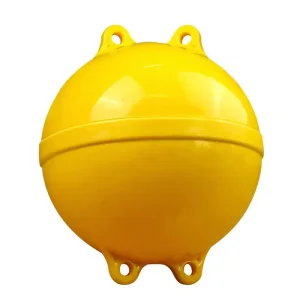
All navigation buoys, marker floats, and channel warning modules are engineered strictly adhering to IALA (International Association of Marine Aids to Navigation and Lighthouse Authorities) maritime surface chromaticity guidelines and PIANC mooring parameters.
ASTM Quality & Mechanical Testing
Every production batch undergoes comprehensive destructive testing: ASTM D1693 environmental stress crack evaluation, ASTM D638 tensile pull testing on integrated molded lugs, and ASTM D2240 durometer hardness verification prior to container loading.
Localized Engineering Integration
We supply turnkey localized hardware kits suited to specific marine conditions: 316L marine stainless steel connecting bolts for high-chloride waters, hot-dip galvanized pins for fresh water, and flexible internal rubber grommets to secure pipes without slippage.
Frequently Asked Questions for Offshore Procurement Teams
Comprehensive engineering, operational, and commercial answers for marine dredging contractors, port authorities, and municipal water agencies.
What is the structural difference between HDPE pontoons and traditional steel floats?
HDPE rotational-molded pontoons possess zero electrochemical corrosion potential, completely eliminating the need for sacrificial zinc anodes, anti-fouling recoating cycles, and sandblasting maintenance. Unlike steel shells that dent permanently or puncture when bumped by service vessels, HDPE exhibits an elastic memory modulus that flexes and rebounds upon kinetic impact without seam rupture or catastrophic flooding.
How do you calculate the required pontoon quantity for heavy slurry dredging lines?
Pontoon calculation requires accounting for dry pipeline weight, internal liquid weight at max slurry density (e.g., 1.8 t/m³ for coarse gravel), flange accessories, and wave impact allowances. Total buoyancy must exceed total system weight by at least 25% to 30% to maintain a continuous working freeboard that keeps pipeline joints from dragging across shallow seabed obstacles.
Can Juhua custom mold pipe floats for non-standard steel and composite pipe ODs?
Yes. While we maintain a stock tooling library covering standard outer diameters from 110mm up to 1200mm, our in-house CNC mold-making shop can design and fabricate customized rotomolding tooling to accommodate non-standard pipe sleeves, insulated thermal pipelines, electrical cable raceways, or structural reinforcement flanges within 20 working days.
How does internal polyurethane (PU) foam filling prevent sinkage if ruptured?
Juhua injects marine-grade hydrophobic closed-cell polyurethane foam with a minimum 95% closed-cell rating and 35-40 kg/m³ density. Even if an external projectile or high-velocity impact breaches the polyethylene skin, the microscopic closed pores of the foam core remain impermeable to water under pressure, preventing water migration and preserving primary buoyancy.
What is the standard commercial warranty coverage and verified operational service life?
Standard warranty coverage runs for 18 months from project handover or 12 months from on-site commissioning, covering manufacturing defects, material separation, and premature UV degradation. With high-purity virgin polymer blended with carbon black and light-stabilizer additives, our marine pontoons routinely exceed 25 to 30 years of continuous service in harsh marine environments.
How are pontoon modules secured against axial slipping along smooth HDPE pipelines?
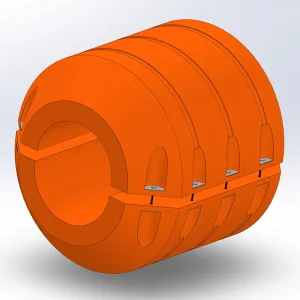
Our two-piece clamp-shell pontoons are precision-molded with ribbed contact inner surfaces. For high-thrust or angled pipelines, we supply heavy-gauge synthetic elastomeric friction liners and molded pipe stop collars that bolt directly around the pipeline outer diameter, locking the floats in their designated longitudinal position without stressing the pipe wall.
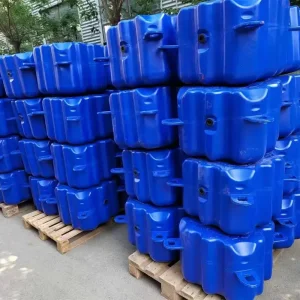
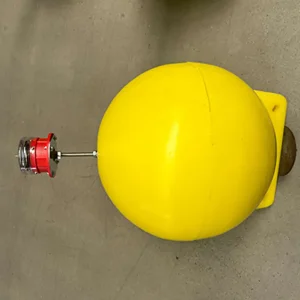
Specialized Marine Flotation & Containment Systems
Heavy-duty, interchangeable float components engineered for offshore pipeline security, marine demarcation, and intake trash barrier deployment.




Consult Directly with a Senior Flotation Engineer
Fast-track your buoyancy calculations, CAD configuration drawings, and bulk port logistics proposals with zero intermediary markups. Our Binzhou technical department delivers turnkey engineering submissions within 24 hours.