

Custom Reliable Marine Buoys for Safe Waterway Operations
View Product Details
Manufactured using virgin food-grade PE resin with rotational molding 4.0 speed control, verified by third-party hydrostatic displacement tests.





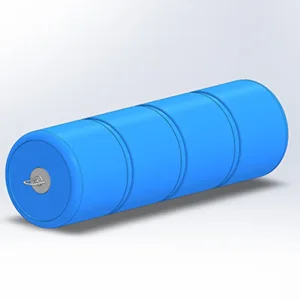
Why modern marine and hydraulic engineers are transitioning from traditional structural steel, timber, and concrete pontoons to rotationally molded high-density polyethylene polymers.
Unlike steel pontoon systems requiring sacrificial zinc anodes, anti-fouling recoating, and hull inspections every 36 months, UV-stabilized rotational polyethylene exhibits complete chemical inertness in oceanic salinity (35 PSU) and high acidic mine tailings (pH 2–11).
HDPE possesses exceptional notch toughness and elastic recovery up to high strain rates. In berthing scenarios or wave impact zones, PE pontoons deflect without plastic deformation, absorbing kinetic energy without tearing welds or cracking concrete core matrices.
Polyethylene's low glass transition temperature prevents seasonal embrittlement in Arctic dredging environments, retaining full ductile performance across freeze-thaw cycles that break rigid expanded foam composites and untreated marine aluminum.
Engineered by Shandong Binzhou Juhua Rubber & Plastic Co., Ltd. through digitized thermal cycles and precision wall-thickness management.
Multi-axis computer controlled rotating arms allow simultaneous biaxial rotation, producing unified single-piece pontoon bodies free of seam stress or welded weak points.
Automated non-destructive ultrasonic gauging monitors critical pontoon corners and load-bearing flanges, maintaining wall thickness within a ±0.5mm variance tolerance.
Polyurethane high-pressure foam injection delivers a closed-cell fill density of 35–45 kg/m³, preventing water ingress even if the outer polyethylene skin is punctured.
With an integrated casting matrix, 1,000+ m² rotomolding bays, and rapid ocean port proximity (Qingdao Port), Juhua shortens large-scale EPC procurement lead times by 35%.
| Performance Criterion | Rotomolded Polyethylene Pontoon | Structural Steel Float | Expanded Polystyrene / Concrete |
|---|---|---|---|
| Seawater Corrosion (3.5% NaCl) | Immune (Zero electrolytic degradation) | High (Requires cathodic sacrificial protection) | Medium (Pitting & rebar corrosion) |
| Impact Recovery & Yield | High elastic deflection / No cracking | Dents, plastic deformation, weld seam splits | Brittle fracturing & aggregate fragmentation |
| Maintenance Routine | Virtually zero maintenance (Pressure wash only) | Sandblasting, ultrasonic testing, repainting | Crack injection, seal inspection |
| Internal Core Protection | Hydrophobic Closed-cell Polyurethane Foam | Air compartments (Vulnerable to leak sinking) | Open/Closed bead EPS (Waterlogging risk) |
| Weight / Transport Footprint | Lightweight, stackable nesting design | Heavy crane required, prohibitive haulage | Extremely heavy, high logistics costs |
Across four continents, Juhua modular polyethylene pontoons and pipe float matrices deliver certified hydrodynamic buoyancy support.
Applied along high-volume trailing suction hopper dredge (TSHD) slurry lines. Sized according to solid-liquid slurry densities up to 1.6 t/m³, maintaining a certified 25% dry freeboard reserve to prevent catastrophic line submersion under peak hydraulic flow rates.
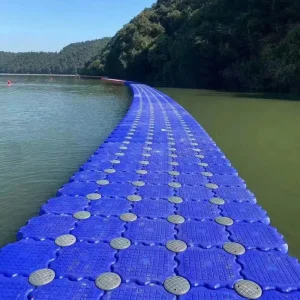
Deployed as structural walkways and inverter buoyancy platforms on industrial reservoirs and hydroelectric impoundments. Resistant to organic algae growth, high thermal variations, and constant cyclic wave fatigue.
Mineral extraction operations in South America and Western Australia rely on our thickened-skin polyethylene floats with integrated electrical cable routing troughs for slurries containing caustic chemical leachates.
Offshore fish farming operations require reliable, non-toxic, food-grade verified buoyant pontoons that release zero phthalates or microplastics into open pelagic zones, preserving ecological biosecurity.
Mounted upstream of hydroelectric dams to intercept floating logs, municipal trash, and aquatic hyacinths, preventing turbine inlet blockage and preserving intake equipment.
Interlocking pontoon modules engineered for civil construction contractors needing temporary floating crane docks, core drilling rigs, and crew embarkation gangways.
Underestimating operating ballast weight remains the leading cause of floating pipeline submergence. Flotation sizing must account for wet sediment specific gravity rather than pure water:
Direct answers for EPC directors, marine contractors, and port infrastructure engineers.
Rotational polyethylene never oxidizes or corrodes in salt water, removing costly sandblasting and cathodic anode replacements. Its elastic recovery absorbs kinetic shock loads without the permanent dents or seam fractures typical of thin-walled steel.
Every industrial pontoon is injected under pressure with closed-cell polyurethane foam (35–45 kg/m³). With >95% closed-cell structure, the foam resists water ingress even if the outer shell experiences abrasions or punctures.
We blend virgin linear low-density and high-density polyethylene resins with UV-8 to UV-16 weather inhibitors. This formulation protects against polymer chain scission in high-UV equatorial environments, guaranteeing 15–20+ years of outdoor operation.
Juhua provides a formal warranty covering 18 months from shipment handover to investor or 12 months post-installation. Replacement pontoon halves are fully standardized for consistent interchangeability across batches.
Yes. Supported by in-house CNC mold-making and computer-controlled rotational molding arm matrices, we fabricate custom tooling for non-standard steel, HDPE, or reinforced flexible dredge hoses within 15–25 business days.
Specify the pipe outer diameter (OD), wall thickness, pipe material, slurry density (t/m³), freeboard safety target, water environment (open sea, protected river, reservoir), dynamic wave currents, and the target port of destination.
Explore heavy-duty dredging pipe floats, mooring floats, and specialized rubber discharge hoses designed for harsh marine projects.
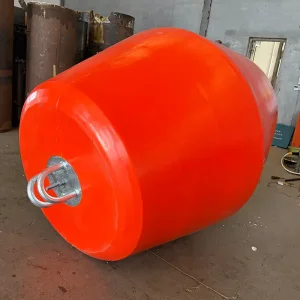
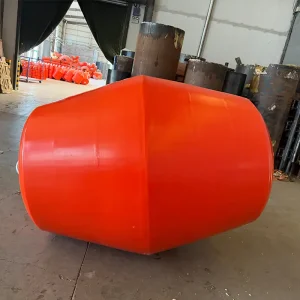
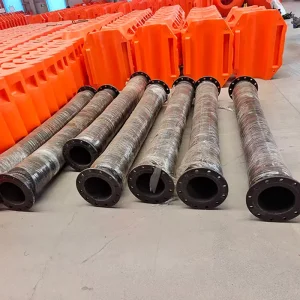

No intermediaries. Connect directly with factory applications engineers for hydrodynamic calculations, pipeline stress analysis, and international container packing plans.
West Industrial Park, Lizhuang Town, Huimin County, Binzhou City, Shandong Province, China
Arrange Factory Inspection