
Featured Precision Marine Flotation Systems
Engineered for extreme hydrodynamic resilience, high slurry payloads, and high-salinity offshore stability.



Engineering Precision: The Science of Marine Hose Flotation
Comprehensive material behavior, hydrostatic load balancing, and chemical stability under open-ocean and dynamic dredging conditions.
Continuous Rotomolding Technology
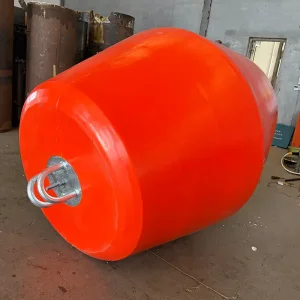
Manufactured using CNC-monitored rotational molding with real-time temperature feedback. This eliminates internal weld seams, micro-porosity, and differential thermal stresses, yielding a homogeneous UV-8 stabilized LLDPE shell with uniform wall thickness across curvature radii.
Polyurethane (PUR) Hydrophobic Core
The interior cavity is pressure-injected with high-density (≥35 kg/m³) closed-cell polyurethane foam. Even under structural puncture, impact fatigue, or outer shell abrasion, the core resists water ingress, guaranteeing <1% water absorption over multi-year continuous deployments.
Corrosion-Proof Fastening Geometry
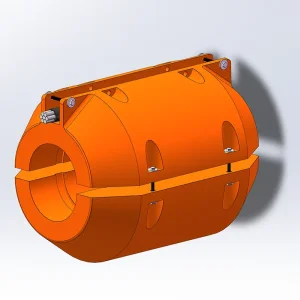
Each module features reinforced bolt pockets and anti-slip ribbed inner contours designed to clamp tightly onto standard HDPE, steel discharge pipes, or flexible rubber dredging hoses. Equipped with Grade 316 / Galvanized 8.8 tensile bolt sets to prevent torque relaxation in rough sea states.
Mathematical Reserve Buoyancy Formula
A fundamental tenet emphasized by marine quality raters and naval architects: buoyancy module sizing must never be based on an empty conduit. Field safety margins must accommodate slurry dynamic densities exceeding 1.6 t/m³, localized wave slam, and macro-fouling accretion.
- Accounts for pipeline dry weight, coupling flanging, and submerged ballast.
- Calculates critical liquid slurry weight under turbulent slurry discharge.
- Ensures a minimum 25% to 30% pipeline freeboard above waterline for continuous visual identification.
Total F_b ≥ (W_pipe + W_slurry + W_hardware) × SF (1.25 ~ 1.30)
Where F_b represents net module upward displacement in seawater (density = 1.025 t/m³), and SF incorporates dynamic surge margins, benthic drag vectors, and marine life adhesion.
Integrated Macro-Industry Flotation Solutions
Custom buoyancy configurations mapped to cross-sector demands in heavy engineering, mining tailings, and municipal hydrology.
Capital Dredging & Port Expansion
Continuous discharge pipelines transporting abrasive seabed sediments demand predictable buoyancy modules. Our floats eliminate axial pipe buckling, absorb torsional vibrations generated by cutter suction dredgers (CSD), and mitigate fatigue failures at hose flange joints.
Offshore Hydrocarbon & Subsea Tie-Ins
Subsea engineering demands buoyancy modules engineered to exact staged displacement. Juhua's custom subsea floats stabilize line installation, control pipeline touchdown angles, and maintain umbilical positioning without compromising syntactic structure integrity.
Mining Tailings & Acidic Effluents
Polyethylene delivers complete inertness toward extreme pH fluids, acidic tailings, and saline liquors common to gold, copper, and iron ore extraction plants. Unlike steel pontoons, Juhua rotomolded shells never require anti-corrosive sandblasting or recoating.
Desalination Intakes & Outfalls
Modern desalination plants utilize large-diameter polyethylene outfall lines. Our buoyant modules secure submerged conduits in tidal sweep zones, reducing anchoring stress and seabed trenching costs while complying with marine environmental protection guidelines.
Renewable Offshore Wind Umbilicals
Dynamic power transmission cables connecting floating offshore wind turbines require specialized floats with cable-troughs. These support minimum bend radii (MBR), protecting copper/fiber cores from wave-induced mechanical shearing and cyclic bending stress.
Municipal Reservoirs & Ecological Booms
Engineered floating barriers and containment floats protect intake screens from floating biomass, silt accumulation, and petroleum spills. Optimized UV-stabilized pigments prevent degradation across decades of inland freshwater service.
China Factory 4.0: Supply Chain Resilience & Cost-Efficiency
Combining automated large-tonnage rotomolding machines with integrated supply chains to provide international EPC contractors with scalable, on-time output.
High-Capacity Production
Covering extensive rotomolding workshops in Binzhou, Shandong, operating computerized carousel machines capable of curing single-piece floats up to 2.2 meters in outer diameter.
Traceable Raw Materials
Every pellet of high-grade virgin polymer undergoes Melt Flow Index (MFI) and Environmental Stress Crack Resistance (ESCR) testing to ASTM D1693 standards before compounding.
Standardized Mold Ecosystem
Over 120 proprietary mold designs allow instant manufacturing initiation for standard pipe sizes (OD 110mm to 1200mm), drastically cutting client tooling expenses and lead times.
Logistical Hub Optimization
Located in Shandong's maritime manufacturing corridor, close to Qingdao and Tianjin deep-water container ports, providing streamlined global container freight and breakbulk services.
Technology Roadmap: The Future of Smart Marine Flotation
Strategic development trajectories targeting smart telemetry, circular life-cycles, and deepwater resilience.
IoT-Integrated Sensor Floats
R&D trials are integrating embedded RFID, pressure sensors, and LoRaWAN/NB-IoT micro-transponders into float shells. This delivers real-time payload displacement metrics, slurry leakage alarms, and predictive maintenance tracking directly to harbor control hubs.
Eco-Circular Marine Polymers
Transitioning toward closed-loop circular economy standards, our polymer engineering lab is advancing post-industrial high-density cross-linked polymers blended with virgin resins, retaining high tensile resilience while minimizing micro-plastic degradation.
Deepwater Syntactic Formulations
Developing specialized hybrid shells engineered with hollow glass microspheres blended inside the polyurethane core. This targets deeper subsea installations, providing structural collapse resistance under 50 bar hydrostatic pressure conditions.
Global Procurement Demands & International Compliance
Meeting the operational risk, certification, and procurement governance requirements of global EPC conglomerates.
Full Audit Transparency
Our operational management is certified under ISO 9001:2015 for Quality Management, ISO 14001:2015 for Environmental Systems, and ISO 45001:2018 for Occupational Health, fulfilling tier-1 vendor audits for major energy and port operators.
Third-Party Verification
We work with international inspection bodies such as SGS, Bureau Veritas (BV), and DNV to provide pre-shipment dimensional inspections, raw material tensile/impact verification, and hydrostatic buoyancy certification per lot.
Tailored Export Documentation
Comprehensive international trade protocol execution: full Mill Test Certificates (MTC), Certificates of Origin (CO, Form E, Form F), complete packing lists configured for container optimization, and localized customs clearance support.
Additional Specialized Buoyancy & Maritime Assets
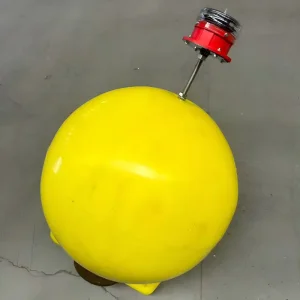
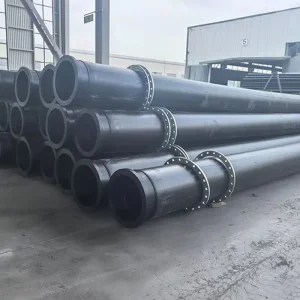
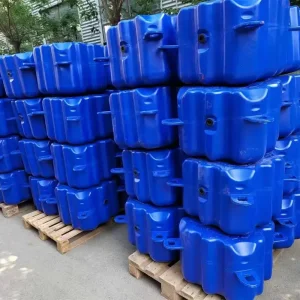
Explore our complete marine fleet, spanning heavy-duty pontoons, navigation markers, and multi-purpose buoys.


Engineering & Sourcing Advisory (FAQ)
Technical guidance covering calculation formulas, operational longevity, environmental suitability, and warranty coverage.
What are pipeline floats and how do they function?
Pipeline floats (dredge floats or buoyancy modules) are paired, semicircular rotomolded polyethylene bodies filled with polyurethane foam. Bolted securely around discharge hoses or HDPE pipelines, they maintain continuous flotation, alignment, and visibility on the water surface during marine operations.
How do you calculate the exact number of floats required?
Total buoyancy must exceed total weight. Add pipe self-weight, joint flanges, hardware, and conveyed medium weight (using actual slurry density, e.g., 1.3 to 1.6 t/m³). Net float buoyancy should provide a 20% to 30% reserve margin, maintaining roughly 1/4 to 1/3 of the pipe diameter above the water line.
Are polyethylene floats suitable for extreme seawater environments?
Yes. Virgin linear low-density polyethylene (LLDPE) compounded with carbon black or UV-8 stabilizers is completely non-reactive with high-salinity seawater. Unlike painted steel floats, it never rusts, pits, or flakes, and does not require cathodic protection anodes.
What is the standard warranty and life expectancy?
The standard operational warranty covers 18 months from final handover or 12 months post-commissioning, whichever occurs first. Field-proven service lives under continuous solar irradiation and open marine exposure routinely exceed 8 to 12 years.
What technical data is required to request a formal quotation?
Please specify pipe outer diameter (OD), wall thickness/SDR rating, pipe material (HDPE, steel, rubber hose), fluid/slurry density, wave heights/tide conditions at the project site, required working freeboard, target quantity, and destination port.
Can flotation units be customized with integrated cable troughs or markings?
Yes. Custom tooling can integrate longitudinal cable channels for power umbilicals, embed client logos, adjust shell wall thicknesses from 5mm to 18mm, match safety colors (marine orange, signal yellow, caution red), and accommodate custom bolt channel spacings.