
Engineered Floating Hose & Buoyancy Systems
Explore heavy-duty maritime floating hoses, mooring buoys, and pipeline buoyancy modules precision-built for international contractors, harbor maintenance, and offshore fluid transfer.




Anatomy of High-Integrity Custom Self Floating Hoses
A comprehensive engineering analysis on elastomeric carcass fabrication, integral closed-cell buoyancy matrices, and hydrodynamic load mitigation in high-turbulent waters.
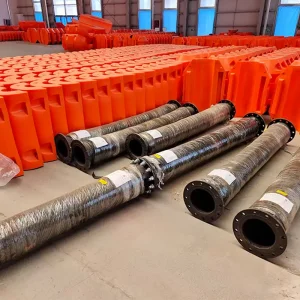
In modern offshore dredging, port reclamation, offshore bunkering, and high-density mineral slurry transport, marine fluid conduits face unprecedented mechanical and environmental demands. Traditional setups relying on rigid steel pipes or bare rubber hoses coupled with external clamp-on polyethylene floats frequently experience concentrated point loading, localized stress fatigue, galvanic flange corrosion, and premature disconnection during sudden wave swells. Custom Self Floating Hoses represent the quintessential technological evolutionary leap, synthesizing fluid containment, reinforcement carcass, and integral buoyancy material into a continuous, flexible elastomeric architecture.
Five-Tier Structural Engineering Architecture
Every custom self-floating hose manufactured at our Binzhou production facility follows a rigorous five-tier vulcanization layout designed to satisfy ISO 28017:2018 (Rubber Hoses and Hose Assemblies for Dredging Applications) and OCIMF GMPHOM 2009 guidance:
1. Primary Wear Liner (Inner Tube)
Formulated from ultra-pure natural rubber (NR), butadiene rubber (BR), synthetic nitrile (NBR), or high-alumina ceramic tile arrays. Formulated with DIN-53516 abrasion loss ratings below 45 mm³ to endure hyper-abrasive sharp quartzite sands, harbor silt, or chemical slurry corrosive attacks.
2. Structural Carcass & Helical Skeleton
Composed of multiple spirally wrapped layers of high-tensile polyester/aramid tire cords and high-elasticity galvanized spring steel wire helixes. This reinforcement matrix guarantees structural collapse resistance under total internal vacuum (-0.08 MPa to -0.09 MPa) and surges up to 30 bar burst ratings.
3. Closed-Cell Buoyancy Core
Formed through multi-stage wrapping of cross-linked isotropic closed-cell polyurethane (PU) or polyethylene (PE) microcellular foam. Even if severe collisions puncture the outer hull, individual cells reject water absorption (water intrusion rate < 1% under hydrostatic pressure), preventing buoyancy decay.
The system is sealed with a sacrificial elastomeric outer cover featuring elevated hypalon and EPDM compounds, providing continuous ozone resistance (ASTM D1149), ultraviolet radiation reflection, hydrocarbon shielding, and abrasion resistance against collision with support vessel hulls. Flange connections utilize integral vulcanized forged steel collars (ASTM A105 / Q235B galvanization) without split clamping rings, mitigating premature end detachment during rough sea state bending.
Global Enterprise Sourcing Criteria & Testing Protocols
How Tier-1 marine engineering contractors (EPCs) evaluate self-floating hose suppliers through structural validation, safety factor audits, and third-party marine classifications.
Procuring heavy-duty flotation hoses for critical civil engineering infrastructure demands comprehensive alignment with international maritime safety codes. Engineering leaders from major dredging consortia evaluate technical bids based on quantifiable metallurgical, polymeric, and hydrodynamic criteria rather than nominal pricing. Key testing protocols executed during Factory Acceptance Testing (FAT) include:
| Test Category | Standard / Norm | Mandated Benchmark Criteria | Factory Quality Control Method |
|---|---|---|---|
| Hydrostatic Pressure | ISO 1402 / ISO 28017 | 1.5x Working Pressure (Proof) / 4.0x (Burst Test) | 15-minute stabilized digital hydrostatic holding test |
| Reserve Buoyancy | PIANC / OCIMF GMPHOM | Minimum 20% to 30% surplus reserve buoyancy when full | Submersion load-cell measurement with high-density slurry medium |
| Tensile & Axial Load | EN 1765 / ISO 28017 | Zero structural elongation beyond 2.5% at rated axial pull | Calibrated hydraulic horizontal tensile bed testing |
| Bending & Flexibility | ASTM D380 / DIN 53530 | Min. Bending Radius = 4x to 6x Inner Diameter without kinking | Dynamic multi-axis cantilever deflection rig |
| Electrical Continuity | BS 5842 / ISO 8031 | Electrically Continuous (< 10 Ω) or Discontinuous (> 25 kΩ) | Four-point probe megohmmeter validation for fuel/slurry safety |
Our company facilitates direct on-site or remote live-streamed FAT inspection alongside global marine classification bodies including Bureau Veritas (BV), Lloyd’s Register (LR), Det Norske Veritas (DNV), and American Bureau of Shipping (ABS). Comprehensive documentation dossiers accompany each export batch, including mill test certificates (EN 10204 3.1), vulcanization curing logs, raw polymer spectrophotometry verifications, and non-destructive flange weld test (NDT/UT) records.
China Factory Supply Chain & Manufacturing Superiority
Combining heavy industrial raw material clustering in Shandong with automated temperature-regulated rotomolding and advanced vulcanization autoclaves.
Integrated Metallurgical & Polymeric Clustering
Situated within the Binzhou manufacturing corridor, our facility leverages direct, friction-free procurement of high-grade virgin LLDPE resins, structural Q235B/Q355 steel, and specialized synthetic elastomers. Eliminating intermediaries slashes supply chain lead-times by 40% while preserving rigorous material traceability.
Massive Autoclaves & Tooling Flexibility
Our production floor features large-diameter vulcanization autoclaves (handling hose IDs from 150mm up to 1200mm and lengths up to 12 meters per section) and multi-axis CNC rotomolding stations. Precision variable-frequency speed controls ensure uniform wall thickness and zero internal air voids.
30% to 45% TCO Reduction
Global EPC buyers achieve 30% to 45% reductions in Total Cost of Ownership (TCO) compared to Western European or North American manufacturing sources, without sacrificing cycle-life or safety. Standardized moulds guarantee fully interchangeable replacement segments for existing marine fleets.
In addition to hardware advantages, our geographical positioning adjacent to major shipping ports (Qingdao, Tianjin) expedites sea-freight logistics. Whether delivering custom-tapered reducer floating hoses, armored dredge discharge hoses, or offshore mooring buoys, standard manufacturing cycles range between 15 to 25 business days, supporting urgent project recovery schedules and tender milestones.
Localized Engineering Application Scenarios
How custom self-floating hoses perform across high-shear marine, coastal, inland riverway, and industrial mine environments.
Deep-Water Port & Harbor Reclamation
Connected directly to Trailing Suction Hopper Dredgers (TSHD) and Cutter Suction Dredgers (CSD). Floating discharge strings transport gravel, coarse sand, and saline sediment under persistent coastal swell conditions (Sea State 4 to 5), accommodating cyclic flexing without delaminating.
Mineral Tailings & Acid Mine Drainage
Installed over retention ponds and tailings dams in South American and African mining projects. Hoses engineered with thick synthetic elastomeric or ceramic liners transport slurry with 40-60% solids content, shielding waterways from toxic chemical leaks.
Offshore SPM & CALM Crude Offloading
Configured as submarine-to-surface transition strings for Single Point Mooring (SPM) and Catenary Anchor Leg Mooring (CALM) crude tanker transfer. Fully compatible with aromatic hydrocarbons up to 50% content, resisting torsional twist during vessel yawing.
Localized Hydrodynamic Calculation Protocol
The primary pitfall in floating pipeline deployment is sizing buoyancy solely for a water-filled pipe. In real operating conditions, the buoyant force must counteract the cumulative submerged weight of the steel flanges, heavy rubber carcass, conveying media, and marine bio-fouling, while compensating for downward vortex suction. We enforce an engineer's design rule:
This mathematical buffer ensures that roughly 25% of the hose outer diameter remains constantly visible above the water surface, minimizing collision danger for navigational vessels and preventing seabed dragging during low-tide windows.
Emerging Industry Trends: Smart Flotation & Eco-Polymers
How real-time telemetry, advanced polyurethane matrices, and circular closed-loop polymers are shaping the next generation of offshore floating conduits.
Integrated IoT Structural Health Monitoring
Next-gen floating hoses embed passive RFID micro-transponders and continuous optical fiber strain sensors within the foam matrix. Operators receive real-time alerts regarding local strain concentrations, internal liner puncture, water ingress, and bending limits before blowout incidents occur.
Bio-Based Elastomers & Microplastic Control
Stringent ESG mandates across European and Australasian ports demand non-leaching marine polymers. New formulations incorporate bio-based vulcanized elastomers and cross-linked outer coatings that eliminate microplastic shedding caused by wave friction and UV breakdown.
Extreme Deep-Sea Tailings Placement (DSTP)
Pushing self-floating hoses into dynamic subsea-to-surface transitions capable of surviving hyperbaric pressures and high currents up to Sea State 6, with custom variable buoyancy grading from the wellhead to the floating separator barge.
Mooring Systems, Pipeline Shells & Environmental Booms
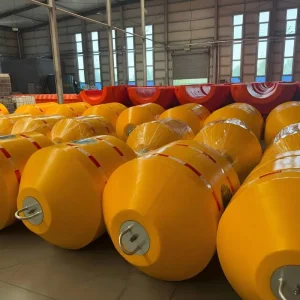
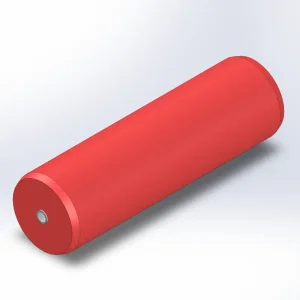
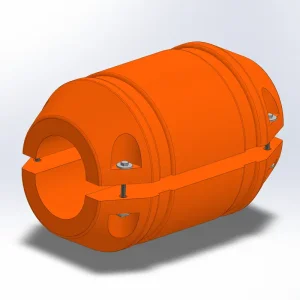
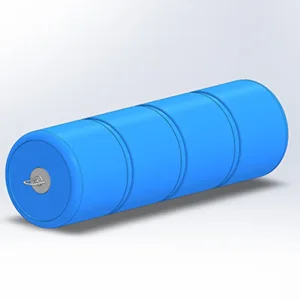
Engineered to operate in synchronization with floating rubber hoses for complete maritime fluid control, channel demarcation, and environmental debris filtration.


Frequently Asked Questions on Custom Self Floating Hoses
Authoritative technical, sourcing, and operational responses addressing the exact inquiries of dredging supervisors and procurement directors.
What is the fundamental engineering difference between a self-floating hose and a rubber hose with PE pipe floats?
A self-floating hose incorporates high-density closed-cell microcellular polyurethane/polyethylene foam directly into its multi-tier vulcanized carcass, forming a seamless, flexible, single-body unit. In contrast, separate clamp-on PE floats impose concentrated point stresses on bare hoses, require periodic bolt retorquing, risk sliding during pipe bending, and cannot match the continuous hydrodynamic bend radius and wave dampening of integral floating hoses.
How is the required reserve buoyancy percentage accurately calculated for mineral slurries?
Reserve buoyancy must factor in the maximum expected slurry density (typically 1.3 to 2.0 kg/dm³ for iron or copper tailings) rather than fresh or seawater. The total buoyant displacement of the hose outer diameter must exceed the combined dry weight of the hose, steel flanges, fluid volume, and safety margin by at least 20% to 30%. Sizing formulas: Reserve Buoyancy = [(Total Displaced Mass of Seawater / Operating Mass of Filled Assembly) - 1] × 100%.
What happens if the outer cover of a self-floating hose is slashed by rocks or boat propellers?
Because the buoyancy layer is composed of cross-linked isotropic closed-cell foam rather than a pressurized or hollow chamber, water cannot penetrate beyond the immediately damaged micro-cells. The foam maintains an absorption rating of <1% under hydrostatic submersion, preserving structural floatation and preventing line sinking until standard routine maintenance can be scheduled.
What design standards and quality control certifications govern your manufacturing process?
Our hose designs, manufacturing processes, and FAT testing conform to ISO 28017:2018 (Rubber hoses and hose assemblies for dredging applications), OCIMF GMPHOM 2009 (Single Point Mooring hoses), and ISO 1402. We provide 3.1 material test certificates, vulcanization cycle records, and support third-party witness verifications with DNV, Bureau Veritas, Lloyd’s Register, and ABS.
What are the minimum bending radius limits to prevent carcass kink failure?
Standard self-floating discharge hoses feature a minimum bending radius (MBR) of 4 to 6 times the nominal internal diameter (4D to 6D) in flexible configurations. For severe bend points—such as the stern transition behind the dredge vessel or the shoreline connection point—we engineer custom tapered or reinforced end segments with progressive flexibility to prevent localized structural pinch.
What parameters must be provided to obtain an engineering quote and buoyancy proposal?
Please specify: 1) Nominal Inner Diameter (ID) and desired segment length; 2) Conveyed medium type, grain distribution, and maximum slurry density (kg/m³); 3) Maximum operating working pressure (WP) and vacuum requirements; 4) Site conditions (wave swell height, current velocity, seawater salinity); and 5) Flange connection specifications (ANSI Class 150, PN10, PN16, or custom drilling patterns).