
Featured Precision Marine Flotation Units
Standardized, interchangeable anti-UV float series engineered for rigorous marine dredging, tailings slurry discharge, and industrial barrier deployment.

Pipe Floats for Water Transfer & Mining Pipeline Systems

Innovative Pipeline Float System for Deepwater Support

Floating Barriers for Safety & Pollution Containment

Floating Buoys for Coastal Navigation & Offshore Projects

Heavy-Duty Marine Buoys for Maritime Safety
Floating Barrier Solutions for Debris Protection
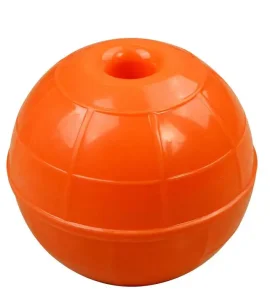
ABS / Polyethylene Float Ball for Buoyancy Support
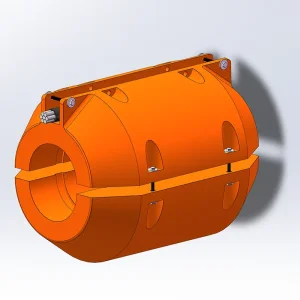
Custom Pipeline Floats for Marine Hydraulic Engineering
Photodegradation Mitigation in Maritime Polymer Floats
How molecular-level polymer compounding prevents embrittlement, stress-cracking, and premature ballast loss in high-UV offshore zones.
Advanced Hindered Amine Light Stabilizers (HALS)
Standard industrial plastics suffer photo-oxidation under UV-A and UV-B radiation, causing free-radical polymer chain scission. Our floats utilize proprietary polymer matrices compounded with oligomeric HALS and micro-dispersed carbon blacks, achieving an accelerated weather test rating exceeding 20,000 continuous hours (ASTM G154).
Seamless Bi-Axial Rotational Moulding
Manufactured using computer-controlled, multi-axis rotational ovens equipped with continuous internal temperature sensors. This eliminates stress risers, cold-feed shear zones, and structural seams, creating a uniform wall thickness (8mm to 18mm) with exceptional environmental stress-crack resistance (ESCR > 1,000 hrs ASTM D1693).
Hydrophobic Closed-Cell Core Chemistry
Should severe maritime collisions rupture the outer polymer shell, our proprietary closed-cell Polyurethane (PU) foaming core (≥ 35-45 kg/m³) provides redundant buoyancy. Featuring < 3% water absorption by volume under prolonged hydrostatic submersion, catastrophic pipeline sinking is structurally mitigated.
Localized Applications Across Global Environments
Tailoring hydrodynamic stability, chemical resistance, and solar stabilization to extreme microclimates and industrial demands.
Middle East & Equatorial High-Solar Zones
Surface water temperatures exceeding 42°C paired with direct UV indices of 11+ trigger rapid photolytic decay in commodity polymers. Our Middle Eastern harbor projects employ UV20 stabilized float shells capable of enduring up to 2,200 kWh/m² annual global irradiance without surface micro-fissuring or chalking.
Sub-Zero Nordic & Arctic Desilting Ports
Low-temperature impact embrittlement poses severe structural risks to dredging discharge modules. By utilizing high-density polymer resins modified for low-temperature ductile transitions, our floats retain crack resistance and flexural modulus in ice-slurry conditions down to -40°C.
Acidic Tailings & Mining Slurry Lines
Mining operations in Latin America and Australia transport hyper-dense, abrasive, and corrosive slurry. Our anti-UV floats resist sulfuric, hydrochloric, and cyanide leaching runoffs (pH ranges 1.5 to 13.0), safeguarding steel and HDPE pipelines against premature ballast failure.
| Pipe Outer Diameter (OD) | Float Internal Diameter (ID) | Outer Diameter × Length | Net Buoyancy Rating (Pair) | Recommended Fastener Spec |
|---|---|---|---|---|
| 160 mm (6 in) | 165 mm | 500 mm × 800 mm | 110 kg | M14 Stainless Steel 316 / Galvanized 8.8 |
| 250 mm (10 in) | 255 mm | 700 mm × 1100 mm | 280 kg | M16 Stainless Steel 316 / Galvanized 8.8 |
| 400 mm (16 in) | 408 mm | 1000 mm × 1400 mm | 720 kg | M18 Stainless Steel 316 / Hot-Dip Galvanized |
| 630 mm (24 in) | 638 mm | 1400 mm × 1800 mm | 1,850 kg | M20 High-Tensile Anti-Loosening Assemblies |
| 900 mm (36 in) | 910 mm | 1800 mm × 2200 mm | 3,900 kg | M24 Heavy-Duty Marine Structural Fasteners |
Chinese Manufacturing Resilience & Global Logistical Execution
Scale advantages, automated processing, and localized cluster integration deliver cost efficiency, short lead times, and rigorous quality standards.
Vertical Petrochemical Aggregation
Situated in Shandong’s advanced polymer and industrial belt, our factory procures virgin LLDPE/HDPE resins directly from prime refining hubs. We maintain automated pre-compounding lines, ensuring precise masterbatch dispersion without intermediary price spikes or polymer degradation.
High-Capacity Rotomolding Tooling Arrays
Our workshop houses multi-station carousels and shuttle rotomolding machines capable of operating 24/7. With over 200 dedicated steel and cast aluminum molds covering pipe sizes from 110mm to 1200mm, we scale production runs to thousands of units monthly without lead-time penalties.
Intermodal Coastal Freight Proximity
Located in Huimin County, Binzhou, direct multi-lane freight corridors connect our facility with Qingdao and Tianjin Ports in under four hours. We utilize specialized nesting and packing techniques that reduce freight cube waste by up to 35% in 40ft High Cube containers.
Technology Roadmap: Towards Circular & Smart Buoyancy Systems
Meeting upcoming European Net-Zero rules, circular polymer mandates, and predictive IoT telemetry in offshore infrastructure.
Graphene-Enhanced Tensile Composites
Integrating surface-treated graphene nanoplatelets within the rotomolding polymer charge. This increases puncture resistance by 40% while reducing wall thickness and carbon footprint, without sacrificing hydrostatic collapse thresholds.
100% Circular Marine Degradation Shields
Developing molecularly recyclable bio-based polyolefins that resist salt and solar degradation for 15+ years of active duty, yet yield 100% pure monomers during closed-loop feedstock recycling at decommission.
Integrated IoT Pipeline Buoyancy Telemetry
Embedding autonomous solar-powered micro-transponders into the float shell during moulding. Monitors real-time pipeline stress, pitch, buoyancy loss, and accidental separation, relaying data directly to dredging command systems via satellite uplink.
International Quality Compliance & Regulatory Conformance
Our manufacturing protocols align with global offshore engineering codes and cross-border environmental treaties.
ISO 9001 & ISO 14001
Comprehensive operational control covering every step from melt flow rate (MFR) testing to closed-loop environmental process waste handling.
IALA E-108 Recommendations
Strict colorimetric compliance (Marine Yellow, Hazard Red, Navigation Green) utilizing high-saturation dyes resistant to chromatic fade.
RoHS & REACH Compliance
Our closed-cell polyurethane cores and additives are certified free of CFCs, HCFCs, lead compounds, and SVHC hazardous substances.
DNV-GL Standards
Physical tests comply with standard drop-impact, environmental stress-crack, and hydro-ballast stability benchmarks for marine fixtures.
Heavy-Duty Marine Flotation & Transfer Assemblies
Explore our expanded equipment range, including mooring buoys, modular pontoons, and specialty subsea tie-in buoyancy structures.
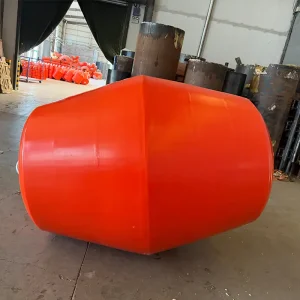
Foam-Filled Polyethylene Mooring Buoys
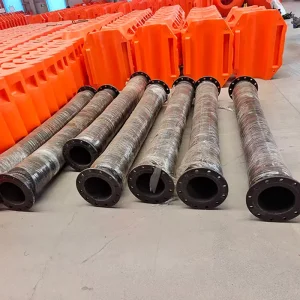
Flexible Dredging Rubber Hoses
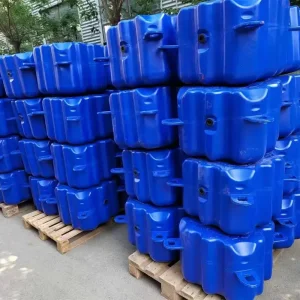
Modular Boat Pontoons & Work Platforms
Modular Deepwater Pipeline Support Floats
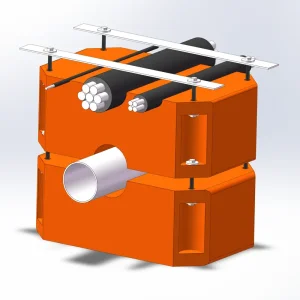
Modular Pipe Floats with Integrated Cable Troughs
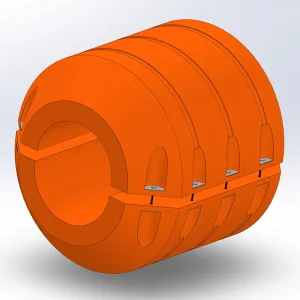
High-Buoyancy Extreme Duty Marine Floats
Subsea Tie-In Pipeline Buoyancy Floats
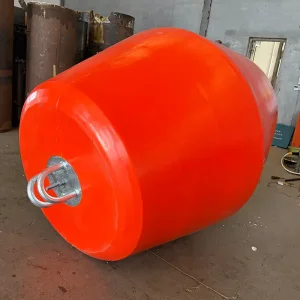
Mooring Buoys for Aquaculture Grids
Frequently Asked Questions (FAQ) & Design Guidance
Detailed answers directly from our senior rotomolding and marine hydraulic application engineers.
How do you mathematically size float buoyancy for high-density slurries?
Calculate for the operational condition, never an empty line. Compute total lineal system mass: M_total = M_pipe + M_medium + M_flanges/cables. With mining slurry, multiply internal volume by slurry specific gravity (often 1.3 to 1.8 kg/L). Total buoyancy should exceed this gross weight by a factor of 1.20 to 1.30 (20-30% reserve buoyancy) to keep 25% of the pipe diameter above the surface.
Why is rotomolded polyethylene preferred over welded steel floats?
Polyethylene floats eliminate marine bio-corrosion, galvanic degradation, and paint maintenance. Rotomolded LLDPE floats absorb rough waves and impacts without denting or puncturing. Unlike steel shells that can flood and sink a pipeline, our floats are filled with closed-cell polyurethane that remains buoyant even if ruptured.
What anti-UV grade is required for long-term open-ocean operations?
For open-water deployments lasting beyond 5 years, we recommend our UV15 or UV20 stabilized LLDPE formulations. These incorporate Hindered Amine Light Stabilizers (HALS) that chemically neutralize free radicals generated by intense photolytic sunlight, preventing surface embrittlement and maintaining structural flexural modulus.
How do you prevent floats from slipping on HDPE discharge lines?
HDPE has a naturally low friction coefficient. Our designs incorporate anti-slip positioning ribs moulded inside the float inner diameter (ID). We also supply reinforced anti-slip elastomeric gaskets or custom stop collars, preventing axial slippage under ocean waves and pipeline flexing.
What information is required to receive a formal quotation?
To provide an accurate technical spec and quote, provide: pipe Outer Diameter (OD), pipe material and wall thickness, conveyed medium and density, operating water environment (currents, waves, salinity), color preference, quantity, and the destination port for freight optimization.
What are your standard warranty terms and conditions?
Warranty coverage begins upon commercial handover to the project investor and extends for 18 months post-handover or 12 months after completed on-water installation, whichever occurs first. Coverage protects against environmental stress cracking, manufacturing defects, and structural delamination.