Featured Marine Flotation & Transfer Systems
Rotomolded with virgin high-density polymer matrices and optimized for axial hydrodynamic stability. Inspect our primary line of high-buoyancy pipeline floats, marine anchoring elements, and subsea transition modules.

Global Industry Development Trends in Offshore Flotation
The worldwide marine buoyancy market is undergoing a structural paradigm shift from legacy fabricated steel pontoon structures toward precision-engineered, rotomolded polyethylene (PE) composite systems. Driven by stringent international maritime safety mandates and lifecycle maintenance economics, the engineering requirements for floats and buoys have elevated beyond basic displacement containers into complex, computational fluid dynamics (CFD) modeled hydrodynamic systems.
Polymeric Material Superiority
Legacy steel buoys suffer from galvanic corrosion, weld seam cracking, and catastrophic ballast flooding upon localized puncturing. Modern high-grade rotational molding utilizes UV-stabilized Linear Low-Density Polyethylene (LLDPE) and High-Density Polyethylene (HDPE) shells compounded with closed-cell polyurethane (PU) foaming cores ($>35\text{ kg/m}^3$). This composite prevents water absorption even under extreme shell breaches.
- Zero oxidization or electrolytic degradation in hypersaline environments.
- Elimination of sandblasting, toxic biocidal recoating, and annual dry-docking.
- High dynamic elasticity: absorbing kinetic vessel impacts without permanent plastic deformation.
Extreme Deep-Water & High-Slurry Demands
Modern mega-dredging vessels (such as trailing suction hopper dredgers with hopper capacities exceeding $30,000\text{ m}^3$) convey highly abrasive slurries with specific gravities exceeding $1.65\text{ t/m}^3$. At the same time, offshore land reclamation pushes floating pipelines into unprotected open-sea environments subjected to multi-directional wave trains and violent tidal surges.
- Sizing formulas must integrate hydraulic dynamic pressure surges and wave impact loads.
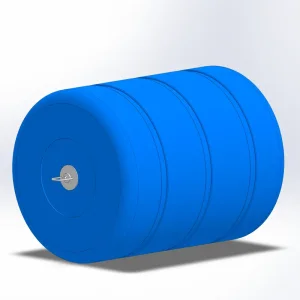
- Transition from uniform cylindrical bodies to hydro-contoured profiles minimizing drag coefficients ($C_d$).
- Integration of dedicated electrical cable troughs and hydraulic umbilical channels within pipeline floats.
Ecological Decarbonization & Circularity
Civil environmental compliance (governed by World Bank Environmental, Health, and Safety Guidelines and regional maritime authorities) mandates zero chemical leaching into sensitive marine habitats. Modern rotomolded PE flotation systems eliminate toxic antifouling paints, deliver a 100% recyclable thermoplastic shell architecture, and dramatically curtail microplastic shedding under severe cavitation.
- Chemically inert formulations compliant with potable water and marine sanctuary standards.
- Reduced carbon footprints during maritime transport due to optimized strength-to-weight ratios.
- Extended 15-to-25-year operational lifespans outlasting conventional painted carbon steel assemblies.
Global Enterprise Sourcing Demands & Total Cost of Ownership (TCO)
Tier-1 marine contractors (e.g., DEME, Jan De Nul, Van Oord, Boskalis), port authorities, and offshore mining corporations no longer evaluate floats and buoys strictly on unit purchase price. Sourcing decisions are executed via comprehensive Total Cost of Ownership (TCO) models encompassing operational resilience, hydraulic efficiency, and downtime mitigation.
Direct Capital Investment vs. Operational Downtime
In dredging and fluid conveyance, the failure of a single pipeline float module can induce localized pipeline sagging, leading to severe bending moment concentrations, flanged joint rupture, or catastrophically submerged dredge lines. An offshore cutter suction dredger operating at thousands of cubic meters per hour faces catastrophic standby penalties if slurry transfer is halted.
- Wall Thickness Uniformity: Sourcing managers demand automated rotational molding with electronic temperature logging to eliminate localized thin spots on structural ribs.
- Closed-Cell Foam Integrity: Sourcing specifications insist on non-hygroscopic expanded polyurethane with water absorption rates lower than $0.05\text{ g/cm}^3$ to prevent gradual sinking under micro-perforations.
- Fastener Metallurgy: Standardized pairing of galvanized Grade 8.8 or marine-grade 316 stainless steel fastening bolts with anti-loosening nylon-insert locking nuts.
Supply Chain Logistics & Nesting Economics
Because buoyancy products are intrinsically high-volume, low-density cargo, international freight costs can rapidly distort unit economics if geometry is unoptimized. International procurement teams audit manufacturer packaging algorithms to calculate container cubing utilization.
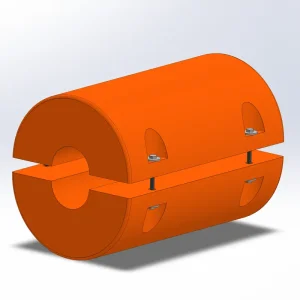
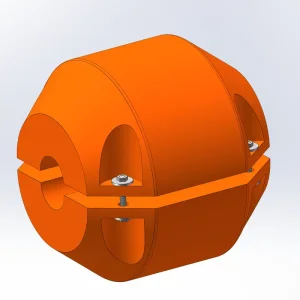
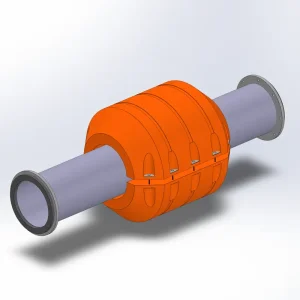
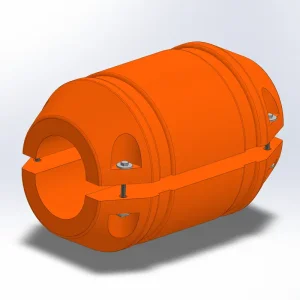
- Modular Semi-Cylindrical Clamp-On Halves: Engineered to nest seamlessly within standard 40ft High Cube (HC) shipping containers, cutting freight expenditure by up to 45%.
- Dimensional Interchangeability: Precision casting tooling ensures that half-shells manufactured in different production runs match with sub-millimeter tolerances on-site.
- Lead Time Compression: Automated continuous-cure carousel ovens allow industrial capacity scaling to deliver thousands of buoyancy sets within critical project weather windows.
To prevent catastrophic sub-surface sinking during high-density slurry transfer, international standards mandate an engineered safety reserve margin ($K_b$):
$$F_{buoyancy\_total} \ge K_b \times \Big( W_{pipe\_dry} + W_{medium\_conveyed} + W_{hardware} + W_{dynamic\_drag} \Big)$$
Where $K_b$ is defined as 1.25 to 1.35 for calm river/lake environments, and 1.40 to 1.60 for exposed offshore marine environments subject to significant hydrodynamic wave run-up and tidal suction forces.
Macro Industry Engineering Solutions
Modern floats and buoys serve as mission-critical civil infrastructure assets. Our engineered systems are custom configured across distinct operational theatres worldwide.
Port & Harbor Capital Dredging
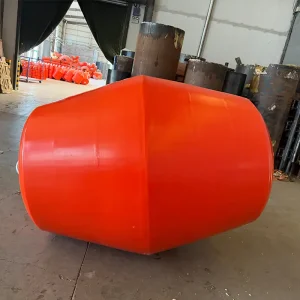
Supporting heavy steel and HDPE slurry pipelines transferring dredged sediment from deepening navigation channels. Integrated high-visibility yellow and international orange coloration ensures day-and-night fairway recognition for transiting commercial vessels.
Subsea Tie-In & Pipeline Positioning
Modular buoyancy assemblies engineered for offshore oil, gas, and green-hydrogen pipelines. Provides precise negative buoyancy offloading during pipeline tow-outs and controlled lowering to seabed target coordinate envelopes.
Mining Tailings & Slurry Evacuation
Engineered to handle caustic, acidic, and hyper-dense mineral tailings lines traversing settling ponds. Chemical-resistant polyethylene shells eliminate pitting corrosion and prevent pipeline submergence during pump surging.
Ecological Barriers & Debris Booms
Interconnected heavy-duty floating barrier strings deployed at hydroelectric dam penstocks, river intake reservoirs, and industrial cooling channels to repel drifting timber, aquatic weeds, and surface plastic pollution.
Manufacturing Rigor: Shandong Binzhou Juhua Rubber & Plastic Co., Ltd.
Operating under the recognized industrial banners of Juhua and Giant Rubber, our manufacturing facility in Lizhuang Town, Huimin County, Binzhou, Shandong Province, constitutes a benchmark center of excellence for heavy-duty marine rotational molding and fluid pipeline equipment.
Advanced Production & Material Metrology
Our specialized plant deploys automated multi-arm carousel rotomolding machines equipped with variable-frequency speed controls and electronic multi-zone internal air temperature measurement systems. This real-time thermomechanical regulation prevents polymer degradation, suppresses volatile gas bubble entrapment, and guarantees razor-sharp wall thickness consistency across intricate internal radii and structural load-bearing ribs.
Every production batch undergoes comprehensive quality gate verifications: raw virgin polyethylene melt flow index (MFI) validation, low-temperature dart impact testing (-40°C), hydrostatic collapse pressure chamber testing, and core polyurethane foam density profiling.
System Integration: Pipes, Hoses & Custom ODM
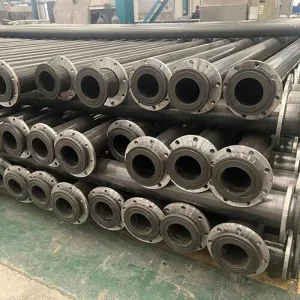
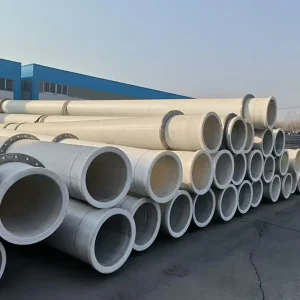
Unlike trading intermediaries, Juhua manufactures complete, mathematically synchronized marine fluid conveyance trains. We supply matched sets consisting of high-elasticity rubber dredging hoses, flanged ultra-high molecular weight polyethylene (UHMWPE) and HDPE dredging pipelines, precision-molded clamp-on pipe floats with customized internal rubber friction pads, and offshore mooring buoys.
Our internal tooling and CNC mould design department supports custom rotomolded float solutions, specialized pontoon sections, cable-trough buoyancy shells, and marine sports hardware directly from client 3D CAD/STEP files.
Localized Support, Quality Standards & Compliance Assurance
Navigating international maritime project specifications demands seamless adherence to international engineering norms, strict warranty governance, and prompt cross-border engineering documentation.
International Maritime Standards
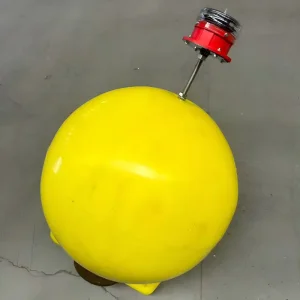
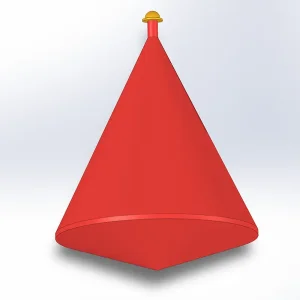
Our marine navigation and fairway buoys adhere stringently to the International Association of Marine Aids to Navigation and Lighthouse Authorities (IALA) Guideline specifications (IALA AISM A-126) for colorimetry, chromacity coordinates, visual focal heights, and topmark mechanical integrity.
- ASTM D1693 Environmental Stress-Crack Resistance (ESCR) tested $>1000\text{ hours}$.
- ASTM G154 accelerated UV aging test rating (UV8 to UV20 stabilization).
- ISO 9001 certified manufacturing, tracking batch numbers to raw polymer lots.
Certified Warranty Governance
Industrial EPC contracts require explicit warranty frameworks to secure project financial close. Juhua provides transparent, enforceable warranty terms directly aligned with commercial handover milestones.
- Standard Warranty: Commences upon buyer handover to the end investor, concluding 18 months post-handover or 12 months post-installation (whichever transpires first).
- Rapid spare parts dispatch program providing precision-matched replacement half-shells and galvanized fastener assemblies worldwide.
Multimodal Logistics Engineering
Direct dispatch from our strategically positioned industrial facilities near Qingdao and Tianjin maritime deep-water shipping terminals. We supply factory-certified nesting, strapped stacking protocols, and breakbulk maritime securing plans to safeguard product geometric stability during extreme trans-oceanic shipping transits.
Technology Roadmap: The Next Generation of Marine Flotation
As offshore structures integrate into smart maritime networks and oceanographic data corridors, the functional scope of floats and buoys is expanding rapidly. Juhua's advanced R&D team is pioneering structural and telemetry integrations across three core vectors:
IoT & Telemetry-Embedded Smart Buoys
Integration of low-power satellite (Iridium/Starlink) and NB-IoT telemetry modules directly into navigation buoys and critical mooring nodes. Onboard sensor packages deliver real-time reporting of catenary mooring line tension, 3-axis acceleration (wave frequency and height monitoring), ambient sea temperature, salinity, and automatic collision detection alerts.
Advanced Syntactic & Micro-Cellular Cores
For deep-water subsea pipeline float tie-in operations exceeding 100 meters of immersion depth, standard polyurethane foam faces hydrostatic cell rupture. Juhua is engineering hybrid syntactic foam formulations utilizing hollow glass microspheres (HGMS) bound in thermoset matrices, delivering ultra-light positive buoyancy capable of withstanding deep hydrostatic isostatic pressures.
Bio-Derived Non-Leaching Polymers
In compliance with emerging European Green Deal regulations and UN Sustainable Development Goal 14 (Life Below Water), our polymers laboratory is developing bio-circular polyethylenes produced from secondary feedstocks. These next-generation polymers retain full mechanical tensile properties ($>21\text{ MPa}$) while eliminating long-term petroleum ecotoxicity.
Engineering & Procurement FAQ for Floats and Buoys
Straight, authoritative answers to critical engineering, installation, and procurement questions encountered by dredging superintendents, marine architects, and supply chain directors.
What fundamental mechanical differences exist between rotational-molded PE floats and welded steel floats?
Rotomolded polyethylene (PE) floats present significant mechanical and operational advantages over carbon steel pontoons: they are 100% immune to galvanic saltwater corrosion, eliminate the need for sacrificial zinc anodes, and feature superior impact resilience. When struck by workboats or debris, the ductile PE shell deforms elastically and recovers its original hydrodynamic profile, whereas steel permanently dents or cracks along welded seams. Furthermore, PE floats are filled with solid closed-cell polyurethane foam, meaning a surface rupture does not result in water ingress or loss of buoyancy, whereas steel pontoon punctures lead to progressive flooding and sinking.
How is pipeline buoyancy calculated for heavy dredging slurries versus fresh water transfer?
Buoyancy sizing must always be executed based on the maximum anticipated operational density of the slurry medium ($S_m$), not clear water. A dredge pipeline carrying iron ore tailings or coarse wet sand frequently operates at specific gravities between $1.4\text{ and }1.8\text{ t/m}^3$. The sizing calculation computes total dry displacement: the mass of the HDPE/steel pipe wall plus the internal fluid column mass, plus steel flange hardware, plus a 25%–35% minimum reserve buoyancy factor. A properly sized floating pipeline must maintain approximately one-quarter to one-third of its outer diameter visibly elevated above the waterline to counteract hydrodynamic surface wave currents and slurry slug surging.
How do clamp-on pipe floats prevent axial slipping along the dredge discharge line?
Axial slippage occurs when hydrodynamic current drag or vessel wave action overcomes friction between the float inner bore and the pipe outer diameter. Juhua solves this by precision-molding internal anti-slip ridges that mate directly into corresponding pipeline grooves, or by integrating textured high-friction elastomeric rubber pads. In addition, when clamping around smooth HDPE pipe strings, our engineering design specifies retaining collar clamps or positions float pairs directly abutting welded HDPE stub-end flange collars, creating an immovable positive physical stop along the line.
What specific UV stabilization chemistry is required to guarantee float longevity in tropical offshore regions?
Unprotected polyethylenes suffer free-radical photo-oxidation, surface chalking, micro-cracking, and loss of impact strength when subjected to intense tropical UV radiation. Juhua compounds virgin LLDPE with high-potency Hindered Amine Light Stabilizers (HALS) and rutile-grade titanium dioxide or carbon black pigment matrices. This achieves a verified UV8 to UV20 stabilization classification under accelerated ASTM G154 weathering standards, assuring more than 15 years of uninterrupted structural integrity under direct equatorial insolation.
What are the structural guidelines for installing marine mooring buoys and tension hardware?
Mooring buoys must never transmit vessel mooring hawser snatch loads directly through their plastic shell. Our mooring buoys feature a central structural steel core: either a heavy through-chain hawse-pipe architecture or an internal forged Grade 316 / galvanized high-tensile steel tension rod terminating in forged eye-shackles on top and bottom. The mooring load path transfers directly from anchor sinker to vessel hawser through this continuous internal steel spine, while the rotomolded PE outer body provides buoyant freeboard without experiencing tensile or shear stress.
What technical data must an engineering client furnish to receive an accurate, custom-engineered quotation?
To provide precise buoyancy modeling, our engineering team requires: (1) Pipe outside diameter (OD) and pipe wall thickness (SDR rating); (2) Pipe material grade (e.g., HDPE PE100, carbon steel, rubber); (3) Specific gravity and temperature of the conveyed fluid or slurry mixture; (4) Total pipeline length and segment flange spacing; (5) Site wave height, current velocity, and water salinity (fresh vs. marine); (6) Requirement for integrated cable or instrument channels; (7) Targeted port of destination for container freight nesting optimization.
High-Capacity Mooring, Navigation & Infrastructure Buoys
Engineered for extreme oceanographic endurance, port fairway channel demarcation, and environmental pollution protection. Review our certified line of foam-filled mooring buoys, floating safety barriers, and offshore tie-in assemblies.