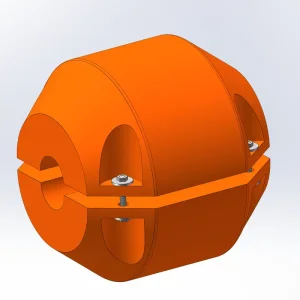
Featured Offshore & Subsea Flotation Assemblies
Engineered for extreme hydrodynamic stabilization, deepwater tie-in alignment, and maximum operational security across offshore dredging, mining slurry, and petrochemical corridors.



Physics, Deflection Mechanics & Subsea Tie-In Dynamics
Understanding the engineering prerequisites of subsea spool alignment, submerged weight neutralisation, and catastrophic stress alleviation during marine installations.
Subsea Spool Tie-In Mechanics
In subsea and nearshore pipeline architecture, the "tie-in" represents the critical mechanical bridge linking a laid marine pipeline to an offshore manifold (PLET), wellhead, riser base, or shore-approach intake. These connection spools are subjected to massive static submerged weights and dynamic hydrodynamic drag. Pipeline Float Tie-In systems provide modular, calibrated buoyancy that counterbalances gravitational load, transforming heavy steel or composite spools into quasi-weightless structures during diver-assisted or ROV-operated flange makeup.
Deflection & Bending Moment Control
Unmitigated deflection during crane lowering induces severe plastic deformation, localized buckling, and unacceptable rotational bending moments at flange faces. Strategically deployed pipeline floats maintain the pipeline’s natural elastic deflection curve within strict allowable DNV-ST-F101 thresholds. By distributing buoyancy modules along designated node points, engineers effectively minimize peak shearing forces at the tie-in transition zone, eliminating premature bolt fatigue and seal ring damage.
Hydrodynamic Trim & Stage Separation
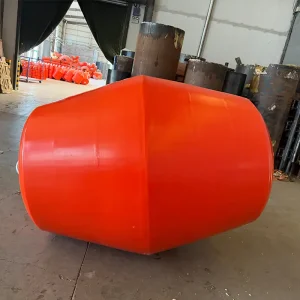
Floating pipelines encounter severe cross-current forces, vortex-induced vibrations (VIV), and wave slam in surf zones. Advanced tie-in buoyancy assemblies feature hydrodynamic ellipsoidal profiles that reduce lateral drag coefficients (Cd) by up to 35% compared to cylindrical drums. Staged release mechanisms allow controlled de-ballasting or selective uncoupling of float modules once the pipeline spool reaches the seabed, guaranteeing pinpoint landing accuracy.
To prevent pipeline grounding or uncontrollable bucking during tie-in positioning, total net buoyancy ($F_{net}$) must be calculated considering the fully operational pipe status:
F_{net} = \sum_{i=1}^n \left[ V_{float, i} \cdot \rho_{seawater} \cdot g - (M_{float, i} \cdot g) \right] - \left( W_{pipe, sub} + W_{medium, sub} + W_{rigging} \right) \ge 1.25 \times W_{total, sub}
Where $\rho_{seawater} = 1025\text{ kg/m}^3$, $\rho_{slurry}$ ranges from $1200\text{ to }1650\text{ kg/m}^3$, and a mandatory safety reserve factor of 25% to 30% is maintained to compensate for hydrostatic foam compression and dynamic sea-state turbulence.
Why Global Marine EPCs Source From China (Binzhou Hub)
Examining the structural supply-chain economics, automated rotational molding scale, and engineering advantages centered in Shandong Province's polymer industrial belt.
CNC Rock-and-Roll Rotomolding
China's modern manufacturing plants operate large-envelope, computer-controlled rotational molding carousels equipped with multi-zone infrared thermal sensors. This eliminates the wall-thickness variations that cause localized rupture under hydrostatic ocean pressures.
Petrochemical Integration
Direct colocation with upstream petrochemical complexes in Shandong enables seamless access to premium virgin linear low-density polyethylene (LLDPE) modified with advanced UV8-UV20 hindrance amine stabilizers (HALS), maximizing resin longevity.
Rapid Tooling & Customization
With integrated in-house mold prototyping, Chinese plants turn around complex, project-tailored clamp geometries, custom buoyancy chambers, and integrated cable troughs in under 15 days—reducing project mobilization schedules by over 60%.
Total Life-Cycle Cost Reductions
Competitive manufacturing economics, high production scale, and precision nesting design for 40ft High Cube containers drastically reduce landed costs (FOB/CIF) for EPC contractors worldwide without compromising international ISO and DNV quality standards.
Pipeline Float Tie-In Technical Specifications
Standard and deep-submergence specification matrix for pipeline tie-in and dredge alignment assemblies.
| Pipe Outer Diameter (OD) | Float OD x Length (mm) | Net Buoyancy per Pair (kg) | Shell Wall Thickness | Core Infill Matrix | Pressure Rating / Service |
|---|---|---|---|---|---|
| DN200 (8") - DN250 (10") | 700 x 1000 mm | 280 - 450 kg | 8 - 10 mm LLDPE | Rigid PU (38-42 kg/m³) | Nearshore / River Dredging |
| DN315 (12") - DN400 (16") | 1100 x 1200 mm | 750 - 1,100 kg | 10 - 12 mm LLDPE | Hydrophobic Closed PU | Estuary / Harbor Expansion |
| DN500 (20") - DN630 (24") | 1400 x 1500 mm | 1,650 - 2,400 kg | 12 - 14 mm LLDPE | High-Density PUR | Coastal Tie-In / Outfall Lines |
| DN710 (28") - DN800 (32") | 1800 x 2000 mm | 3,200 - 4,800 kg | 14 - 16 mm Crosslinked PE | Reinforced Closed-Cell PU | Deep Dredge / Heavy Tailings |
| DN900 (36") - DN1200 (48") | 2200 x 2500 mm | 6,500 - 9,800 kg | 16 - 20 mm Specialized PE | Syntactic / Structural PUR | Deepwater Spool Tie-In / EPC Lay |
Corrosion-Proof Metallurgy
All connecting hardware integrated into our float modules features Marine-Grade 316 Stainless Steel, Super Duplex 2507, or Hot-Dip Galvanized Grade 8.8 structural fasteners. Equipped with nylon locknuts and anti-loosening spring washers, these assemblies withstand decades of continuous saline immersion without galvanic degradation.
Anti-Slip Internal Ribbing
A major point of failure on uncalibrated floats is longitudinal slippage along the pipe axis during towing or high-velocity discharge. Juhua's pipeline float tie-in designs incorporate molded radial ribs and optional synthetic neoprene gripping gaskets that maximize frictional contact with bare steel, concrete-weight coating (CWC), or HDPE surfaces.
Cable & Umbilical Channels
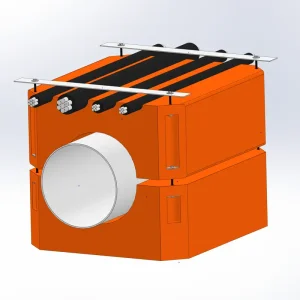
Modern subsea operations frequently require concurrent electrical power distribution, hydraulic actuation lines, or fiber-optic monitoring cables. Integrated peripheral cable troughs eliminate the need for secondary buoyant lines, protecting vulnerable conduits from marine vessel collisions and abrasive seafloor scraping.
Localized Application Scenarios & Turnkey Solutions
Deploying specialized flotation solutions across marine construction, energy distribution, and environmental stewardship domains.
Subsea Hydrocarbon & Gas Tie-Ins
In shallow-to-medium offshore extraction zones, connecting wellheads to floating production storage and offloading (FPSO) units or subsea manifolds requires calibrated buoyancy kits. Our pipeline float tie-in units preserve rigid spool tolerances, easing diver torque operations and protecting vital hub seals against axial shear stress during installation.
Offshore Wind Subsea Array Landing
Export power cables for bottom-fixed and floating offshore wind farms experience severe cyclical bending fatigue near the seabed touch-down point (TDP). Integrated pipeline and cable support floats maintain dynamic bend radius (MBR) envelopes, defending high-voltage armored conduits against storm-induced seabed abrasion.
Harbor Dredging & Land Reclamation
Mega-scale reclamation initiatives across Southeast Asia and the Middle East rely on massive trailing suction hopper dredgers (TSHD). High-buoyancy clamp modules suspend extended discharge lines filled with high-density sand slurries, preventing seabed snagging and maximizing continuous pumping uptime.
Mining Tailings & Slurry Transport
Tailings transfer systems across acidic or alkaline processing ponds face severe chemical degradation. Juhua's chemically inert polyethylene float shells provide impenetrable protection against aggressive chemicals, maintaining stable freeboard for tailings pipelines without risk of corrosion-induced structural failure.
Municipal Outfalls & Desalination
Seawater Reverse Osmosis (SWRO) intake pipelines and treated brine outfall lines demand stable, durable flotation during marine pull-in installations. Our pipe float systems guide kilometers-long strings safely into pre-dredged trenches prior to controlled marine ballast filling and burial.
Offshore Carbon Capture (CCUS)
As offshore geological sequestration projects accelerate globally, pipeline tie-in buoyancy assemblies are engineered to support specialized dense-phase CO2 transportation pipelines, accommodating cryogenic operating temperatures and specialized thermal insulation jackets.
Global Industry Trends & EPC Procurement Framework
Key evolutionary directions in subsea polymer engineering and a systematic breakdown of criteria for international tenders and factory evaluations.
Syntactic Core Technology
While conventional nearshore pipeline floats utilize rigid closed-cell polyurethane foam (35-45 kg/m³), deepwater installations exceeding 300 meters require hollow glass microspheres embedded in high-grade resin matrices (syntactic foam). These formulations prevent hydrostatic cell collapse under extreme deepwater pressures.
Smart IoT Telemetry Systems
Next-generation offshore projects are integrating low-power acoustic transponders, hydrostatic load cells, and tilt sensors directly into buoyancy modules. This enables real-time acoustic telemetry during subsea tie-in positioning, providing the bridge crane operator with accurate spatial deflection feedback.
Rigorous Factory QA/QC Protocols
Global energy conglomerates require standardized Factory Acceptance Testing (FAT) before dispatch. This includes 100% water immersion buoyancy verification, dimensional ultrasonic shell-thickness testing, foam density core analysis, and fastener tensile yield certifications per ISO 10474 / EN 10204 3.1 standards.
To receive an accurate, production-ready quote from an authorized manufacturing facility, tender dossiers should clearly document:
Engineering & Procurement FAQ
Key technical considerations regarding hydrodynamic design, manufacturing tolerances, and operational deployments.
What is the primary difference between a standard dredge pipe float and a pipeline float tie-in?
Standard dredge floats prioritize surface freeboard and wave impact resistance for floating pipelines. Pipeline float tie-ins are precision-engineered buoyancy tools designed for subsea or nearshore spool alignment, deflection mitigation, and structural load balance. They feature tighter dimensional clamp tolerances, higher compressive-strength foam cores (often rigid PU or syntactic hybrids), integrated cable channels, and specific release mechanisms for controlled seabed touchdown.
How is buoyancy reserve determined for lines carrying high-density slurries?
Buoyancy cannot be sized based on an empty pipe. Sizing must account for the heaviest operational state: pipe weight plus high-density slurry (frequently 1.3 to 1.65 specific gravity), plus all flanges and hardware. We calculate total displaced volume to provide a net positive freeboard showing 20% to 30% of the pipe diameter above water, ensuring the line avoids excessive sag or underwater grounding during sudden slurry pressure surges.
Why is rotomolded polyethylene preferred over welded steel pontoon floats?
Unlike steel buoyancy cans, rotationally molded virgin polyethylene (LLDPE/HDPE) shells never rust, require no recurring cathodic protection, and resist marine biofouling and saline chemical attack. Furthermore, in the event of an accidental hull puncture from marine debris, our closed-cell polyurethane foam core blocks internal water ingress, completely preventing catastrophic buoyancy loss.
What torque standards are recommended when clamping modules around HDPE or steel pipes?
Tightening torques depend directly on float model, pipe outer diameter, and structural bolt size (typically M16 to M24). Bolts must be tightened in a cross-pattern sequence to ensure uniform clamping pressure. For smooth steel or HDPE pipes, we incorporate molded-in gripping ribs and high-friction elastomeric gaskets that achieve required longitudinal restraint without crushing or ovalling the carrier pipe.
Can pipeline float tie-in tooling be customized for non-standard pipe diameters?
Yes. With extensive in-house mold design and fabrication capacity, custom internal bore sizes, asymmetric buoyancy envelopes, auxiliary cable troughs, and specific towing eyelet points can be engineered, cast, and validated in under three weeks, ensuring a precise match with project-specific pipeline configurations.
What is the standard product warranty and expected operating lifespan?
The standard warranty period runs for 18 months from delivery or 12 months from operational marine deployment. With UV20 ultraviolet stabilizer compounding and marine-grade stainless hardware, our polyethylene pipeline float assemblies provide a typical operating service life exceeding 10 to 15 years, even under intense tropical sunlight and turbulent open-ocean marine environments.
Auxiliary Flotation, Buoys & Industrial Storage Solutions
Expand your procurement plan with high-performance mooring buoys, water containment barriers, and specialized rotomolded assemblies.