High-Quality Versatile Floating Boat Pontoon for Water Projects Products, Company
View Product Specs
Explore standard and ODM-certified floating pontoon modules, specialized mooring buoys, and pipeline support systems engineered to ISO & ASTM international durability ratings.


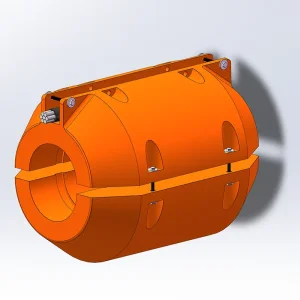
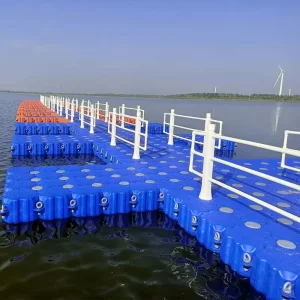
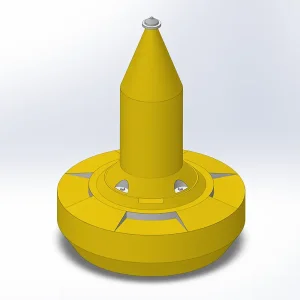
Strategic analysis of infrastructure investment, floating construction mechanics, and turnkey contract specifications across offshore sectors.
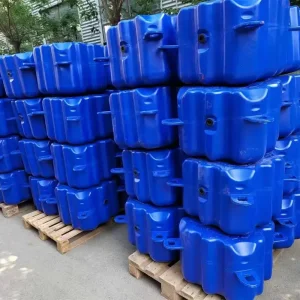
Harbor expansions, fairway desilting, and land reclamation require modular work pontoons capable of securing heavy dredging pipelines, conveying dense marine slurries, and serving as stable, non-slip access walkways for heavy site machinery and crew transfers.
Extreme conditions in mineral tailings storage facilities require corrosion-free flotation platforms. Juhua's rotomolded polyethylene units resist aggressive chemical salts, low pH slurries, and heavy sediment abrasion where galvanized steel barges pit and fail within months.
Offshore wind farm construction staging, submerged high-voltage cable pull-ins, and utility-scale floating solar installations rely on interconnected pontoon matrices designed with precise reserve buoyancy margins to safely house inverters, transformers, and service personnel.
Under international maritime standards (including PIANC and ISO 12217-1 stability protocols), work platform procurement mandates certified verification of material yield point, ultimate tensile strength, and internal Closed-Cell Polyurethane (PUR) foam water absorption under sustained head pressures.
A technical assessment of physical dynamics, structural endurance, capital expenditures, and total lifecycle management.
| Evaluation Parameter | Juhua Advanced Rotomolded PE Platform | Conventional Welded Steel Barge | Expanded Polystyrene (EPS) Concrete Pontoons |
|---|---|---|---|
| Corrosion & Seawater Resistance | Inert to salinity, acidic mine water, and biofouling. Never rusts. | Requires regular cathodic protection, zinc anodes, and sandblasting. | Concrete can spall over freeze-thaw cycles; internal rebar rusts. |
| Impact Absorption & Dynamic Resilience | High elastic elongation. Recovers from barge impacts without denting. | Prone to structural deformation, weld ruptures, and localized breach. | Brittle upon impact; outer skin easily fractures under heavy shear load. |
| Buoyancy Integrity & Foam Core | Closed-cell PUR foam core (40 kg/m³); 0% water absorption if holed. | Hollow bulkheads require constant bilge monitoring and water pumping. | Polystyrene breaks down over time when exposed to fuel spills. |
| Transport & Modular Assembly | Compact modular units flat-pack directly into standard 40ft HQ containers. | Requires expensive tugboat mobilization, heavy slipways, and coastal cranes. | Heavy self-weight; extremely high transport and site placement costs. |
| Designed Operational Lifespan | 15 to 25+ Years with minimal preventative maintenance. | 7 to 12 Years before drydock refurbishment is needed. | 10 to 15 Years contingent on structural water tightness. |
Variable-frequency rotational molding ovens utilize digital electronic thermal sensing to maintain a continuous, seamless wall thickness of 12mm to 18mm without seam vulnerabilities.
Molded-in diamond-tread patterns achieve superior dry and wet friction coefficients (DIN 51130 R11 rated), ensuring worker safety in heavy swells and high moisture environments.
Reinforced interlocking lug connectors combined with high-grade stainless steel (AISI 316) tie rods disperse dynamic wave-induced shear forces across the entire platform array.
Compounded with high-performance UV absorbers (UV8 to UV15 rating) and carbon black dispersions, preventing polymer embrittlement under intense tropical or desert UV exposure.
Scientific buoyancy calculation formulas, structural stability design methods, and smart monitoring integration.
Proper buoyancy sizing requires an accurate safety reserve factor to accommodate dynamic personnel movement, equipment live loads, mooring line tension, and changing water conditions:
Interconnected pontoons must withstand hydrodynamic drag forces caused by tides and current drag velocities:
Juhua's next-generation platform designs incorporate built-in load-cell telemetry, draft depth monitoring, GPS geofencing, and solar-powered alert buoys to track floating platform stability and anchor health remotely from project control centers.
Full conformance with worldwide engineering codes, stringent raw material traceability, and sea-freight packaging logistics.
Our rotomolding facilities operate under audited quality and environmental management protocols. Every polymer batch undergoes melt flow index (MFI), tensile yield, and environmental stress crack resistance (ESCR ASTM D1693) testing.
Components are dimensionally matched to standard 20GP, 40GP, and 40HQ container volumes. Modular interlocking designs eliminate freight waste, lowering landed delivery costs across European, Middle Eastern, Southeast Asian, and American sea ports.
Platforms carry an industry-grade warranty covering up to 18 months from delivery or 12 months from commissioning. Technical support includes comprehensive modular layout plans, anchorage calculations, and on-site assembly supervision.
Detailed technical answers addressing design capacities, environmental durability, and operational constraints.
Standard modular pontoons support single-layer distributed working loads ranging from 300 kg/m² to 380 kg/m². When heavy machinery (such as excavators, winches, or drill rigs) is deployed, units can be assembled in double-layer or reinforced multihull configurations to deliver load capacities exceeding 800 kg/m².
Our pontoon modules absorb dynamic wave energy through controlled flexural elasticity in the polymer skin, dampening shock loads on joint connectors. The modular interlocking architecture allows the assembly to flex slightly over swell crests, preventing the severe bending moment fractures common to rigid welded steel platforms in winds up to Beaufort Force 7.
The thick exterior shell (up to 18mm) offers high puncture resistance. In the unlikely event of an exterior tear caused by dropped heavy steel tooling, the platform’s high-density closed-cell polyurethane foam filling prevents water ingress, preserving full design buoyancy and avoiding sudden trim loss.
To generate an accurate quotation, please provide: targeted platform overall dimensions (length x width), total live load requirements (machinery weights, personnel count), operational environment (wave heights, water current speeds, water salinity/chemistry), planned mooring method (piles, deadweight anchors, shore winches), and target destination seaport.
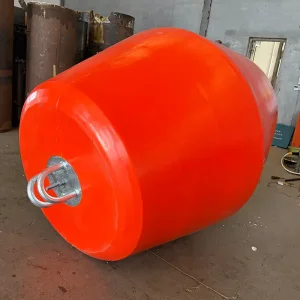
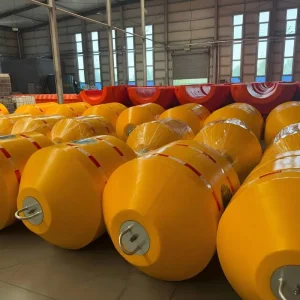
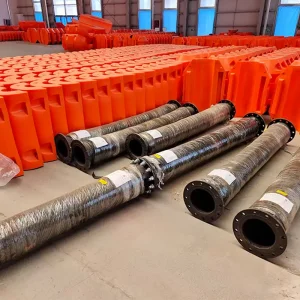
Complete product support systems including deepwater pipeline floats, dredge discharge hoses, and commercial mooring buoys.