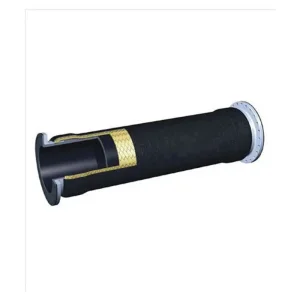
Primary ODM Pipeline Buoyancy Modules
Engineered polyethylene float matrices customized for high-stress slurry transit, structural offshore tie-ins, and complex coastal hydraulic barriers.

Global Maritime & Buoyancy Dynamics: Industrial Status
The global marine dredging, hydro-transportation, and subsea mining sectors are witnessing a structural transition. Aging steel floats are being completely displaced by advanced, closed-cell polyurethane-injected polyethylene buoyancy blocks due to stringent anti-corrosion, environmental, and lifecycle requirements.
Material Evolution & Steel Displacement
Traditional fabricated carbon steel floats suffer catastrophic localized oxidization, high marine maintenance overhead, and rapid loss of positive buoyancy upon skin perforation. Modern virgin LLDPE/HDPE polymer envelopes deliver non-reactive resistance across extreme salinity, pH ranges, and continuous solar exposure without structural degradation.
Dynamic Hydraulic Shock Resilience
Slurry pumping projects undergo violent kinetic transients during start-ups and water-hammer occurrences. Rotomolded shell designs absorb severe flexural and torsional impact energies, mitigating point loading on HDPE pipelines and steel dredging discharge conduits during severe littoral swells.
Standardization & Interchangeability
Global dredging contractors require rapid modular repair cycles. Utilizing high-precision computerized rotational moulding with electronic automatic temperature measurement ensures absolute symmetry and uniform wall thickness across production batches, allowing instant field replacement of damaged half-shells.
Total Lifecycle Optimization (TCO)
While initial acquisition cost is a key procurement metric, modern industrial operators evaluate operational deployment efficiency. Maintenance-free polyethylene buoyancy assemblies drop maritime handling weights significantly, slashing mobilization expenses and crane vessel requirements.
Engineering Buoyancy Calculation Methodology
A frequent error in industrial pipeline deployment is sizing buoyancy under static, clean-water assumptions. Our engineering whitepaper models full operating slurry loads under extreme wave velocity.
B_total ≥ [W_pipe + (V_internal × ρ_slurry) + W_fittings + W_accessories] × Safety_Factor (1.25 to 1.30)
Where:
• W_pipe = Submerged weight of HDPE/Steel pipe per unit run (kg)
• V_internal = Interior pipeline volume (m³)
• ρ_slurry = Specific gravity of pumped material (e.g., up to 1,600 - 1,800 kg/m³ for dense tailings)
• Safety Margin = 25% to 30% reserve providing 1/4 pipe outer diameter visual freeboard above water surface.
| Nominal Outer Diameter (OD) | Recommended Shell Wall Thickness | Polyurethane Core Density | Reserve Buoyancy Factor | Recommended Primary Fasteners |
|---|---|---|---|---|
| 110mm – 250mm | 5.5mm – 7.0mm | 35 – 40 kg/m³ Closed-Cell | ≥ 1.22 | SS304 / Grade 8.8 Galvanized |
| 280mm – 560mm | 7.5mm – 10.0mm | 38 – 45 kg/m³ Closed-Cell | ≥ 1.25 | SS316 / Hot-Dip Galvanized Bolt Sets |
| 630mm – 800mm | 10.0mm – 13.5mm | 42 – 48 kg/m³ Closed-Cell | ≥ 1.28 | Marine Grade SS316 with Anti-Seize |
| 900mm – 1200mm | 13.5mm – 18.0mm | 45 – 52 kg/m³ Closed-Cell | ≥ 1.30 | High-Tensile Coated Marine Studs & Flanges |
Site-Specific Industrial Scenarios & Operational Environments
From shallow continental rivers to ultra-harsh open-water installations, float design must match hydrodynamic current loading, localized tidal drift, and slurry composition.
Port Deepening & Fairway Dredging
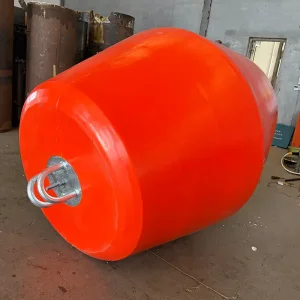
Deployed adjacent to heavy container vessel lanes. High-visibility UV stabilizers (RAL 1028 Yellow / RAL 2004 Orange) resist fading while ensuring round-the-clock channel safety. Integrated radar reflective additives and marine navigation aids can be co-molded directly into upper shells.
Tailings Disposal & Mining Extraction
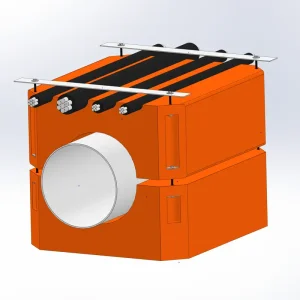
Handling dense, abrasive slurry mixtures in high-altitude or inland acidic tailings dams. Chemical-resistant virgin polyethylene shells prevent solvent degradation, while cable-trough configurations protect critical power and fiber monitoring telemetry without risk of severance.
Land Reclamation & Sand Discharging
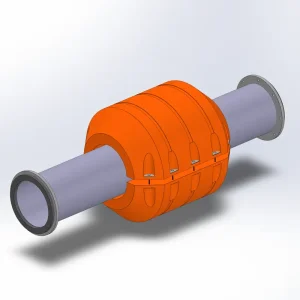
Sustained continuous pumping across multi-kilometer floating lines. Modular, stepped interlocking ribs prevent relative axial displacement along smooth HDPE pipe exteriors, avoiding slippage and pipeline snake deflections during dynamic tidal current reverses.
Reservoir Water Intake & Diversion
Protecting potable domestic reservoirs and hydroelectric turbine intakes. Polyethylene materials certified for zero leachable toxins prevent ecosystem contamination, while combined barrier floats block aquatic vegetation and surface plastic debris from penstock entry.
Localized Support & Certified Regulatory Compliance
Operational integrity requires verifiable metallurgical tests, polymer stress crack certifications, and tailored local logistics compliant with sovereign maritime mandates.
ASTM / ISO Raw Polymer Validation
Every resin batch undergoes Melt Flow Index (MFI) and Environmental Stress Crack Resistance (ESCR ASTM D1693) testing, guaranteeing extreme resistance against brittle failure under prolonged littoral flexure and wave chop conditions.
Weld-Free Monolithic Integrity
Rotational moulding yields unified, single-piece, stress-free hollow shells without structural seam vulnerabilities. High-density rigid polyurethane foam filling creates a 100% closed-cell interior, eliminating the risk of sinking even if puncture occurs during rough transport.
Custom Heavy Hardware Integration
Supplied fastening arrays include zinc-plated high-tensile hardware, hot-dip galvanized sets, or 316-grade stainless steel assemblies. Custom anti-loosening rubber cushions prevent pipeline chafing and thermal expansion pinching over multi-year deployments.
Global Export Logistics Engineering
Direct export configurations designed for maximum 40HQ container space utilization. Nesting geometries reduce sea freight surcharges, backed by direct harbor-side documentation, customs transit declarations, and full inspection certifications.
Engineering Roadmap: The Next Generation of Marine Buoyancy
Bridging traditional rotational moulding with sensor telemetry, circular manufacturing methods, and hyper-resilient nanocomposites.
IoT-Enabled Dynamic Telemetry
Co-molding of internal low-power RF and satellite transducers tracking real-time buoyancy degradation, localized tilt angle, dynamic pipeline bend strain, and positional shift on dredging lines.
Graphene-Enhanced Skin Shells
Incorporation of functionalized carbon nanomaterials into polyethylene matrices to drastically enhance abrasion resistance during violent littoral seabed grounding and rocky surf scrapes.
Bio-Polyol Injection Systems
Pioneering fully recyclable polyurethane foam formulations utilizing plant-based polyols without compromising closed-cell buoyancy density or compressive hydro-pressure ratings.
Robotic Continuous Molding
Deployment of next-gen variable-frequency robotic rotational moulding cells guaranteeing micrometer-level shell uniformities and zero internal residual shrinkage stresses.
Frequently Asked Questions: Industrial Procurement & Engineering
Essential guidance covering hydrodynamic calculations, material selections, and turnkey OEM/ODM quotations.
What are the primary mechanical benefits of polyethylene floats over fabricated steel pontoons?
Polyethylene pipe floats manufactured via rotational moulding are non-corrosive, highly resilient to UV exposure and seawater salts, and will not dent or rupture under wave-induced slamming. Unlike steel floats, which require sandblasting, protective paint recoating, and sacrificial zinc anodes, poly floats require zero routine maintenance and are lightweight for reduced installation craneage.
How do you determine the correct pipeline float sizing and spacing intervals?
Float calculation is based on the submerged weight of the pipe, fittings, and internal media at peak operating specific gravity (slurry density), factored with a mandatory reserve buoyancy coefficient between 1.20 and 1.30. Spacing is customized to match pipe stiffness (SDR rating) to avoid concentrated point loads and mid-span line deflection between neighboring float modules.
Are your flotation modules resilient against closed-cell core water penetration if outer shells are breached?
Yes. The hollow interior cavity of our float shells is injected with high-density polyurethane closed-cell foam (≥ 92% to 95% closed-cell content). In the rare event of localized shell abrasion, puncture, or deep structural gouging from marine debris, the internal closed-cell structure completely halts capillary water ingress, ensuring ongoing positive buoyancy.
What documentation is required to generate an instant, definitive ODM quotation?
To provide a turnkey ODM quotation, please supply: outer pipe diameter (OD) and material (HDPE, steel, or rubber hose), pumped medium density (kg/m³), environmental conditions (river, harbor, or offshore swell), required operational freeboard height, cable trough routing requirements, and destination seaport for optimized container layout calculation.
What warranty policy applies to offshore marine pipeline floats?
Standard warranty begins upon product handover to the site investor, extending 18 months from official handover or 12 months from final pipeline installation and commissioning, whichever comes first. This warranty covers material integrity, rotational shell weld-free stability, and core retention under normal specified operating envelopes.
Specialized Marine Flotation, Mooring & Conveyance Systems
Explore our extended series of deepwater pipeline support structures, high-visibility marine navigation markers, and rugged industrial slurry pipelines.