
Integrated Flotation Modules & Mooring Ensembles
Advanced pontoon configurations engineered to withstand dynamic hydrodynamic loads, cyclic fatigue, and hyper-saline oceanic environments.

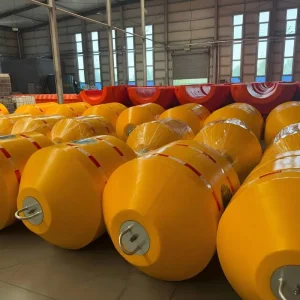
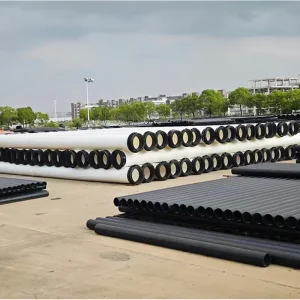
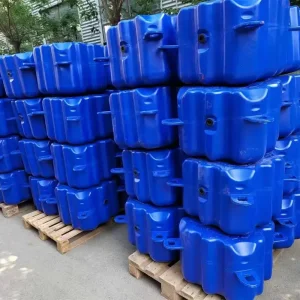

Global Industrial Status & Polymer Flotation Engineering
Evaluating the macroscopic transition from legacy steel assemblies to high-density rotomoulded polyethylene (HDPE) pontoon architectures.
Across the international marine, mining, and dredging logistics sectors, floating infrastructure has historically struggled against electrochemical oxidation, premature shell fracturing, and catastrophic micro-fissuring induced by cyclic UV exposure. The contemporary industry has pivoted decisively towards rotationally moulded High-Density Polyethylene (HDPE) and Linear Low-Density Polyethylene (LLDPE) cellular pontoon architectures.
The Macroscopic Industrial Shift: Overcoming Galvanic Deterioration
In high-salinity oceanic environments, traditional steel pontoon solutions suffer significant maintenance liabilities. Even high-tier marine coatings experience osmotic blistering and galvanic corrosion, which demand frequent dry-dock recertification and costly cathodic protection programs. Conversely, rotomoulded polyethylene pontoons leverage closed-cell structural configurations that possess total non-corrosive chemical inertness. Saturated with high-concentration carbon-black additives or hindered amine light stabilizers (HALS), our polymer matrices actively mitigate photo-oxidative degradation for operational lifespans exceeding 25 years under high-UV solar radiation.
Chemical & Saline Inertness
Zero electrolytic or galvanic corrosion. Fully resistant to severe hydrochloric, alkaline, petroleum, and marine micro-organism exposure without structural thinning or delamination.
High-Energy Impact Dampening
The high molecular ductility of PE absorbs excessive mechanical shock loads from marine vessel berthing, workboat collisions, and hydraulic surges without plastic rupture.
Closed-Cell Foam Stabilization
Pontoons are pressure-injected with high-density polyurethane (PU) closed-cell foam. Even if the outer shell experiences severe punctures, water ingress remains at 0%.
Buoyancy Modeling & Sizing Protocols
A systematic design methodology to prevent underwater subsidence, overcome dynamic pipe weight fluctuations, and safeguard freeboard margins.
Where C_reserve represents the structural safety factor, calibrated strictly between 1.25 and 1.35 (delivering 25% to 35% net reserve buoyancy above operational equilibrium). Calculations must assume the conveying pipe is completely filled with high-density slurry rather than pure fresh water.
Hydrodynamic Freeboard Targets
Proper sizing must maintain 25% to 33% of the floating assembly's vertical diameter above the mean dynamic waterline to prevent hydrodynamic drag and vortex shedding.
Slurry Density Deviations
Standard water calculates at 1.0 t/m³, while active dredging slurries fluctuate between 1.3 and 1.8 t/m³. Calculating buoyancy for clean water guarantees field failure.
Torque Retention & Clamping
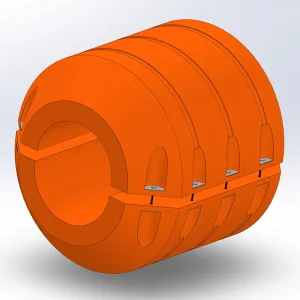
Precision-moulded clamp inner surfaces maintain non-slip retention on HDPE or steel carrier pipes, mitigating longitudinal displacement caused by hydrodynamic currents.
Localized Applications & Macro-Engineering Solutions
Turnkey buoyancy implementations for severe, capital-intensive marine civil works, resource extraction, and public infrastructure projects.
Offshore Renewable Energy Support
Buoyancy foundations for floating photovoltaic (FPV) platforms, wave-attenuation breakwaters, and dynamic subsea cable protection architectures in challenging coastal waters.
Tailings & Mining Slurry Lines
Heavy-duty containment arrays in acidic or alkaline tailings lagoons, preventing submerged line failure and facilitating safe pipeline repositioning without plant downtime.
Port Expansion & Capital Dredging
High-discharge velocity pontoon couplings for deep-water port deepening, navigation channel maintenance, and coastal reclamation transport pipelines.
Aquaculture & Mariculture Rigs
Sanitary, non-toxic, biofouling-resistant floating perimeter booms and feeding pipe pontoons, meeting stringent international marine environmental protection standards.
Municipal Security & Debris Booms
Hydrodynamic trash intercept barriers and reservoir security lines designed to deflect fast-moving debris, microplastics, and unauthorized vessels at hydroelectric intakes.
Temporary Industrial Bypass Lines
Rapid-deployment modular bypass pontoons for municipal wastewater relocations, cooling water channel servicing, and flood mitigation water transport.
Engineering Roadmap & Next-Gen Polymer Science
How automation, sensory telemetry, and sustainable polymer matrices are shaping the next generation of industrial flotation.
Smart Sensor & IoT Telemetry
Integration of self-powered LoRaWAN and satellite load-cell stress sensors directly within the pontoon matrix to monitor real-time buoyancy loss, tilting, and mooring line tension.
Circular Bio-Polymer Formulation
R&D into cross-linked closed-loop recyclables and bio-derived polyolefin matrices, reducing the overall cradle-to-gate carbon footprint without sacrificing UV stability or mechanical tensile strength.
Multi-Cavity Co-Axial Moulding
Automated variable-thickness rotomoulding algorithms that deposit reinforced high-density polymer layers precisely along high-stress clamping flanges and impact zones.
Specialized Floatation & Hydrodynamic Barrier Systems
Explore our specialized range of pipeline float modules, pollution barriers, and high-stability mooring buoys.


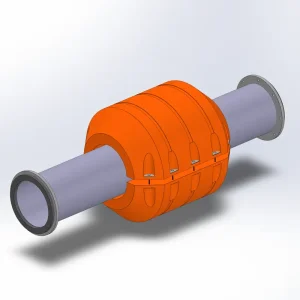

Engineering Inquiries & Technical Clarifications
Direct answers covering material properties, buoyancy verification, international warranties, and custom ODM manufacturing.