High-Integrity Pipeline & Subsea Cable Buoyancy Modules
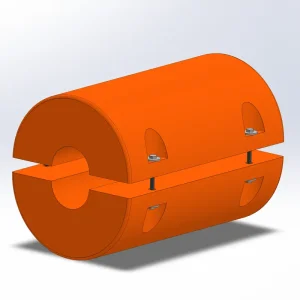
Precision-molded outer polyethylene shells with internal high-density closed-cell polyurethane cores, customized clamp configurations, and streamlined hydrodynamic geometry for demanding open-sea conditions.



Strategic Trajectory of Subsea Cable Floats & Umbilical Systems
The rapid acceleration of floating offshore wind (FOW), trans-oceanic interconnectors, and high-voltage direct current (HVDC) installations has revolutionized the functional criteria for subsea cable flotation from simple surface buoyancy to high-precision hydrodynamic wave absorbers.
Floating Offshore Wind (FOW) S-Wave Configuration
Unlike fixed-bottom monopile wind turbines, floating substructures continuously displace due to wave action, tidal heave, and 100-year storm surges. Subsea cable floats are engineered into distributed buoyancy modules (DBM) creating Lazy-S or Wave-shaped riser profiles that decouple vessel motions from seabed touch-down zones (TDZ).
- Absorbs cyclical fatigue stresses over 25+ years
- Maintains cable minimum bend radius (MBR) limit
- Prevents seabed trenching friction and abrasion wear
Ultra-Deep Hydrostatic Resistance
As subsea projects plunge into bathymetric depths from shallow 30-meter harbor dredging to 1,500+ meters subsea umbilical installations, float construction has shifted toward multi-layered virgin PE matrices and high-density syntactic micro-balloon foam cores that withstand relentless hydrostatic crushing pressure.
- Zero water absorption under sustained hydrostatic load
- Engineered yield against long-term polymer creep
- Rotational moulding with uniform cross-sectional density
Specialized Trough & Clamp Integration
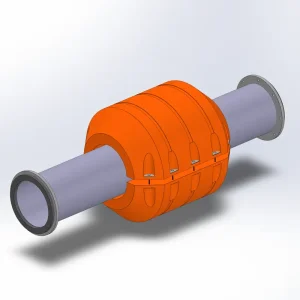
Modern subsea cable installation mandates dual-purpose or multi-conduit support bodies. Specialized pipe floats equipped with dedicated cable troughs allow offshore operators to lay heavy slurry or discharge lines while simultaneously securing electrical feed lines and fiber-optic communication cables safely alongside.
- Integrated cable trough channels eliminate tangling
- Non-marking elastomeric internal liners protect sheath
- Titanium & 316L stainless steel fastener clamping
Strategic Sourcing & Rigorous Technical Evaluation
Global EPC contractors, offshore wind operators, and marine dredging consortiums evaluate subsea flotation systems against stringent failure-mode analyses. Our ODM factory provides verified data sheets and full traceability to guarantee risk-free subsea installations.
1. Material Purity & UV-C Resistance
Low-grade regrind plastics suffer rapid photodegradation and embrittlement under intense tropical or offshore UV exposure. Tier-1 buyers demand virgin rotational-molding polyethylene (LMDPE/HDPE) compounded with Class 8 UV inhibitors, ensuring crack resistance and impact durability exceeding 15 to 25 operational years.
- 100% virgin polyethylene resin batch certification
- No environmental stress cracking (ESCR > 1,000 hrs)
- Immune to bio-fouling and chemical hydrocarbon attack
2. Hydrodynamic Form & Axial Retention
When subsea cables endure high current velocities, poorly clamped floats can slip longitudinally along the cable or induce excessive Vortex-Induced Vibrations (VIV). Procurement specifications mandate custom elastomeric internal gripping pads coupled with hydro-dynamically shaped hemispherical ends.
- Calibrated slip resistance under dynamic axial loading
- Torque-verified stainless steel bolt-on clamping hardware
- Low drag coefficient ($C_d$) profile to limit hydrodynamic wake
3. Complete Interchangeability & Sizing Precision
Field installations cannot tolerate variance in clamping bolt pitch or dimensional runout. Juhua's continuous rotational molding production lines leverage digital variable-frequency speed controls and electronic automatic thermal telemetry to maintain micro-tolerance uniformity across thousands of production modules.
- Exact matching to project pipe and cable outer diameters (OD)
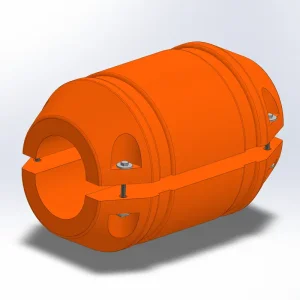
- Interchangeable split-body half-shell design
- Certified buoyancy margins with factory test logs
Turnkey Macro Solutions for Offshore & Dredging Infrastructures
A single failure on a subsea umbilical or discharge line can halt operations costing tens of thousands of dollars per hour. Our systems are engineered as holistic assemblies, integrating pipeline, floats, hoses, and cable carriers into a unified marine asset.
Port & Deep-Channel Dredging Lines
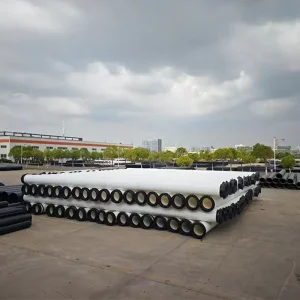
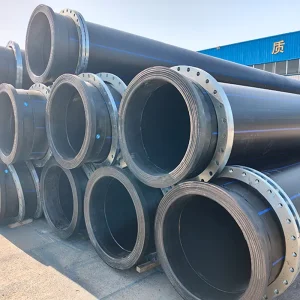
Harbor deepening and berth expansions require high-volume discharge pipelines operating in heavy swell and high vessel density. Our pipe floats ensure maximum freeboard, keeping lines stable and prominently visible to commercial maritime navigation while buoy markers keep shipping channels clear.
Subsea Dynamic Tie-Ins & Risers
During underwater pipe connection and subsea spool tie-in operations, controlled buoyancy is crucial to counter negative submerged weights. Our staged buoyancy tie-in floats allow ROVs and divers to maneuver heavy steel and composite lines into connection flanges with sub-millimeter precision.
Dredge Slurry with Integrated Cables
Cutter suction dredgers require massive three-phase electrical power and real-time instrumentation telemetry routed along the floating discharge pipeline. Pipe floats equipped with custom cable troughs physically isolate and safeguard power cables from abrasive mechanical slurry impacts.
Mining Tailings & Impoundment Safety
Mining decant operations demand slurry buoyancy capable of handling high-density tailings (up to 1.6–1.8 t/m³). Juhua's custom buoyancy sizing prevents line submergence, while integrated floating containment barriers prevent surface oil, trash, and silt spread in tailings ponds.
| Installation Parameter | Engineering Standard Requirement | Juhua Factory Specification | Quality Verification Protocol |
|---|---|---|---|
| Outer Shell Polymer | Virgin LMDPE / HDPE, UV-8 Stabilized | High-Grade LMDPE with 12–16mm Nominal Wall | ASTM D1693 ESCR Testing > 1,000 hrs |
| Internal Buoyancy Foam | Closed-Cell Polyurethane / Syntactic Matrix | $\ge 35\text{–}45\,\text{kg/m}^3$ Closed-Cell PU Core | Hydrostatic Water Absorption < 1.0% by Vol |
| Reserve Buoyancy Safety Factor | Minimum +20% to +30% above operational weight | Calculated at 1.25x – 1.35x Operating Slurry Mass | Calibrated Hydrometer & Load-Cell Immersion Tests |
| Fastener Metallurgy | ISO 3506-1 A4 Marine Grade Stainless Steel | Grade 316 / 316L Stainless Steel with Nyloc Nuts | ASTM B117 1,000-Hour Salt Spray Certification |
| Submerged Service Warranty | Standard International EPC Handover | 18 Months Post-Handover / 12 Months In-Service | Full Certificate of Conformance (CoC) & Serial ID |
International Compliance & Localized Technical Assurance
Exporting to more than 80 countries requires unwavering adherence to maritime certifications and frictionless logistics execution. From the port of Qingdao directly to projects across Europe, the Middle East, Southeast Asia, and the Americas.
API 17L & DNV Marine Compliance
Our subsea cable float design methodologies and manufacturing processes align with the strict guidelines of API Spec 17L1 (Specification for Flexible Pipe and Cable Ancillary Equipment) and DNV-ST-F119 for marine cables, ensuring that bending restrictors, flotation shells, and clamping bands satisfy rigorous offshore structural criteria.
Optimized Export Packaging Logistics
Volumetric freight efficiency directly governs project total landing cost. Our nesting float geometries, precision palletization methods, and container utilization software ensure that container stowage (20GP, 40HQ, 45HQ) achieves maximum payload density without compromising shell structural integrity during transit.
Direct On-Site Technical Deployment
We supply step-by-step engineering installation manuals, bolt-torque sequence schematics, and digital freeboard calculation tools. When critical tie-ins or major offshore dredging mobilizations take place, our bilingual application engineers offer real-time tele-engineering support and on-site oversight.
Next-Generation Subsea Flotation & AI IoT Telemetry
The horizon of subsea infrastructure demands smart buoyancy systems that not only provide static Archimedean upward force, but actively monitor operational stresses, water ingress, and mooring stability.
IoT-Enabled Smart Float Telemetry
Developing prototype integrated MEMS accelerometers and RF-acoustic modems embedded directly within rotational molded shells. These modules allow offshore operators to monitor cable tilt angles, dynamic bending cycles, and ambient water temperature in real-time, feeding digital twin models of offshore wind farms.
Bio-Circular Polyethylene Matrices
Committed to international Net-Zero maritime initiatives, Juhua is formulating bio-circular rotational molding polymers derived from renewable feedstocks. These novel composites maintain identical mechanical tensile strength and crack resistance while reducing the carbon footprint of marine flotation units by up to 40%.
Ultra-Compact Syntactic Cores
Advancing deepwater micro-balloon hollow glass sphere synthesis to expand operational depth thresholds from 500 meters down to 2,000+ meters subsea. These next-generation syntactic blocks offer high strength-to-weight ratios, ensuring buoyant performance under multi-megapascal hydrostatic pressures.
Frequently Asked Technical & Procurement Questions
Authoritative responses derived from over two decades of rotational molding and subsea flotation manufacturing.
What is the definitive buoyancy sizing equation for floating pipelines and cables?
Total net buoyancy must always factor in operational conditions rather than empty pipes. The engineering formula is: Total Float Buoyancy ≥ (W_pipe/cable + W_slurry/fluid + W_hardware) × Safety Factor (1.20 to 1.30). Sizing for an operating slurry density of 1.3 to 1.6 t/m³ guarantees that approximately 25% of the pipe/cable diameter remains comfortably above the waterline (freeboard), mitigating submerged dynamic shock and wave drag.
Why is rotomolded polyethylene superior to welded steel pontoons in marine environments?
Polyethylene (PE) never rusts, pits, or suffers electrolytic galvanic corrosion in saltwater. Unlike steel floats, which require sandblasting, epoxy recoating, and cathodic sacrificial anodes, rotomolded PE floats are self-lubricating, resilient to high kinetic impacts, and maintain full integrity across pH extremes (1 to 14). In the event of an outer puncture, closed-cell polyurethane foam prevents water ingress, eliminating catastrophic sinking risks.
How do pipe floats with cable troughs safeguard electrical cables?
Pipe floats with dedicated cable troughs feature external molded longitudinal channels that house high-voltage electric power feeds, hydraulic control lines, or fiber-optic umbilical conduits. The lines are securely seated below flush level, avoiding pinching against dredge pipe flanges, preventing entanglement in winches, and protecting cables from surface marine debris and sun exposure.
What is the standard warranty coverage and service lifespan of Juhua floats?
Our standard commercial warranty extends for 18 months from the date of cargo handover to the project investor, or 12 months from the active installation date, whichever milestone arrives first. Due to our automated rotational molding heating curves and UV-8 compounding, our flotation shells consistently achieve a real-world field lifespan exceeding 15 to 20 years in harsh marine and coastal environments.
Can internal clamp diameters be customized for non-standard cable outer diameters?
Yes. Through in-house CNC mold manufacturing, we engineer internal clam-shell diameters to match exact cable, umbilical, or pipeline specifications ranging from small 50mm dynamic cables up to 1,400mm major discharge pipelines. Custom vulcanized neoprene or EPDM elastomeric liners are added to provide precise friction coefficients without indenting sensitive outer cable jackets.
What documentation and test certificates accompany export shipments?
Every export consignment from Shandong Binzhou Juhua is accompanied by a comprehensive Quality Dossier, including: Raw Material Virgin PE Certificate of Analysis (CoA), Foam Core Density Verification Log, Hydrostatic Compression Test Reports, Dimension Inspection Sheets, and ISO 9001/14001 Quality System Documentation. Third-party inspections (SGS, BV, DNV) are routinely accommodated.
Need a Tailored Hydrodynamic Buoyancy Analysis?
Submit your cable outer diameter, submerged weight, and water depth for factory-direct buoyancy calculations.
Engineered Marine Flotation, Pipelines & Mooring Buoys
Heavy-duty rotational molded configurations engineered for maximum durability across ports, open-sea waterways, river terminals, and underwater pipeline connections.