Precision Engineering Solutions
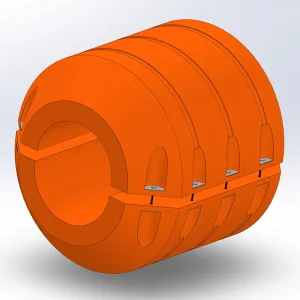
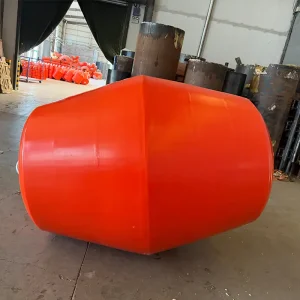
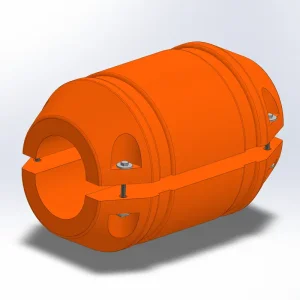
Primary Floating Pipeline & Buoyancy Modules
Turnkey offshore flotation systems engineered for heavy mining slurry, deepwater dredging, and subsea tie-in deployments.
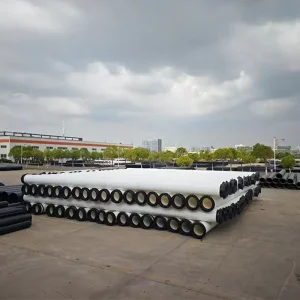
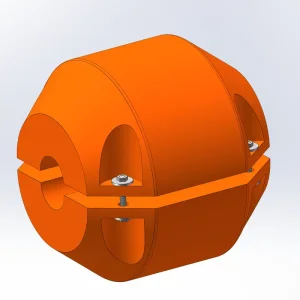

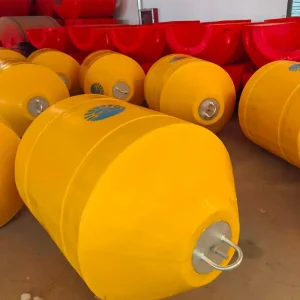

20+
Years Flotation Manufacturing
80+
Countries & Regions Served
100+
Specialized Engineers & Techs
100%
Virgin High-Grade Polymers
Global Industrial Landscape
The Global Demand for High-Integrity Floating Pipelines
From deepwater land reclamation across the Middle East to active lithium and copper tailings management in Latin America, floating pipeline infrastructure forms the lifeline of modern hydraulic engineering.
Port & Coastal Expansion
Megaprojects require dredging discharge lines running continuously in harsh coastal conditions. Traditional metal pontoons suffer severe galvanic corrosion and structural fatigue, accelerating the worldwide transition to rotomolded UV-stabilized virgin PE flotation systems.
Tailings & Slurry Transport
Dense industrial slurries (specific gravity > 1.35) exert extreme loads on pipeline walls and buoyancy modules. Engineered polyurethane-filled shells provide fail-safe buoyancy, preventing sudden pipe sinking even if outer hulls suffer puncture by jagged rocks.
Operational OPEX Reduction
EPC contractors face strict downtime penalties. Utilizing seamless rotational-molded pipeline floats with interchangeable shells slashes demobilization and repositioning labor costs by over 40% compared to cumbersome welded steel drums.
Engineering Authority & E-E-A-T
Buoyancy Dynamics & Structural Sizing Criteria
A rigorous hydrodynamic analysis to prevent premature line sagging, hydrodynamic drag oscillation, and fatigue failure.
Critical Engineering Rule
The Slurry Operational Buoyancy Formula
One of the most frequent specification oversights in floating pipeline projects is calculating module volume against an empty HDPE pipe or pure freshwater weight. In production slurry environments, specific density and hydrodynamic impact demand an engineering reserve safety factor of 1.2 to 1.3.
Total Float Buoyancy (F_b) ≥ [ W_pipe + (π × (ID/2)² × L × ρ_slurry) + W_hardware ] × Safety Factor (1.20 - 1.30)
Target Freeboard
Design maintaining 25% to 30% of total pipeline outer diameter above water plane to accommodate tidal heave.
Closed-Cell Core
High-density polyurethane core (≥ 35 kg/m³) ensures < 1% water absorption under prolonged hydrostatic pressure.
Stress Distribution
Internal anti-slip ribbing contours accurately lock onto HDPE, steel, or rubber hoses without inducing localized hoop stress.
Torque Retention
Galvanized Grade 8.8 or 316 Stainless fasteners paired with nylon locknuts resist continuous marine cyclic vibration.
Manufacturing Superiority
Chinese OEM Factory Resilience & Production Scale
Integrating raw material compounding, automated rotational moulding, and computerized quality control in Shandong Binzhou.
Advanced VFD Rotational Moulding
Our workshop utilizes computer-synchronized variable-frequency speed control and multi-point electronic temperature sensors. This guarantees homogeneous wall thickness across all quadrant curves, avoiding weak pinch points typical of manual moulding.
Raw Polymer Traceability
We strictly utilize 100% virgin linear low/high-density polyethylene (LLDPE/HDPE) compounded with premium carbon black and anti-UV stabilizers (UV8-UV16 index). Every production run delivers verified tensile strength (≥ 21 MPa) and impact resilience.
Turnkey Supply Integration
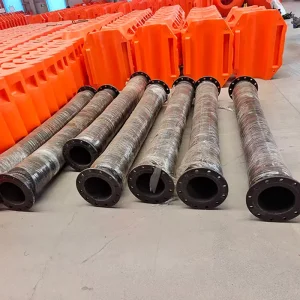
Unlike simple pontoon shops, we manufacture the entire marine transport train: matching rotational-molded floats, wear-resistant dredge pipelines, suction/discharge rubber hoses, subsea tie-in clamps, and mooring markers in a unified shipment.
Global Deployments
Localized Engineering Applications Around the Globe
Demonstrated performance across divergent water salinity, thermal variances, and hydraulic velocities.
Middle East Port Expansion
Deployment: Gulf reclamation channels facing 48°C ambient heat and high salinity. Specialized UV16 polyethylene resists blistering and thermal warpage over multi-year dredging cycles.
Andean Copper Tailings Line
Deployment: High-altitude mineral waste discharge with extreme diurnal temperature fluctuations (-15°C to +25°C). Highly flexible polyethylene shells accommodate aggressive thermal pipe expansion.
Southeast Asia River Desilting
Deployment: Fast-current river basins with heavy vegetative debris. Smooth streamlined outer contours minimize hydro-drag and avoid floating debris entanglement along the discharge string.
Offshore Intake & Outfall Lines
Deployment: Modular subsea tie-in buoyancy assemblies used during controlled pipe sinking, positioning, and diver lock-in during municipal desalination outfall projects.
Innovation Roadmap
Technological Evolution & Sustainable Buoyancy Engineering
Continuous investment into bio-polymer circularity, IoT load monitoring, and ultra-deepwater syntactic flotation.
Phase 1 • Material Science
Cross-Linked Hybrid PE
Deploying advanced nano-clay blended polymers that enhance abrasive puncture resistance by 35% without adding module tare weight.
Phase 2 • Smart Sensing
Integrated IoT Telemetry
Internal buoyancy-chamber load sensors transmitting draft depth, internal moisture, and tilt via LoRaWAN/Satellite back to harbor command centers.
Phase 3 • Deepwater Tech
Syntactic Foam Matrix
Engineered hollow glass microsphere syntactic foam cores engineered to withstand hydro-pressures down to 500 meters for deep subsea tie-in ops.
Phase 4 • Circularity
100% Recyclable Marine Pontoons
Full closed-loop buyback and remanufacturing programs reducing lifecycle carbon footprint for international marine infrastructure contractors.
Reliability & Risk Mitigation
Localized Support, Standards & Quality Compliance
Engineered to international maritime and pipeline safety regulations, ensuring total site compliance.
Testing & Certifications
Manufactured under strict ISO 9001, ISO 14001, and ISO 45001 management protocols. Materials conform to ASTM D1693 environmental stress crack resistance (ESCR) and ASTM D638 tensile testing criteria.
- Bureau Veritas / SGS inspection supported
- Full raw material batch traceability sheets
Logistics & Nesting Efficiency
Pipeline float semicircular shells are dimensionally engineered to nest tightly inside standard 40ft High Cube containers. This cuts international ocean freight rates by up to 300% per pipeline meter compared to rigid drums.
- Port-ready palletized & banded packaging
- Complete fastener kits pre-sorted per assembly
Standardized Commercial Warranty
We stand fully behind our structural integrity. The standard factory warranty commences when the client transfers equipment to the project investor, concluding 18 months from delivery or 12 months post-installation.
- 24-Hour response for engineering inquiries
- Emergency spare float batches dispatched rapidly
Knowledge Base
Frequently Asked Technical & Commercial Questions
In-depth responses authored by senior marine flotation project engineers.
What is the standard lifetime expectancy of PE floating pipeline modules?
Under severe marine conditions (tropical UV exposure and high salinity), our virgin polyethylene shells with UV8+ stabilization typically deliver an operational lifespan of 10 to 15 years. Unlike steel pontoon systems, polyethylene is completely inert to electrolytic corrosion and chemical attack from acidic tailings.
How do you calculate the exact number of floats required for a slurry line?
Float requirement is derived from the total combined operational load. We calculate: Float Count = [Total Pipeline Weight (Pipe + Slurry + Couplings)] × Safety Factor (1.2 to 1.3) divided by the Net Buoyancy of a single float set. This ensures approximately 25% of the pipe diameter remains visible above the water surface to resist rolling and submersion during pump start-up shock waves.
Can you customize floats for pipelines carrying electrical cables or hydraulic lines?
Yes. We design and mould customized pipeline floats with built-in cable troughs running alongside the inner perimeter. This enables power cables, instrumentation wiring, or hydraulic umbilical lines to run directly along the top or side of the floating slurry pipe securely clamped and protected from snagging.
What happens if the outer polyethylene shell gets punctured by floating debris?
Our pipeline floats are filled with high-density polyurethane (PU) closed-cell foam (≥ 35 kg/m³). Because the microscopic cell structure is completely closed, water cannot migrate through the core even if the exterior wall is gouged or cracked. The unit retains more than 98% of its original buoyancy rating.
What technical data is required to receive an engineering proposal and quote?
Please provide: (1) Pipe Outer Diameter (OD) and material (HDPE/Steel/Rubber); (2) Pipe wall thickness or SDR rating; (3) Specific gravity or density of the pumped slurry/medium; (4) Total pipeline running length; (5) Environmental water conditions (wave height, river velocity); and (6) Target destination seaport.
Complete System Catalog
Marine Flotation, Barriers & Mooring Portfolio
Fully compatible buoys, containment booms, and tie-in assemblies for all dredging and industrial outfalls.