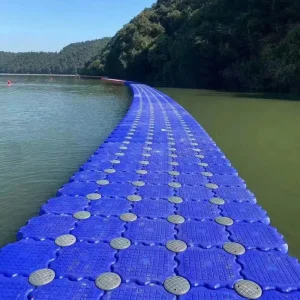
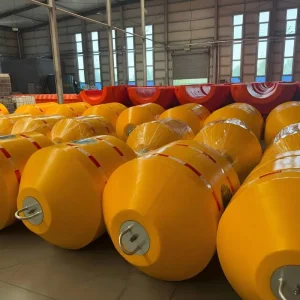
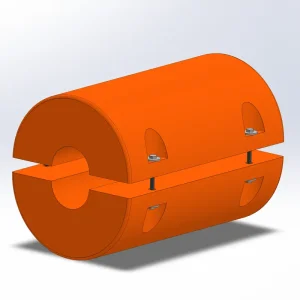
Heavy-Duty OEM Marine & Dredging Solutions
Explore our foundational rotomolded polyethylene lineup built with uniform wall thickness, marine-grade closed-cell polyurethane cores, and corrosion-resistant fasteners.



Evolving Procurement Needs in Global Offshore Infrastructure
From shallow coastal fairway widening to deep-water mineral reclamation and oilfield subsea tie-ins, global engineering procurement requires rigorous lifecycle resilience and strict metallurgical compatibility.
Aggressive Saline & Chemical Resistance
Traditional coated-steel buoyancy collars suffer rapid pitting corrosion in tropical coastal conditions. Engineering procurement officers are prioritizing rotationally molded linear low-density polyethylene (LLDPE) infused with hindered amine light stabilizers (HALS), eliminating cathodic degradation and chemical erosion completely.
Slurry Sloshing Dynamics & Wave Shear
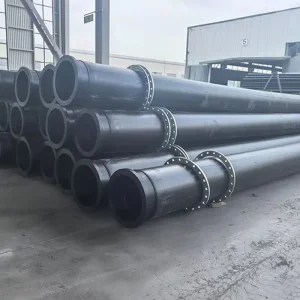
Dredging pipelines conveying gravel, iron sands, or mining tailing slurries (specific gravity 1.3 to 1.8 t/m³) exhibit high moment inertia during cyclic offshore waves. Procurement demands engineered clamp channels with anti-slip rib architectures that dissipate circumferential shear forces directly to the conduit casing.
Severe Oceanic Microclimatic Aging
Offshore infrastructure deployed across the Middle East, Southeast Asia, and Australasia confronts intense solar radiation combined with elevated water temperatures. Modern EPC tenders enforce UV8-to-UV15 polyethylene formulations certified under ASTM D2565 to guarantee 15+ years of tensile retention without embrittlement.
Integrated Macro Flotation Engineering Framework
A high-performance offshore discharge pipeline is never an isolated asset. It represents an interconnected system where hydrodynamics, anchoring mechanics, flotation reserve, and hose flexibility work in unison.
Port & Navigation Channel Deepening
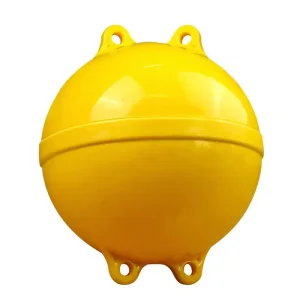
Continuous capital dredging requires rapid modular repositioning. Our interlocking float collars provide rapid bolt-on detachment, high visibility orange/yellow pigments conforming to IALA navigational standards, and optimized draft depths that safeguard passing container vessels.
Subsea Tie-In & Deep Sea Pipeline Installation
Subsea tie-in demands precision engineered buoyancy modules with graduated ballast compartments. Rather than sudden displacement, our staged-buoyancy modules enable controlled acoustic lowering and precise alignment of subsea manifolds and steel spools without seabed impact shocks.
Industrial Tailings Disposal & Water Intake
Discharge of high-salinity brine from desalination plants and mining effluent ponds necessitates chemically inert hulls. Juhua's thick-wall rotomolded polyethylene shells resist aggressive acids, abrasive grit slurries, and biological fouling without structural degradation.
Marine Engineering Best Practice: Buoyancy Sizing Mechanics
The cardinal error in pipeline flotation design is sizing solely for dry pipe or clear water. Slurry density, internal fluid friction head, dynamic wave acceleration, and biofouling accumulation must be integrated into finite freeboard margins.
Where ρ_slurry denotes real-time maximum mixture density (often reaching 1,650 kg/m³ in trailing suction hopper dredgers), ID is pipeline internal diameter, and SF is our recommended safety factor guaranteeing a minimum 25% pipeline diameter clear above the still-water datum line.
Next-Generation Flotation: The Engineering Trajectory
As offshore infrastructure pushes into deeper waters and harshest climatic zones, our research and development framework advances toward smart monitoring, advanced polymeric alloys, and circular manufacturing.
IoT-Enabled Sensory Buoyancy Monitoring
Integrating wireless ultrasonic draft sensors and micro-strain gauges within the core polyurethane matrix to deliver real-time load displacement, slurry density shifts, and freeboard safety warnings directly to dredger bridge SCADA systems.
Cross-Linked Polyolefin Syntactic Cores
Pioneering closed-cell polyolefin and syntactic micro-balloon foam matrices capable of resisting hydrostatic compressive deformation at depths exceeding 200 meters for offshore hydrocarbon gathering lines.
100% Recyclable Marine-Grade Polymer Alloys
Developing ultra-high molecular weight polyethylene (UHMWPE) hybrid matrices containing zero ozone-depleting blowing agents, driving closed-loop recyclability at end-of-commissioning without compromising impact rupture resistance.
Global Regulatory Conformance & Project Localization
Operating across international waters demands seamless alignment with maritime registries, environmental protections, and site-specific civil engineering mandates.
Material Purity & Marine Non-Toxicity
Rotomolded virgin polyethylene shells certified to FDA/RoHS environmental leach standards, preventing micro-pollutants and heavy metal release in marine nature reserves.
Automated Infrared Pyrometry
Variable-frequency rotational molding cycles coupled with electronic multi-point thermal monitoring eliminate wall-thinning defects and localized internal stress risers.
Interchangeable Spare Precision
CNC-machined tooling ensures identical bolt-hole pitch and inner curvature profiles, allowing seamless replacement half-modules to mate perfectly with deployed lines.
Offshore Pipe Flotation Engineering & Procurement FAQ
Comprehensive technical clarity on manufacturing parameters, buoyancy calculation methodologies, installation protocols, and lifecycle assurance.
What are the core advantages of polyethylene pipe floats over traditional steel floats?
How do you calculate the precise number and spacing of pipe floats needed?
What parameters are essential when requesting an accurate OEM quote?
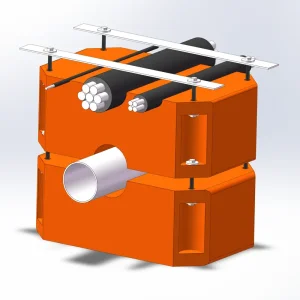
How are cables, hydraulic hoses, and warning lights integrated safely?
What is Juhua's standard commercial and technical warranty framework?
Can your facility fabricate custom rotomolded buoyant parts to drawings?
Specialized Floating Modules & Moorings
Complete project coverage: auxiliary pipeline floats, subsea tie-in collars, and industrial workboat mooring terminals engineered for rigorous multi-year marine service.