High-Efficiency Marine Flotation Systems (Batch 01)
Engineered for high-abrasion sediment dredging, offshore hydraulic disposal, port maintenance, and subsea tie-ins across challenging maritime zones.



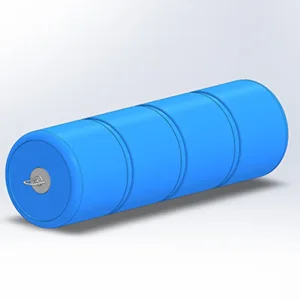
Global Dredging Demands & Commercial Flotation Dynamics
Strategic maritime logistics, environmental desilting, and mega-scale coastal reclamation have fundamentally shifted modern dredging procurement from generic components to precision-engineered OEM buoyancy solutions.
The Evolution of Marine Pipe Dredging Sourcing
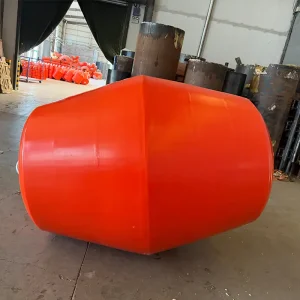
Historically, dredging contractors relied on welded steel pontoons or rudimentary improvised metal barrels to suspend sediment discharge conduits. In saltwater environments, corrosive galvanic breakdown, weld-seam fatigue under cyclic wave action, and massive deadweight created catastrophic sinking hazards. Today, global EPC engineering firms and Tier-1 dredging operators (including DEME, Jan De Nul, Boskalis, and Van Oord) mandate rotomolded linear low-density polyethylene (LLDPE) floats filled with closed-cell polyurethane (PU) foam.
As deep-water fairway navigation channels expand to accommodate mega-container vessels exceeding 24,000 TEU, hydraulic slurry transport distances now routinely exceed 5 to 15 kilometers offshore. Consequently, floating discharge pipelines experience immense torsional stress, requiring modular buoyancy systems with strict dimensional tolerances and certified buoyancy reserves.
Total Cost of Ownership (TCO) vs. Initial OEM Quotes
When procurement officers request dredging quotes, analyzing Capex in isolation frequently leads to project-derailing oversights. A low-grade float shell lacking certified UV inhibitors (such as UV8 to UV20 stabilization) or manufactured with reprocessed polymer scrap experiences rapid environmental stress cracking (ESCR) within 6 to 12 months under tropical insolation.
Unplanned pipeline sinking results in slurry clogs, pump impeller cavitation, emergency offshore work stoppages, and catastrophic environmental fines. Premium OEM pipe floats from Shandong Binzhou Juhua Rubber & Plastic Co., Ltd. offer an operational service life spanning 8 to 15 years, reducing pipeline lifecycle Opex by up to 42% through interchangeable clamp designs, marine-grade hot-dip galvanized hardware, and crack-resistant rotomolded architecture.
End-to-End Solutions Across Five Industrial Sectors
Every marine environment exhibits unique hydrodynamic challenges. Our OEM flotation systems are tailored to the precise specific gravity, velocity, and wave regimens of your site.
Port & Harbor Capital Dredging
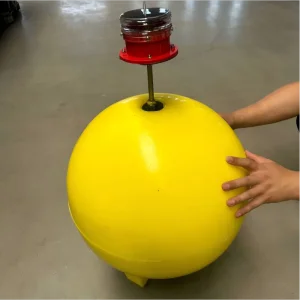
Continuous basin maintenance and fairway deepening require floating pipelines that maintain rigid alignment despite tidal flux and wake turbulence from commercial vessel traffic. Our high-visibility safety orange shells paired with IALA-compliant navigation buoys secure operational waterways.
Coastal Land Reclamation
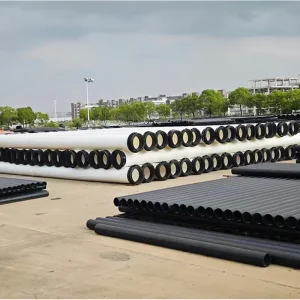
Long-distance hydraulic sand filling requires massive HDPE pipeline strings conveying dense coarse sands ($>1.6\text{ t/m}^3$). Juhua floats provide calibrated excess reserve buoyancy (25% to 35%) ensuring continuous offshore discharge without risk of pipeline swamping under surging surf conditions.
Inland River Desilting & Flood Control
Shallow river channels, silted reservoirs, and environmental wetlands present unpredictable currents and sharp bends. Lightweight two-half clamp floats allow rapid field assembly and minimal draft, preventing grounding on shallow mudflats while transferring organic silt.
Mining Tailings & Slurry Transport
Conveying acidic or alkaline mineral tailings across settling ponds destroys traditional materials. Our rotational molded PE shells are completely chemically inert (pH 1–14), resisting abrasive tailing slurry spills and offering integrated cable troughs for submerged pump power feeds.
Municipal Water Intake & Hydro Dams
Protection of hydroelectric penstocks, drinking water intakes, and municipal facilities from debris, surface pollutants, and floating silt. Modular floating containment barriers and high-density floating balls deliver 24/7 physical security and environmental containment.
Custom OEM Pontoon & Marine ODM
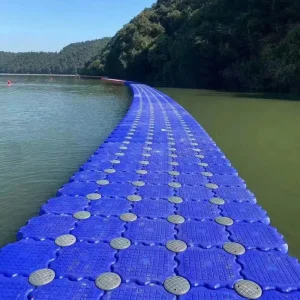
Need bespoke subsea tie-in buoyancy modules, floating workboat docks, solar aquaculture pontoons, or high-load offshore monitoring platforms? Our CAD/CAM mold tooling and CNC rotational ovens manufacture custom configurations directly from customer blueprints.
Engineering Sizing Framework: Buoyancy & Slurry Dynamics
Avoid pipeline swamping and catastrophic fatigue failure. Our senior naval architects calculate exact displacement requirements accounting for dynamic slurry densities and wave loads.
The Safety Margin Paradigm
The most prevalent failure mode in international dredging operations is calculating float displacement based on an empty pipe or clean freshwater. When cutter suction dredgers (CSD) or trailing suction hopper dredgers (TSHD) pump abrasive sediment, the conveyed slurry specific gravity frequently jumps from $1.0\text{ t/m}^3$ to $1.5\text{–}1.8\text{ t/m}^3$.
Under these heavy slurry conditions, a marginal buoyancy ratio causes the pipeline to ride dangerously low in the water. High breaking waves then exert crushing hydrodynamic down-force, submerging the pipe, increasing bend radius curvature beyond allowable limits, and snapping pipeline flanges or rubber hoses.
Juhua Engineering Standard: Always apply a safety factor ($SF$) of 1.25 to 1.30 over the gross loaded pipeline weight, maintaining approximately 25% of the outer float shell above the static waterline for optimal freeboard and visibility.
B_total ≥ (W_pipe + W_slurry + W_hardware) × SF
- B_total: Net buoyant displacement generated by paired float modules (kgf or kN).
- W_pipe: Weight per meter of the empty conduit (HDPE, steel, or armored rubber).
- W_slurry: Operating mass: $\pi \times (ID/2)^2 \times \rho_{slurry} \times L$, where slurry density $\rho$ reaches up to $1,800\text{ kg/m}^3$.
- W_hardware: Weight of backing rings, flanges, joint bolts, and cable harness systems.
- SF (Safety Factor): Minimum 1.20 for calm waters; 1.30–1.35 for open marine fairways.
Precision Rotational Molding & Quality Engineering
Operating inside our modernized industrial park in Lizhuang Town, Huimin County, Binzhou, Shandong, Juhua utilizes automated temperature cycles and closed-cell polyurethane injection.
Variable-Frequency Control
Our biaxial rotational ovens use automated variable-frequency speed regulation, ensuring 100% uniform resin dispersion and homogenous wall thickness without thin corners or pinholes.
Electronic Thermal Profiling
Multi-point infrared temperature sensing tracks mold temperature curves continuously during sintering, eliminating internal thermal stresses and optimizing raw polymer tensile strength.
High-Density PU Foam Core
Every hollow chamber is filled with pressure-injected closed-cell polyurethane foam ($\ge 35\text{ kg/m}^3$). If an outer shell is punctured by sharp debris, water absorption remains under 1%, preserving buoyancy.
Modular Interchangeability
High-precision CNC aluminum tooling guarantees that every replacement half matches pipelines already in field operation, providing exact bolt-hole registration across repeat supply batches.
Optimizing Your OEM Dredging Quote: The 5-Step Path
Accelerate your procurement lead times and avoid costly redesign loops by following our structured technical intake framework.
Pipe Dimensioning
Supply pipe Outer Diameter (OD), wall thickness (SDR rating for HDPE, schedule for steel), and conduit length per section to ensure snug collar clamping.
Medium Density
Define transported slurry concentration, specific gravity ($\text{t/m}^3$), fluid viscosity, and temperature to calculate required net displacement.
Hydro Dynamics
Outline environmental conditions: maximum wave height ($H_s$), current velocity, tidal range, and exposure to open-sea swells or debris.
Hardware Selection
Specify fastening metallurgy: Class 8.8 hot-dip galvanized bolts for cost-effective marine service or AISI 316 stainless steel for hypersaline water.
Logistics & Quotes
Receive comprehensive quotation package: unit price, FOB/CIF breakdown, container nesting scheme, 3D CAD drawings, and buoyancy validation report.
Technology Roadmap: Next-Gen Dredging Flotation
Exploring advanced IoT draft telemetry, circular economy polymer formulations, and digital twin asset tracking for modern offshore dredging fleets.
IoT Telemetry & Smart Buoys
Integration of low-power LoRaWAN and satellite-enabled telemetry sensors into the buoyancy shell. Real-time monitoring of freeboard waterline, pipeline strain, GPS geofencing, and water ingress gives dredger bridge captains instantaneous alerts before pipeline sinking occurs.
Circular Economy & Bio-Polyolefins
Addressing international decarbonization and maritime microplastic regulations. Juhua is pioneering closed-loop mechanical recycling programs and trialing bio-based high-molecular-weight polyethylenes with certified equivalent environmental stress crack resistance (ESCR).
Nano-Engineered UV25+ Inhibitors
With mega-dredging projects expanding across extreme high-UV regions (the Arabian Gulf, Red Sea, and Sub-Saharan coastlines), next-generation hindered amine light stabilizers (HALS) and inorganic titanium nano-coatings guarantee zero polymer embrittlement for over 15 years.
Regulatory Compliance & Global Sourcing Assurance
Ensuring full alignment with international maritime safety codes, classification societies, and environmental governance frameworks.
PIANC & IALA Conformance
Marine navigation buoys, mooring markers, and channel aids are manufactured in strict conformance with IALA (International Association of Marine Aids to Navigation and Lighthouse Authorities) chromaticity coordinates and PIANC dredging navigation guidelines.
ASTM ESCR Material Certification
Raw materials are independently tested under ASTM D1693 for Environmental Stress Crack Resistance (ESCR > 1,000 hours), guaranteeing complete structural integrity against dynamic flex fatigue, saltwater brine, and abrasive hydraulic tailings.
Comprehensive Factory Warranty
Backed by our explicit industrial warranty: protection starts when the buyer hands over the goods to the investor and concludes 18 months post-handover or 12 months after active water installation, whichever benchmark comes first.
Frequently Asked Questions on Pipe Floats & OEM Sourcing
Clear, unvarnished engineering answers addressing procurement specifications, buoyancy physics, chemical resistance, and logistics.
What is the primary function of dredging pipe floats?
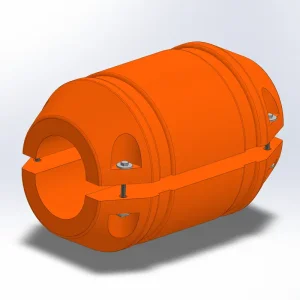
Dredging pipe floats (buoyancy modules) are clamp-on, rotomolded polyethylene bodies fitted symmetrically around discharge conduits. They maintain the pipeline's buoyancy on the water surface, preserve line alignment, minimize hydrodynamic drag, prevent conduit scouring against riverbeds or coral reefs, and provide high visibility for safe maritime traffic navigation.
How do you calculate the exact number of floats required?
Total buoyancy must exceed total load. Calculate: (1) Dry weight of the pipe, (2) Total weight of the pumped medium based on actual slurry density ($1.2\text{–}1.8\text{ t/m}^3$), (3) Weight of flanges, couplings, and accessories. Multiply this sum by a 1.20 to 1.30 safety factor. Divide this total required buoyancy by the net buoyant rating of a single paired float set to determine module quantity and spacing.
Why is rotational molded polyethylene preferred over steel pontoons?
Polyethylene never rusts, suffers zero galvanic corrosion in hypersaline water, requires no sandblasting or toxic anti-fouling coatings, and absorbs heavy kinetic impacts from service boats without permanent deformation. Furthermore, PE floats are drastically lighter, drastically reducing installation labor, transport freight, and crane rigging hazards.
What happens if the outer polyethylene shell gets punctured?
Every Juhua dredging pipe float is high-pressure injected with marine-grade closed-cell polyurethane (PU) foam. Because each cell is completely sealed and structurally independent, water cannot migrate through the core even if the shell is ruptured by sharp rocky outcroppings or boat collisions. The float retains over 98% of its buoyant capacity.
Can you customize floats for cables and hydraulic lines?
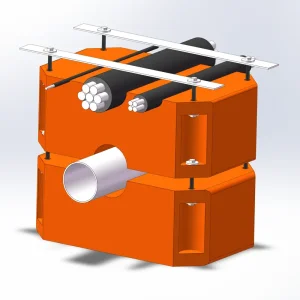
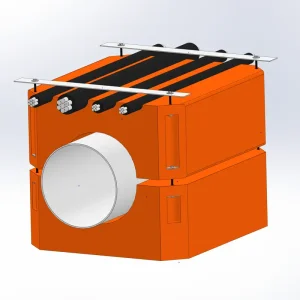
Yes. Juhua engineers and manufactures specialized floats with integrated cable troughs. These channels allow heavy submersible electric cables, communication cables, or hydraulic lines to run safely along the top or side of the floating discharge pipe, shielded from pinched bends, propeller strikes, and snag hazards.
What details are required to issue an accurate OEM quote?
To receive a finalized formal commercial quote within 24 hours, provide: (1) Pipe outer diameter (OD) and material (HDPE/Steel/Rubber), (2) Conveyed medium slurry density ($\text{g/cm}^3$ or $\text{t/m}^3$), (3) Pipeline total length and working pressure, (4) Operational location (inland lake, river, port, or offshore), (5) Preferred color/markings, and (6) Required quantity and destination port.
High-Efficiency Marine Flotation Systems (Batch 02)
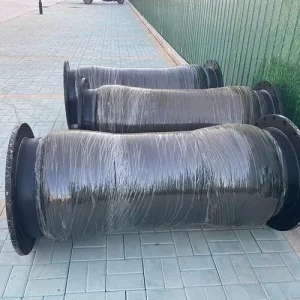
Explore heavy-duty pipelines, submersible cable trough floats, modular boat pontoon docks, and flexible rubber dredging hoses.