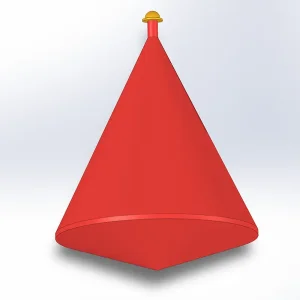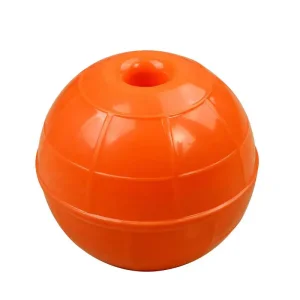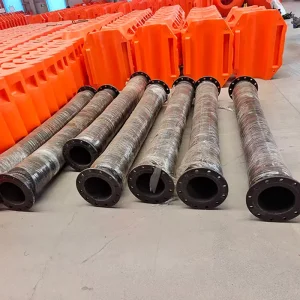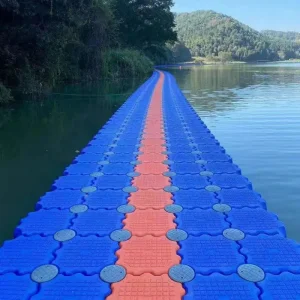
Heavy-Duty Pipeline Floats, Subsea Modules & Mooring Buoys
High-molecular-weight UV-stabilized virgin polyethylene floating components, rotationally cast with uniform wall thickness and filled with closed-cell polyurethane foam for zero water ingress under deep hydrodynamic loads.
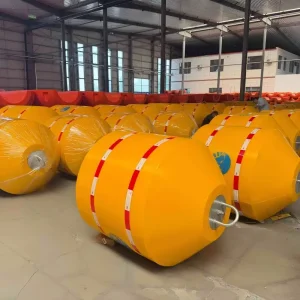
The Global Industrial Landscape of "Plastic That Floats"
In modern marine civil engineering, dredging, and offshore resource extraction, metallic pontoons have been systematically phased out. Corrosion fatigue, catastrophic pitting in saline conditions, excessive tare weight, and costly cathodic maintenance cycles have driven an irreversible shift toward rotationally molded high-grade thermoplastic polymers.
Why Polymer Specific Gravity Dictates Operational Longevity
The term "plastic that floats" references an engineered family of polyolefins—primarily Linear Low-Density Polyethylene (LLDPE) and High-Density Polyethylene (HDPE)—having a base polymer specific gravity ranging between 0.935 and 0.955 g/cm³. Because fresh water has a specific gravity of 1.000 g/cm³ and typical seawater averages 1.025 g/cm³, these polymers naturally float even before incorporating internal air or cellular foam matrices.
However, raw material flotation alone is insufficient for heavy industrial duty. When supporting pressurized steel, HDPE slurry pipelines, electrical transmission umbilical cords, or navigation markers, the shell must withstand continuous flexural fatigue, hydrodynamic vortex-induced vibrations (VIV), chemical leaching from mining tailings, and severe ultraviolet degradation.
E-E-A-T Technical Benchmark: Shandong Binzhou Juhua Rubber & Plastic Co., Ltd. incorporates masterbatch blends compounded with UV-8 to UV-16 Hindered Amine Light Stabilizers (HALS) and minimum 2.5% dispersed furnace carbon black or titanium dioxide pigments, ensuring compliance with ASTM D2565 xenon-arc weathering exceeding 20,000 continuous hours without environmental stress crack (ESC) failure.
| Polymer Type | Density (g/cm³) | Impact Resistance | Seawater Resistance | Primary Application |
|---|---|---|---|---|
| Rotomolded LLDPE | 0.935 - 0.942 | Exceptional | Impervious (No Rust) | Pipeline Floats, Navigation Buoys |
| Blow-Molded HDPE | 0.945 - 0.960 | Moderate | Impervious | Lightweight Demarcation, Aquaculture |
| Engineered ABS | 1.030 - 1.070 | High (Rigid) | Good (Non-Saline) | Water Metering Balls, Valves |
| Expanded PU (Core) | 0.035 - 0.045 | Cushioning Support | Closed-Cell Hydrophobic | Internal Safety Buoyancy Core |
| Carbon Steel (Legacy) | 7.850 | High (Deforms) | Severe Pitting / Rust | Obsolete Floats / Pontoon Tanks |
China Factory Efficiency: The Binzhou Rotomolding Advantage
How advanced tooling automation, vertically integrated compound sourcing, and rapid mold cavity fabrication establish unprecedented cost-per-liter buoyancy performance for Tier-1 marine engineering contractors.
Variable-Frequency Multi-Axis Rotomolding
Our production bays feature multi-arm, independent turret rotational molding machines equipped with multi-zone variable-frequency speed controls. This ensures dynamic bi-axial rotational control (major/minor ratio adjustments), yielding seamless one-piece hollow structures completely free of weak weld seams or residual parting lines.
Electronic Dynamic Thermal Monitoring
Unlike conventional small-scale molders relying on manual timer guesswork, Juhua utilizes real-time non-contact infrared pyrometers and internal air temperature (PIAT) telemetry inside the rotating mold cavity. This controls polymer fusion, suppresses crystalline voids, and guarantees uniform wall thickness across radical curvature zones.
In-House Tooling & Mold CNC Machining
With an integrated casting and CNC tooling division, Juhua develops custom pipeline diameter molds (ranging from outer diameters of 110mm up to 1200mm+) within 10 to 14 business days. This agility slashes OEM design iterations and reduces procurement time for international EPC engineering tenders.
Dual-Component Polyurethane Core Injection
Every industrial float body undergoes pressurized high-pressure automated reaction injection molding (RIM) of closed-cell polyisocyanurate / polyurethane foam. In the rare event of puncture from high-energy marine debris or dredger anchors, water absorption remains under 1.5% by volume, ensuring complete buoyancy security.
Batch Interchangeability Engineering
Our strict mold locking clamps, precision CNC trunnions, and dimensional calibration fixtures guarantee that float halves produced today match seamlessly with units delivered five years ago. This eliminates assembly headaches, bolt alignment slippage, and downtime on remote reclamation barges.
Localized Application Scenarios: Where Polymer Flotation Thrives
From sub-zero Canadian mining tailings to the ultra-saline Arabian Gulf, Juhua rotomolded products are purpose-built to withstand severe hydro-mechanical stressors across diverse sectors.
Capital Marine Dredging & Land Reclamation
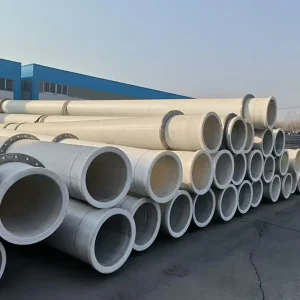
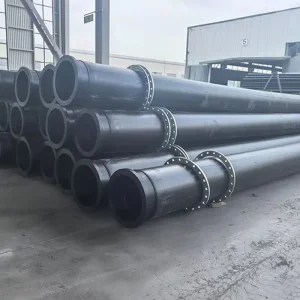
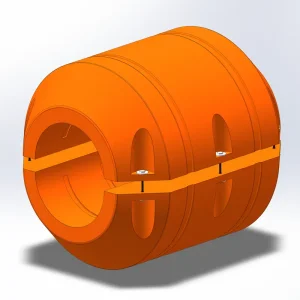
Traversing high sand slurry densities (1.3 to 1.6 t/m³) through discharge pipelines requires precisely engineered buoyancy module spacing. Our floats incorporate internal non-slip ribbing that clamps securely around HDPE or steel discharge pipes, preventing longitudinal migration during violent tidal surge cycles.
Tailings Disposal & Chemical Process Ponds
Mining operations in copper, gold, and lithium processing handle aggressive leaching chemicals with extreme pH values (pH 1.5 to 13.0). Polyethylene's chemically inert nature prevents embrittlement, wall thinning, and corrosive failure common with welded alloy barrels.
Hydroelectric Dams & Debris Trash Booms
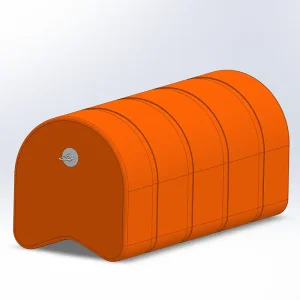
Water intakes at hydroelectric turbines require heavy-duty floating barriers to deflect timber, urban refuse, and vegetative rafts. Linked via galvanized or stainless Grade 316 chains, our modular cylindrical float barriers absorb dynamic floating impact energy without cracking.
Offshore Wind & Subsea Umbilical Tie-Ins
Subsea cable installation requires staged buoyancy to maintain S-curve bending radius limits during cable laying. Our custom tie-in floats clamp safely over subsea electrical conduits and fiber optic umbilicals, providing stable hydrodynamic lift down to specified deployment depths.
Floating Solar FPV & Modular Pontoons
The rapid expansion of Floating Photovoltaic (FPV) arrays on freshwater reservoirs demands polymer flotation structures with a 25-year service life. Our food-grade virgin PE blends ensure zero heavy metal leaching into drinking water supplies while resisting biological fouling.
Rigorous Flotation Sizing: Engineering Reserve Buoyancy
The single most dangerous failure mode on a floating discharge pipeline is undersized buoyancy. Calculating flotation modules based strictly on an empty pipe guarantees disaster the instant the line charges with high-density slurry. When sediment settles during emergency pump shutdowns, excessive line sag generates bending moments that can snap flanges or sink entire pipeline sections.
Our engineering protocol mandates calculating the Total Wet Load ($W_{total}$) under maximum anticipated slurry density, plus a safety margin factor ($K_s$) of 1.25 to 1.35.
Design Objective: Maintain 25% to 30% of the pipe diameter above the static waterline ("Freeboard"). This profile minimizes hydrodynamic drag from incoming sea waves while preventing vortex-induced pipeline rollover.
Buoyancy Calculation Formula
Key Parametric Variables:
- V_float: Outer displaced volume of the rotomolded float pair (m³)
- ρ_water: Density of operational water (Fresh: 1.0 t/m³, Marine: 1.025 t/m³)
- W_pipe: Mass of discharge pipe per linear pair spacing (kg)
- W_slurry: Full volume mass of conveyed slurry (slurry density: 1.25–1.65 t/m³)
- W_hardware: Weight of Grade 8.8 galvanized or 316SS bolts, nuts, and flanges
Global Enterprise Procurement: Critical Engineering Specifications
Procurement teams at international dredging contractors and maritime EPC conglomerates evaluate plastic flotation vendors against strict destructive and non-destructive quality benchmarks.
Wall Thickness Ultrasonic Gauging
Because rotomolded parts can experience resin thinning at sharp radius changes, Juhua executes multi-point ultrasonic non-destructive thickness testing (NDT) across outer shoulders and internal saddle recesses to verify continuous thickness compliance (typical range: 8mm to 18mm depending on float capacity).
Low-Temperature Dart Drop Testing (ARM)
Conducted in accordance with Association of Rotational Molders (ARM) impact testing protocols. Test plaques sawed from molded shells are conditioned to -40°C and subjected to heavy falling darts to verify completely ductile failure modes without shattering or micro-crack propagation.
Closed-Cell In-Situ Foam Hydrostatic Submersion
Sample core sections are subjected to hydrostatic pressure vessels simulating complete immersion. The core must exhibit greater than 92% closed-cell content, ensuring that even if an outer poly shell is breached, internal buoyancy loss remains negligible over multi-year deployments.
Technological Trajectories: Smart Buoys & Sustainable Polymers
The flotation sector is rapidly evolving from passive plastic shells into intelligent, telemetry-enabled marine monitoring assets and circular lifecycle polyolefins.
IoT Telemetry & Pipeline Tilt Sensing
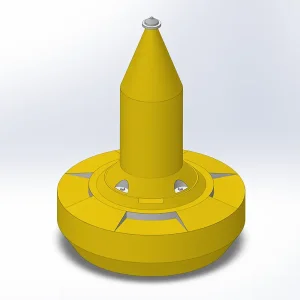
Integration of self-powered NB-IoT and LoRaWAN inclination sensors directly embedded inside rotomolded buoy cavities. Real-time telemetry detects pipeline twist, sediment choking, and structural displacement, transmitting instant alerts to dredger control bridge rooms.
Circular Economy & Ocean-Bound PCR Resins
To satisfy international ESG requirements, advanced compounding lines now co-extrude multi-layer rotomolded skins utilizing up to 40% chemically upgraded ocean-bound Post-Consumer Recycled (PCR) polyolefins in middle layers while maintaining 100% virgin polymer on outer contact shells.
Antifouling Hydrophobic Polymer Blends
Novel fluoro-polymer additive masterbatches integrated directly into molten rotomolding resin produce high-lubricity outer shells. This reduces barnacle, algae, and marine organism adhesion by up to 60%, drastically reducing offshore diver cleaning cycles.
Frequently Asked Questions: Buoyancy Sizing & OEM Sourcing
Detailed technical answers to common queries submitted by marine dredging operators, port authorities, and offshore project managers.
Industrial Pipelines, Marine Buoys & Modular Float Systems
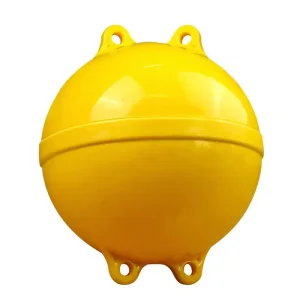
Complete integrated marine flotation hardware: heavy-duty dredging discharge lines, ABS buoyancy spheres, high-pressure flexible sediment hoses, and modular boat pontoons.