

Heavy-Duty AtoN
ODM Heavy-Duty Marine Buoys for Tokyo Bay Navigation & Offshore Safety
Immediate deployment inventory engineered to endure heavy hydrodynamic shear, high-density container traffic within the Uraga Channel, and seismic sea-state anomalies.

Tokyo Bay represents one of the world's most congested and technologically integrated maritime environments. Housing the interconnected mega-ports of Tokyo, Yokohama, Kawasaki, and Chiba (collectively comprising the Keihin Port system), the basin manages annual cargo throughput exceeding 500 million tons. Vessels navigating this corridor must negotiate the bottlenecked Uraga Channel, where over 400 commercial transits occur daily. Under such conditions, maritime aids to navigation (AtoN) cannot merely be static floating signals; they represent critical infrastructure that directly safeguards ultra-large container ships (ULCS), LNG carriers, and bustling coastal ferries from catastrophic groundings and collisions.
The procurement demands of the Tokyo Metropolitan Government's Bureau of Port and Harbor, together with the requirements enforced by the 3rd Regional Coast Guard Headquarters, mandate rigorous structural and optical reliability. Buoys positioned within Tokyo Port’s main fairways (such as the Chuo Passage and Haneda Offshore fairways) face localized environmental stresses: acute wave diffraction generated by reclaimed land walls, aggressive wake turbulence from commercial tugs and high-speed patrol craft, and high summer seawater temperatures juxtaposed against Pacific seasonal typhoons.
In compliance with Japan’s Ministry of Land, Infrastructure, Transport and Tourism (MLIT) guidelines, Aids to Navigation deployed within the Kanto coastal belt must incorporate high-tensile mooring kinematics capable of accommodating sudden ground displacement and impulsive sea-level drops associated with Nankai Trough and Tokyo inland seismic projections.
The industrial geography along Kawasaki and Chiba features substantial petrochemical, refining, and steel plant discharge zones. Navigation buoys fabricated with traditional unlined steel hulls suffer accelerated galvanic corrosion, blistering, and chemical deterioration in these sulfur- and chemical-bearing runoff waters. Consequently, the Tokyo port authority and domestic terminal concessionaires have progressively shifted specifications toward rotationally moulded virgin Linear Low-Density Polyethylene (LLDPE) incorporating UV-stabilizers (UV-8 / UV-16). Virgin polyethylene eliminates rust flakes, mitigates heavy metal leaching into vulnerable coastal ecosystems, and completely bypasses the cyclical dry-dock blast-and-paint protocols required by legacy steel buoys.
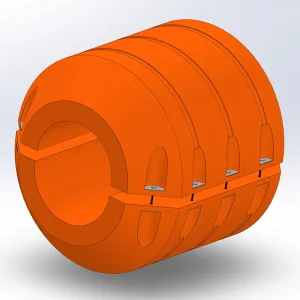
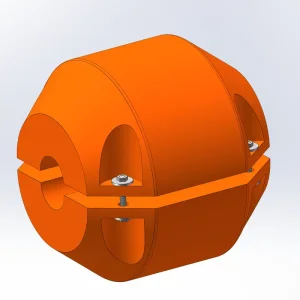
From reclamation dredge pipe stabilization to real-time telemetry marine buoys, our manufacturing capacity covers every sector of Tokyo’s marine supply chain.
Utilizing variable-frequency speed control and multi-axis electronic temperature tracing, our rotomoulded float shells maintain uniform wall thickness (12mm–18mm) with zero localized stress fractures, ensuring total structural integrity against ship impacts.
Optimized underwater hull profiles (conical and catamaran-inspired keels) minimize dynamic heel under strong tidal flows along the Arakawa River mouth and Tokyo Outer Channels, maintaining topmark lantern alignment within ±3 degrees of the vertical axis.
Customized upper superstructures integrate high-efficiency mono-crystalline solar panels sealed in marine-grade polymer cases, paired with deep-cycle LiFePO4 battery modules offering up to 25 days of continuous autonomous operation during extreme cloud cover.
Pre-engineered mounting housings accommodate Type 1 and Type 3 AIS AtoN transponders, hydrometeorological sensor packages, and NB-IoT / 4G cellular uplinks, delivering real-time positioning data directly to Tokyo Bay Vessel Traffic Service (Tokyo Wan VTS).
Even in the improbable event of puncture from high-speed debris or propeller impacts, the internal volume is completely filled with high-density polyurethane closed-cell foam, retaining 98% nominal buoyancy and preventing water ingress.
Hot-dip galvanized internal ballast steel frames (HDG to ASTM A123) distribute mooring tension directly through the central axis, preventing tensile stress fractures in the outer polymer skin during heavy typhoon swells.
Get direct-from-manufacturer pricing, custom hydrodynamic mooring calculations, and fast logistics dispatch to Yokohama, Tokyo, and Chiba ports. Talk directly with our senior flotation engineer today.
Send Inquiry Now for Tokyo QuotesLifecycle Cost Analysis (LCC), Environmental Social Governance (ESG) criteria, and automated maintenance schedules driving Tokyo port modernizations.
Historically, public port authorities in Japan leaned heavily toward steel fabricated navigation buoys due to long-standing specifications established in the mid-20th century. However, comprehensive Life Cycle Cost (LCC) modeling over a 20-year horizon reveals a decisive economic advantage for modern rotational moulded virgin polyethylene AtoN platforms. Steel buoys deployed in Tokyo Bay necessitate bi-annual or tri-annual retrieval via heavy crane vessels, expensive sandblasting, toxic biocidal antifouling repainting, and internal weld inspections.
Conversely, virgin UV-stabilised polyethylene buoys manufactured by Juhua exhibit inherently non-stick surface characteristics that inhibit rapid barnacle, macroalgae, and tubeworm adhesion. Routine maintenance is reduced to simple pressure-washing carried out directly on-station using small service craft, slashing operational expenditure (OPEX) by up to 65% over a 15-year lifecycle.
The Port of Tokyo’s Carbon Neutral Port (CNP) initiative places strict scrutiny on the carbon footprint of marine infrastructure assets. The manufacturing of rotational-moulded LLDPE requires approximately 45% less embodied energy compared to the smelting and fabrication of equivalent steel marine buoys. Furthermore, because polyethylene retains total colorfastness throughout the complete cross-section of the hull material, zero VOCs (volatile organic compounds) or toxic heavy-metal pigments leach into the aquatic habitat—a vital parameter for projects situated near Tokyo Bay's shallow tidal flats and migratory fish zones.
Modern international EPC contractors operating in East Asia increasingly require buoys that function beyond visual aids. Our specialized buoys supplied to international waterways integrate multi-parameter sensor wells for hydrological monitoring: measuring water temperature, pH, turbidity, dissolved oxygen, and current velocity. In congested shipping channels like Tokyo’s Chuo fairway, buoys equipped with AIS AtoN Transponders actively broadcast synthetic or virtual aids to navigation messages, enabling vessel electronic chart systems (ECDIS) to anticipate channel margins even in pea-soup fog or extreme sea-smoke conditions.
Anticipating maritime automation demands for Tokyo Bay from 2025 to 2035: autonomous shipping corridors, AI wave anomaly warning, and kinetic micro-generation.
Deployment of ultra-wideband (UWB) and RTK-enhanced GPS beacons on channel buoys, establishing high-accuracy reference baselines for automated, unmanned container vessel docking trials across Tokyo Bay terminals.
Integration of wave-activated internal pendulum micro-turbines alongside solar collectors, generating surplus continuous power to run high-output active radar reflectors and real-time lidar scanning modules.
Buoy-to-buoy low-latency mesh radio frequencies delivering instant, offshore tsunami detection alerts to port pilots and coastal flood barrier gates before surface anomalies reach the inner metropolitan canals.
Authoritative guidance regarding hydrodynamic calculations, mooring catenary design, seismic resilience, and customs logistics.
Our navigation buoys utilize high-density, high-impact virgin LLDPE with wall thicknesses scaled from 12mm to 18mm depending on the buoy diameter (1.2m to 3.0m). The rotational moulding process ensures a seamless, monolithic hull free of weld seams or weak points. Combined with a low center of gravity achieved through internal cast-iron or concrete ballast and a heavy internal galvanized core frame, the buoy maintains self-righting characteristics even when subjected to breaking wave action exceeding 6.5 meters and 50-knot gale winds common in Typhoon season.
All our colored polymer compounds strictly comply with the IALA Recommendation E-108 (Maritime Buoyage System - Region A, which includes Japan). Pigments are compounded directly into the virgin resin matrix during compounding—not dry-blended—ensuring zero chalking, fading, or color drift under high UV exposure. The CIE chromaticity coordinates for lateral green, lateral red, cardinal yellow/black, and special mark yellow are fully certified via spectrophotometric testing.
Mooring calculations are conducted using static and dynamic catenary equations based on local bathymetry, tidal ranges (up to 2.2m in Tokyo Bay), seabed substrate (silt, sand, or gravel), and peak 100-year storm conditions. We supply complete mooring sets including Grade U2/U3 studless or studlink anchor chains, synthetic elastomer tethers for shallow berths, sinkers (cast steel or reinforced concrete blocks), and swivel shackles rated to extreme safety factors (SF ≥ 4.5).
Yes. We offer fully integrated turnkey AtoN packages. Buoys can be pre-fitted with marine LED self-contained solar lanterns (range from 2NM to 8NM, programmable flash characters matching Tokyo Port Authority notices), internal 10m² or 20m² radar cross-section (RCS) reflectors, and pre-wired top-hat compartments for AIS AtoN transponders. Factory acceptance tests (FAT) ensure all electrical systems are IP68 sealed.
Our rotational moulded buoy hulls possess a projected operational design life of 15 to 20 years with negligible material degradation. Our standard industrial warranty covers 18 months from delivery or 12 months from on-water commissioning. In the event of hull rupture due to vessel impact, our closed-cell polyurethane foam core guarantees non-sinkability, and spare modular tower sections can be dispatched rapidly.
We provide direct shipping via containerized break-bulk or 40ft High Cube containers. Modular buoy sections (detachable towers, float bodies, and ballast systems) are designed for optimal space utilization inside standard sea containers, significantly reducing international ocean freight costs. Direct sailings to the Port of Tokyo or Port of Yokohama typically arrive within 4 to 8 days following factory dispatch.
Explore our full line of rotomoulded polyethylene solutions for fairway delineation, dredging slurry pipeline buoyancy, and offshore platform containment.

From customized rotomoulded molds to certified IALA Region A chromatic compliance, our engineering division delivers tailored solutions directly to Tokyo, Yokohama, Chiba, and global maritime facilities.