
High-Performance Marine Flotation Systems & Mooring Anchors
Engineered for offshore tie-ins, heavy-duty dredging discharge, slurry conveyance, and critical deep-water terminal moorings.




The Global Mooring Buoy Industry: Evolution, Material Science & Structural Integrity
Transitioning from Legacy Steel Hulls to High-Impact Elastic Virgin Polyethylene Shells Filled with Closed-Cell Hydrophobic Polyurethane.
In modern marine civil engineering, Single Point Mooring (SPM), Multi-Buoy Mooring (MBM), and dynamic anchor systems require uninterrupted operational longevity under high cyclical stress. For decades, port authorities, offshore EPCs, and naval facilities relied on welded steel mooring buoys. While structurally rigid, steel buoys suffer from catastrophic marine corrosion, galvanic deterioration, coating flaking, and excessive weight that complicates open-ocean anchoring logistics and regular recertification procedures.
As a specialized leader in industrial rotomolding, Shandong Binzhou Juhua Rubber & Plastic Co., Ltd. (Juhua / Giant Rubber) spearheads the technological transition to rotationally molded ultra-high molecular weight and linear low-density polyethylene (LLDPE/HDPE) buoy architectures. Engineered in our West Industrial Park facility in Lizhuang Town, Huimin County, Binzhou, our buoys combine variable-frequency speed-controlled rotational molding, multi-axis computerized furnace thermometry, and military-spec foaming cores. This creates a zero-maintenance, impact-absorbing mooring station capable of withstanding 250kN to over 2000kN breaking loads without permanent plastic deformation.
Anti-Corrosive Polymer Skin
Hydrophobic Foam Core
High-Tensile Through-Core Steel
Macro-Industry Solutions & Enterprise Procurement Archetypes
Addressing the Distinct Operational and Regulatory Demands of Offshore Terminals, Dredging Fleets, and Marine Infrastructure.
Offshore Oil & Gas Terminals
Designed for FSO, FPSO, and bunker tanker offloading terminals requiring Catenary Anchor Leg Mooring (CALM) and single-point hawser tie-ups. Engineered with Class-certified tension shackle eyes, swivel connectors, and spark-free polyurethane exterior bumpers.
Multi-Berth Port Navigation
Harbor authorities utilize Juhua modular mooring buoys to securely hold container ships and bulk carriers during transshipment and berth queueing. Bright pigmented IALA colors and integrated radar reflectors prevent harbor navigational collisions.
Floating Wind & Marine Energy
Floating offshore wind substructures and wave converter farms demand high-buoyancy cable-support buoys and anchor positioning units. Our specialized cable-trough floats integrate submarine high-voltage cable pathways with continuous static buoyancy.
Heavy Slurry & Tailings
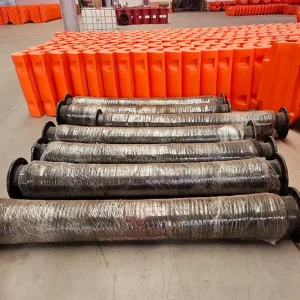
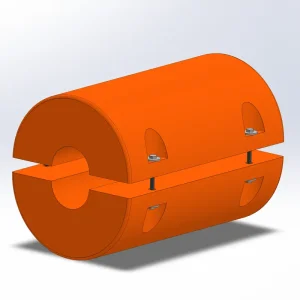
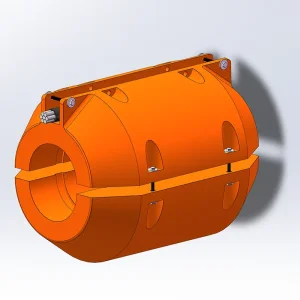
For hydraulic dredging operators and deep-sea mining contractors, discharge pipes carry abrasive iron ore tailings or coarse coral sand. Our pipe floats and tie-in positioning floats prevent pipeline flexural fatigue, maintaining designated bend radiuses.
Hydrodynamic Sizing & Reserve Buoyancy Formula
A common failure in marine mooring procurement is calculating buoy displacement purely based on quiescent deadweight. Marine mooring systems operate in non-linear dynamic states influenced by wind shear, tidal swell, current drag, and hawser snap loads.
- Dynamic Factor: Calculate for maximum wave-induced vertical acceleration (≥1.25g).
- Slurry Density: For pipelines, factor specific gravity up to 1.6 t/m³ for dense mine tailings.
- Submergence Margin: Maintain at least 25% to 33% freeboard exposure under peak operational loads.
B_net = (W_tackle + W_chain + F_downward) × SF
Where:
• B_net = Total Net Buoyancy required (kg/kN)
• W_tackle = Static weight of shackles, swivels & central core
• W_chain = Suspended catenary weight of chain tackle
• F_downward = Vertical load vector from hawser angle (θ)
• SF = Dynamic Safety Factor (1.30 to 1.50)
*Juhua's marine engineers review full hydrodynamic bathymetry datasets to deliver custom finite-element analysis (FEA) and catenary line calculations prior to tooling extrusion.
Classification Standards, Factory Auditing & Global Compliance
Every Juhua mooring buoy and pipeline float undergoes systematic metallurgical, polymeric, and pressure hydro-testing.
International Marine Directives
Tensile Proof & NDT Validation
Global Port Logistics & Packing
Technology Roadmap (2026–2035): The Era of Smart IoT Buoys
Next-generation rotational molding blends circular bio-polymers with smart marine sensor telemetry.
IoT Telemetry & Tension Sensors
Embedding low-power LoRaWAN, 4G LTE-M, and Iridium Satellite transceivers directly into the central steel member. Real-time monitoring of hawser dynamic tension, GPS geofence drift alerts, and wave acceleration profiles transmitted to terminal control centers.
Self-Powered Photovoltaic Shells
Integrating curved, high-efficiency CIGS thin-film solar laminates flush with the rotomolded polymer crown. Eliminates protruding solar brackets prone to vessel impact damage while providing continuous trickle-charge power to navigation lanterns and water sensors.
Closed-Loop Bio-PE & Non-Biocide Shells
Pioneering non-leaching micro-textured superhydrophobic polymer skins that resist barnacle, mussel, and marine algae colonization without biocides or heavy metal copper additives, satisfying stringent zero-discharge environmental zones in Arctic and protected reef areas.
Engineering Questions & Procurement Verification (FAQ)
Detailed technical answers for EPC engineering heads, procurement officers, and harbor masters.
Why is rotomolded polyethylene preferred over welded steel for mooring buoys?
Unlike structural carbon steel, rotomolded virgin polyethylene will never oxidize, rust, or corrode in harsh saline marine waters. It requires zero sandblasting, sacrificial zinc anode replacements, or toxic antifouling recoatings. Its innate elasticity allows it to deform elastically during vessel impact without rupture, protecting both ship hulls and the buoy structure.
How do you calculate required buoyancy for dredging pipelines with high slurry concentration?
Total float gross buoyancy must cover the combined submerged weight of the steel or HDPE pipe, bolted steel flanges, joint fittings, and the slurry mixture at peak design density (typically 1.3 to 1.65 t/m³). We engineer floats to deliver a reserve safety margin of 25% to 35% above the combined weight, ensuring the crown remains visible above waves to avoid submarine seabed dragging.
What is Juhua's standard international warranty and operational service life?
Juhua provides a formal warranty starting when the client hands over the goods to the project investor, concluding 18 months post-handover or 12 months after on-site commissioning, whichever occurs first. With virgin LLDPE/HDPE compounded with UV20+ stabilizers, our rotomolded flotation shells exhibit an expected field operational lifespan exceeding 15 to 20 years in open ocean marine environments.
Can you provide custom central steel tension members and load certifications?
Yes. We manufacture central tension members using Q355B or 316L stainless steel, fully hot-dip galvanized per ISO 1461. We accommodate customer-specific eyelet layouts, cross-tree designs, quick-release hooks, and swivels. Every batch can be supplied with third-party tensile proof load testing reports witnessed by classification societies (ABS, BV, CCS, or DNV).
How does Juhua maintain wall thickness uniformity across large rotomolded parts?
Our specialized factory utilizes multi-axis computer-controlled bi-axial rotational ovens equipped with multi-point infrared thermal pyrometers. By managing variable-frequency rotation speeds and staged temperature cycles, polymer powder melts and coats internal mold surfaces uniformly, eliminating the severe thin-wall stress risers common in conventional casting.
What critical technical data is needed to receive an exact quotation and drawing?
Procurement teams should provide: (1) Pipe outer diameter (OD) or required net buoyancy (kg/kN); (2) Pipe wall thickness and medium density; (3) Water body classification (protected river vs offshore dynamic breakwater); (4) Mooring load or proof load requirements (kN); (5) Topmark, color, lantern, or radar reflectivity requirements; and (6) Delivery destination port.
Pipeline Floats, Waterway Barriers & Offshore Modular Units
Rotational molding solutions tailored for long-distance water transfer, underwater power cables, and maritime containment.

Connect Directly with Juhua Marine Flotation Engineers
Bypass general trading brokers. Speak straight with our technical design team in Huimin County, Binzhou for custom buoy displacement calculations, GA drawings, FEA stress analyses, and containerized FOB/CIF quotation breakdowns within 24 hours.