

High-Quality Pipeline Float Tie-In – Modular Buoyancy Solution for Deepwater Pipelines
Request Quote
Rotationally molded virgin polyethylene flotation units with polyurethane closed-cell foam infusion. Factory direct pricing and immediate CAD dispatch.
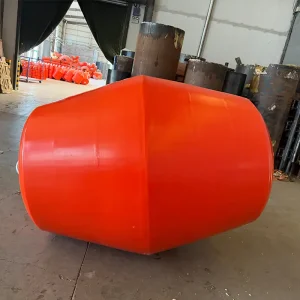

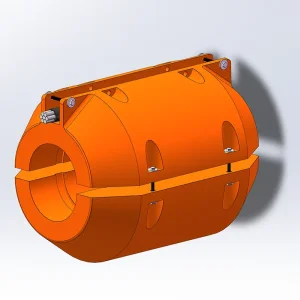

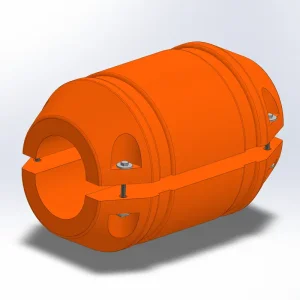

From coastal land reclamation in Southeast Asia to oil & gas offshore tie-ins in the North Sea, rotational molded polyethylene is replacing legacy steel pontoons.
Traditional steel pontoons suffer from internal pitting corrosion, heavy deadweight, and exorbitant drydock maintenance costs. Modern maritime engineering has shifted completely to Linear Low-Density Polyethylene (LLDPE) shells filled with closed-cell polyurethane foam, guaranteeing zero-rust and 30-year saltwater resistance.
Procurement teams evaluate floats based on operational longevity rather than initial unit outlay. Polyethylene floats eliminate repainting cycles, cathodic anode replacements, and environmental lead-paint flaking, reducing 10-year maritime pipeline maintenance expenditure by over 62%.
In open sea conditions, cyclic swell loads and wave refraction introduce severe torsional stress along clamp interfaces. Contemporary PE float bodies feature reinforced structural ribs, integrated anti-slip inner ribs, and marine-grade hot-dip galvanized or 316 stainless fastening arrays.
Binzhou Juhua leverages deep industrial integration in Shandong Province to compress lead times, reduce tooling amortisation, and ensure flawless batch consistency.
Equipped with modern multi-arm carousel and shuttle rotomolding machines with computerised multi-zone temperature balancing. Guarantees wall thickness tolerance within ±0.5mm across complex curvature points.
Direct supply contracts with tier-1 petrochemical producers ensure strictly virgin polymers (Sinopec / Sabic grades). In-house blending integrates anti-UV agents (UV8–UV16 rating) and carbon dispersion for non-chalking field endurance.
High-pressure, dual-component polyurethane foaming ensures a dense closed-cell micro-cellular structure (35–45 kg/m³). Even if the outer PE skin is pierced by sharp coral or metal impact, water absorption stays below 1%.
In-house CNC aluminum tooling workshop enables customized prototype mould casting in as short as 14 days, reducing new diameter or custom tie-in design gestation from months down to weeks.
Field-tested methodologies for dredging contractors, port authorities, and hydraulic infrastructure engineers.
Gold, iron ore, and copper slurry transport involves densities up to 1.6–2.1 t/m³. Calculating buoyancy based on freshwater guarantees line submersion and blowout. High-density dredging floats are calculated with reinforced reserve margins to maintain positive freeboard under peak pulp flow.
During mega port dredging, high-velocity tidal changes impart severe drift forces on high-density polyethylene (HDPE) lines. Floats with integrated cable-troughs permit power/signal line passage while hydrodynamic profiles minimize lateral anchoring drag.
Hydroelectric and municipal water storage reservoirs demand zero leachate water safety. Certified virgin food-grade PE shells guarantee zero heavy-metal release and maintain water resource integrity across extreme summer UV exposure.
Do not size pipe floats based solely on dry pipe displacement. Operating buoyancy must account for conveyed solids density, flange hardware, joint flexure, and dynamic marine sea conditions:
Total Required Buoyancy (F_buoy) = [ M_pipe + (V_internal × ρ_slurry) + M_acc ] × SF_marine
Where: M_pipe = Dry pipe weight per section; V_internal = Internal slurry volume; ρ_slurry = Specific gravity of discharge pulp (e.g. 1.4–1.8 kg/L); M_acc = Flanges, backing rings, rubber hoses, fasteners; SF_marine = Maritime Safety Factor (typically 1.25 for sheltered waters, 1.35 for open sea).
Full dimensional availability matching standard HDPE / Steel dredging pipes (OD 110mm to 1200mm).
| Pipe OD Range (mm) | Float Inner Dia (ID mm) | Outer Dia (OD mm) | Length (L mm) | Gross Buoyancy (kg) | Shell Thickness (mm) | Recommended Fasteners |
|---|---|---|---|---|---|---|
| OD 200 – 225 | 225 mm | 500 mm | 800 mm | 120 kg | 6 – 8 mm | M16 Marine Galvanized / SS316 |
| OD 315 – 355 | 355 mm | 850 mm | 1100 mm | 380 kg | 7 – 9 mm | M18 Marine Galvanized / SS316 |
| OD 450 – 500 | 500 mm | 1100 mm | 1300 mm | 780 kg | 8 – 11 mm | M20 Heavy High-Tensile |
| OD 560 – 630 | 630 mm | 1300 mm | 1600 mm | 1,350 kg | 9 – 12 mm | M22 Grade 8.8 Galvanized |
| OD 710 – 800 | 800 mm | 1600 mm | 2000 mm | 2,500 kg | 11 – 15 mm | M24 Custom Flange Array |
| OD 900 – 1000 | 1000 mm | 2000 mm | 2200 mm | 4,200 kg | 14 – 18 mm | M27 Reinforced Clamp Assembly |
What engineering consultancies, port directors, and dredge masters require in plastic flotation RFQ packages.
Top-tier tenders require raw material MTR (Material Test Reports) showing tensile strength >16 MPa and elongation at break >400%. Shell thickness ultrasonic validation, drop-impact testing at sub-zero temperatures (-20°C), and water absorption immersion logs.
International freight costs can outweigh initial production savings if packing geometry is suboptimal. Juhua engineers optimize split-body nested stacks, maximizing 40ft HQ container loading density to decrease per-unit freight charges by up to 28%.
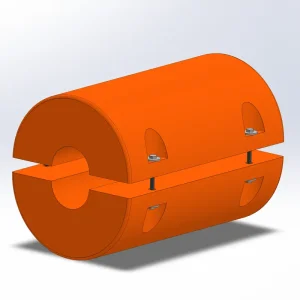
Standardized CNC tooling ensures each upper and lower half-shell is symmetrical and completely interchangeable with spares from previous production batches, eliminating on-site installation sorting downtime.
Engineered alongside our pipe floats for turnkey hydraulic dredging, water safety barriers, and floating line connections.
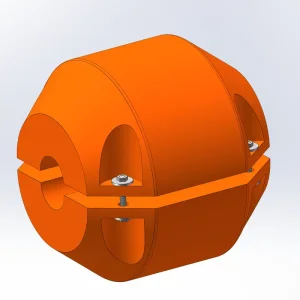


Direct engineering answers to questions raised by project engineers, naval architects, and port authority purchasers.