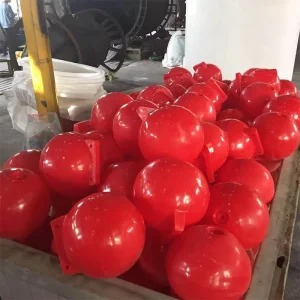
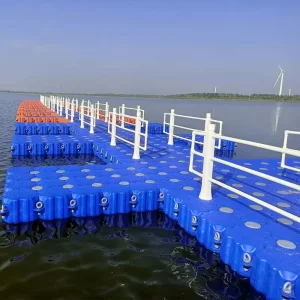
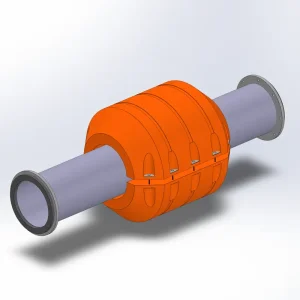
Featured Marine Buoys & Floating Assemblies
High-integrity rotomolded polyethylene floats engineered for dredging lines, marine channel marking, platform mooring, and heavy industrial water conveyance.
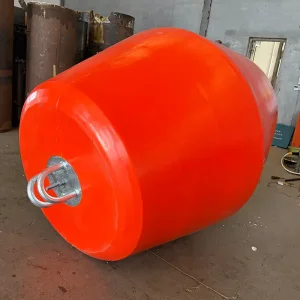


Industrial Evolution of A Floating Buoy Systems
As offshore extraction, coastal land reclamation, and renewable marine platforms expand into harsher hydrographic domains, selecting the right floating buoy supplier determines structural survivability and total lifecycle expenditure.
Shift from Welded Steel to Rotomolded PE
Historically, marine deployments relied on fabricated steel buoys. However, severe electrochemical galvanic corrosion, recurring dry-dock repainting costs, and weld-line cracking have led global operators to transition toward virgin LLDPE rotational molding. Polyethylene hulls provide complete corrosion immunity, self-pigmented IALA chromatic retention, and natural elastic recovery during berthing collisions.
Closed-Cell Hydrophobic Polyurethane Cores
A primary point of operational failure in low-grade floating pontoons is hull breaches that lead to progressive flooding. Modern offshore standards specify inner core filling using high-density closed-cell polyurethane foam (≥35-45 kg/m³). Even if the exterior PE armor suffers high-velocity impact from workboats or dredge anchors, water ingress remains localized to less than 2% of the cross-section.
Digital Telemetry & MetOcean Integration
A floating buoy supplier is no longer just a plastic mold factory; the sector is actively adopting integrated telemetry. Modern navigational and offshore aquaculture buoys must incorporate top-mounted photovoltaic generation, AIS transponders, LED lanterns, wave-height Doppler sensors, and satellite links (Iridium/4G) to relay hydrographic metrics to onshore control centers.
Global Procurement Analysis & Buoyancy Sizing
Procurement officers at international EPC firms evaluate raw material grade, wall uniformity, rotational cycle thermal parameters, and reserve buoyancy ratios.
Thermal Monitoring & Variable Frequency Molds
Inconsistent cooling across a rotomolding mold produces localized internal stress lines and non-uniform wall thickness. Juhua's computerized lines deploy infrared thermal sensors and variable-frequency rotation to maintain a tolerance within ±0.5mm across complex shapes.
- UV-Stabilized UV8/UV16 formulation
- High environmental stress crack resistance (ESCR > 1000 hrs)
Internal Steel Skeleton Integration
For mooring buoys and anchor tension nodes, tensile loads cannot rely exclusively on polymer skins. High-durability buoys feature an internal hot-dip galvanized Q235/Q355 steel framework connecting the top lifting eye directly to the bottom anchor padeye, preventing skin de-lamination.
- Certified proof load testing to 1.5x SWL
- ISO 1461 hot-dip galvanizing (≥85 μm)
Hydrodynamic Drag & Mooring Line Physics
When calculating moored stability in tidal conditions (>3 knots), the frontal drag coefficient of cylindrical versus spherical buoys determines submerged trim angle. We run simulated hydrodynamic calculations to guarantee sufficient residual freeboard under peak current shear.
- Pitch stability < 5° in open sea states
- Mooring chain catenary simulation support
Engineer's Golden Rule: Real Dynamic Buoyancy Sizing
Do not size pipeline or marine buoys on dead-weight air values. Account for slurry specific gravity, accessory cable drag, dynamic wave slamming, and target freeboard margin.
Macro Industry Solutions by Sector
Customized floating buoy assemblies engineered for varied hydrological environments, from mine tailings impoundments to open-ocean navigational routes.
Port, Harbor & Waterway Expansion
During capital dredging and berth deep-water deepening, continuous dredge slurry pipelines must remain stable while marine traffic proceeds safely. Juhua's paired pipeline floats keep discharge lines clear of the seabed while color-coded navigational markers define safe vessel channels according to IALA Region A & B guidelines.
Mining Tailings & Slurry Transport
Transferring high-density mineral slurries (specific gravity 1.3 to 1.8) across tailings impoundments requires specialized buoyancy ratios. Our reinforced pipe floats resist abrasion, tailing chemical exposure, and sub-zero freeze-thaw cycles without stress cracks, keeping transfer pipes safely afloat.
Hydroelectric Dams & Trash Debris Booms
Surface trash, plastics, and floating timber threaten turbine intakes and dam spillways. Coupled modular floating barriers form continuous safety lines, deflecting drift debris toward extraction chutes while warning recreational boats away from danger zones.
Offshore Aquaculture & Mariculture Grids
Deep-sea fish cages and mussel lines require mooring and tension floats that can withstand cyclic wave fatigues. Juhua's high-buoyancy polyethylene balls and cylindrical buoys provide steady buoyancy that prevents fish cages from collapsing during storm surges.
Subsea Pipeline Tie-In & Installation
Lowering or towing steel pipelines onto coastal sea floors requires controlled buoyancy relief. Project-engineered pipeline float tie-in units provide calculated negative or positive buoyancy margins during deployment, easing subsea pipe laying before detachment.
Modular Floating Pontoons & Workstations
From floating solar PV farms to mobile pump stations and temporary industrial floating walkways, our rotomolded pontoons provide stable, non-slip footing with resistance to chemicals, petroleum lubricants, and marine biofouling.
Quality Control & Global Compliance Framework
Rigorous manufacturing standards protect high-capital maritime projects against unexpected downtime and early equipment failure.
Material Authenticity & Testing
Every batch of raw PE powder is verified for melt flow index (MFI), density, and carbon black/pigment dispersion. Standardized drop-impact testing at -20°C ensures brittle fracture resistance in arctic dredging environments.
Compliance With IALA E-108
Our navigation buoys align with international maritime standards, including IALA chromaticity tolerances for daylight visibility and night-time retroreflection, helping offshore terminal managers meet maritime authority requirements.
Export Packing & Site Support
Standardized nested packing maximizes ocean container utilization (20GP, 40HQ, 40OT), while dedicated logistics documentation—including certificate of origin, raw material test certificates, and bolt torque tables—ensures swift customs clearance.
Flotation Technology Roadmap & Horizon
Developing next-generation buoyancy assets designed for harsh offshore environments, circular lifecycle demands, and remote connectivity.
Graphene-Enhanced Polymers
Integrating nano-graphene additives into PE matrix shells to improve puncture resistance by 40% while reducing total structural weight for rapid deployment.
100% Recycled Ocean Resins
Qualifying post-consumer marine plastics into rotational compounds without sacrificing tensile strength or UV stability, helping ports achieve lower Scope 3 carbon metrics.
Embedded Smart Buoy IOT
Molding stress and strain sensors directly into polyethylene walls to provide continuous warnings for loose bolts, internal dampness, or extreme current loads.
Kinetic Wave Self-Charging
Building micro-piezoelectric wave generation directly into internal buoy structures to power lanterns and radios during extended cloudy seasons without battery swaps.
Frequently Asked Questions
Answers to common engineering, procurement, and field assembly inquiries from port engineers and dredging contractors.
What are pipeline floats, and what is their primary working function?
How do I calculate the exact number and buoyancy rating of floats required?
Are polyethylene (PE) buoys better than traditional welded steel buoys?
What is the standard warranty period for Juhua marine flotation products?
What technical data is needed to receive a custom quote?
Can flotation dimensions, mooring eyes, and color schemes be customized?
Explore Complete Offshore Buoyancy Systems
Heavy-duty pipeline flotation, coastal navigation buoys, and mooring platforms built for multi-year marine service.