Featured Marine Flotation & Dredge Pipe Floaters
Field-proven rotomolded polyethylene dredge pontoons, pipeline floats, and mooring assemblies tailored to rigorous hydrodynamic requirements.

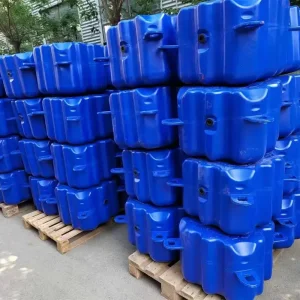
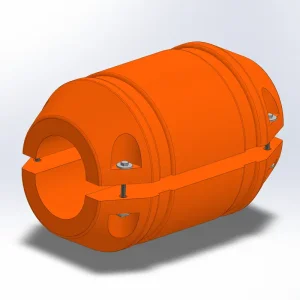


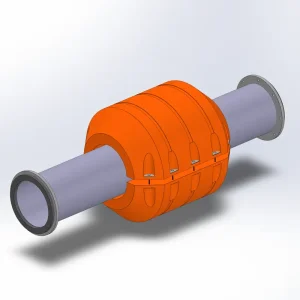
Global Slurry Pipeline Flotation Dynamics & Operational Realities
Examining the operational physics, multi-phase fluid dynamics, and environmental forces governing slurry pipeline performance in harsh maritime and open-pit mining environments.
Hydrodynamic Slurry Loading
Unlike water discharge, slurry transfer involves multi-phase dense solid-liquid mixtures with specific gravities frequently reaching 1.3 to 1.8 SG. Our high-density polyethylene (HDPE) pontoons are calibrated precisely to manage cyclic fluid surges, dampening wave resonance and preventing flexural stress fatigue on bolted pipe flanges.
Closed-Cell Polyurethane Core
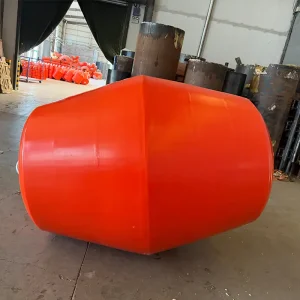
Each hollow rotomolded shell is injected under controlled thermal environments with high-density, closed-cell polyurethane (PU) foam (≥35-45 kg/m³). Even in the rare event of puncture from debris or vessel collision, water absorption remains under 1%, guaranteeing zero loss of pipeline reserve buoyancy.
UV & Saltwater Passivation
Manufactured from premium virgin high-grade polyethylene enriched with UV stabilizers (UV8 to UV16 grade) and anti-aging agents. The non-corrosive shell is totally immune to extreme salinity, acidic tailings ponds, micro-organism encrustation, and aggressive chemical runoffs found in hard-rock mineral extraction.
Slurry Pipe Float Sizing & Hydrostatic Buoyancy Rules
Empirical formulation parameters applied by offshore dredging superintendents and tailings transport engineers to ensure pipeline stability.
The Core Calculation Rule
The cardinal error in pipeline flotation design is calculating buoyancy solely against pure water. A dredge slurry pipe contains high-viscosity sands, iron ore silt, or bauxite tailings, generating elevated gravitational moments.
Total Net Buoyancy ≥ [W(pipe) + W(slurry) + W(accessories)] × 1.25 to 1.35
Engineering recommendations require keeping approximately 25% to 30% of the pipe diameter (freeboard) continuously above the water level. This prevents wave sloshing over the line, minimizing submerged hydrodynamic drag and protecting internal cable trays from tension stress.
Rotomolding Consistency & Fitment
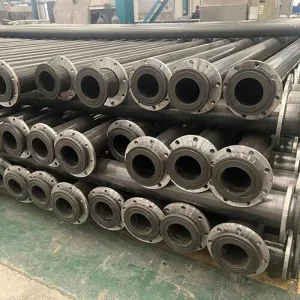
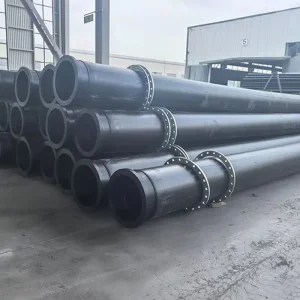
Standardized mold tolerances guarantee consistent inner curvature matched to actual steel, HDPE, or ultra-high-molecular-weight polyethylene (UHMWPE) pipe outside diameters (OD). Utilizing electronic variable-frequency speed regulation and digital infrared multi-point heat sensors during rotational curing, wall thickness remains perfectly uniform without cold-weld points or internal stress cracking.
Reinforced perimeter ribs distribute radial compression force evenly across high-tensile hot-dip galvanized or stainless steel fasteners, ensuring no slippage occurs during high-thrust pump cycles.
| Float OD / Length Range | Applicable Pipe OD | Nominal Net Buoyancy (Pair) | Primary Industrial Domain |
|---|---|---|---|
| ∅500mm × 800mm | 110mm – 160mm | 110 kg – 180 kg | Agricultural intake lines, reservoir decanting, pontoon bypass |
| ∅900mm × 1200mm | 250mm – 315mm | 480 kg – 650 kg | Sand suction dredging, industrial effluent transfer, tailings dewatering |
| ∅1400mm × 1800mm | 450mm – 560mm | 1,400 kg – 2,200 kg | Harbor capital deepening, gold/copper tailings tailings disposal lines |
| ∅2200mm × 2500mm | 710mm – 1000mm | 5,500 kg – 9,800 kg | Offshore mega-reclamation, trailing suction hopper dredgers (TSHD) |
Macro Solutions Across Core Industrial Verticals
From harsh sub-zero Canadian oil sands to hyper-saline Middle Eastern reclamation lagoons, Juhua slurry pipe floaters operate under extreme conditions.
Port & Deepwater Harbor Expansion
Supporting high-volume cutter suction dredge (CSD) lines during berth dredging and waterway deepening. Units integrated with marine navigation markers maintain safe fairways for merchant ship traffic while maintaining continuous discharge.
Mining Tailings Dam Management
Deployed in copper, bauxite, iron, and coal processing ponds where abrasive tailings must be delivered smoothly to containment cells. Acid- and alkali-resistant polyethylene skin avoids structural oxidation common in steel pontoons.
Municipal Desilting & Ecological Restoration
Enabling river channel clean-up, urban lake de-sludging, and flood-control retention pond sediment extraction without damaging delicate shoreline ecosystems or disrupting seasonal aquatic life.
Next-Generation Smart Flotation Technologies
Anticipating maritime trends: from embedded telemetry and automated draft detection to circular polymer sustainability.
Phase 1: Sensor-Integrated Smart Floats
Integrating real-time IoT strain gauges, hydrostatic draft sensors, and satellite GPS beacons directly into molded float bodies. Dredging masters monitor slurry clogging or line submersion risks instantaneously via SCADA systems.
Phase 2: Bio-Circular Polymers
Developing molecularly enhanced cross-linked PE compounded with ocean-recycled plastics, ensuring zero environmental microplastic shedding while retaining high Shore D hardness and Charpy impact resistance.
Phase 3: Quick-Lock Modular Couplings
Replacing traditional zinc-plated bolts with heavy-duty interlocking polymer hinge-pins and snap-clamp locking mechanisms, shrinking pipeline offshore assembly and teardown times by upwards of 40%.
Frequently Asked Questions for Project Engineers
Detailed engineering answers regarding calculation methodology, materials compliance, dynamic conditions, and warranty protection.
What are pipeline floats, and what is their operational mechanism?
How do I calculate how many floats are required for my pipeline?
Are rotomolded polyethylene floats fully suitable for seawater duty?
What is the comprehensive warranty coverage and service lifespan?
What exact operational parameters are needed for engineering sizing?
Can float assemblies, buoys, and fasteners be fully customized?
Subsea Mooring, Heavy Pipelines & Industrial Marine Equipment
Comprehensive fluid conveyance lines, marine mooring buoys, and heavy-duty wear-resistant pipelines manufactured to international standards.