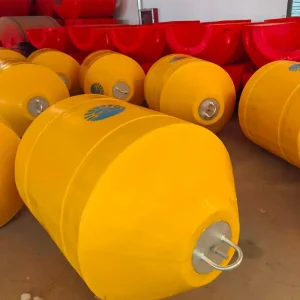
High-Performance Dredge Floats & Mooring Components
Engineered for high-shear hydrodynamic stability, UV50+ marine durability, and seamless dimensional interchangeability across global pipeline deployments.
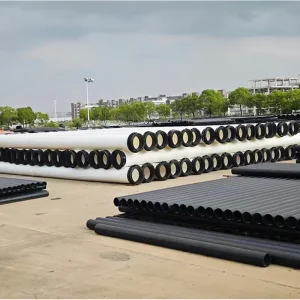


Macro Dynamics of Dredging Flotation & Marine Operations
Evolving coastal restoration demands, port megaprojects, and strict ecological requirements redefine the technical baseline for modern HDPE pipe float engineering.
Global Dredging Escalation
Global port deep-water expansions and artificial island construction require continuous hydraulic slurry pumping. Flotation modules must withstand aggregate impact, shear currents, and dynamic multi-axis bending without crack propagation.
Transition Away From Steel Pontoons
Traditional hollow steel pontoons suffer from galvanic corrosion, salt degradation, and puncture waterlogging risks. Rotomolded virgin HDPE combined with closed-cell polyurethane foam has replaced older alloys, cutting operational maintenance costs by over 70%.
Ecological Marine Safety Mandates
Environmental authorities worldwide prohibit leaky hydraulic systems or flaking toxic antifouling paints. Food-grade chemically inert HDPE prevents marine biotope pollution while resisting long-term chemical abrasion from tailing acidic pond discharge.
Precision Structural Anatomy & Slurry Buoyancy Physics
A comprehensive examination of rotational molding thermodynamics, closed-cell polyurethane core stabilization, and hydrodynamic drag minimization.
Uniform Wall Thickness & Polymer Crystalline Kinetics
Conventional blow-molded floats often exhibit severe corner thinning, resulting in micro-fractures under cyclical oceanic surf. Our production facility employs electronic temperature instrumentation paired with multi-axis variable-frequency speed controls, ensuring wall uniformity from 6mm up to 20mm.
- Virgin LLDPE/HDPE Shell: Compounded with carbon black or UV-stabilizer 944 to ensure 15+ years of sunlight exposure without chalking or brittle cracking.
- Hydrophobic PUR Foam Infill: High-density expanded closed-cell polyurethane (32–45 kg/m³) keeps water absorption below 1% even in the event of an accidental exterior puncture.
- High-Tensile Hardware Interface: Reinforced through-bolt slots with hot-dip galvanized or Marine Grade 316 stainless-steel fastening configurations.
Buoyancy Reserve Calculation Formula
A safe marine operation requires calculating the buoyancy margin based on working conditions, specifically when the pipeline is filled with heavy sediment slurry rather than clear water.
- Recommended freeboard: pipeline centerline maintained at or above the waterline
- Slurry density adjustments: accounts for specific gravities of 1.3 to 1.8 kg/L
- Dynamic allowance: factored reserve to account for tidal bore and crosswind loads
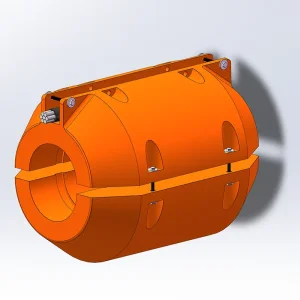
Interchangeable Halves
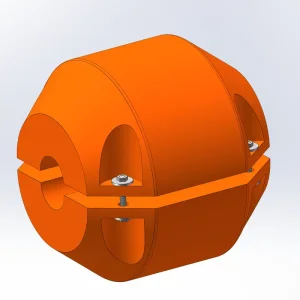
Two identical semi-circular cylindrical shells bolt securely across the pipe outer diameter, enabling swift installation and replacement.
Integrated Wave Dampening
Ribbed external contours absorb tidal energy and mitigate longitudinal pipe whipping caused by passing vessels and high swells.
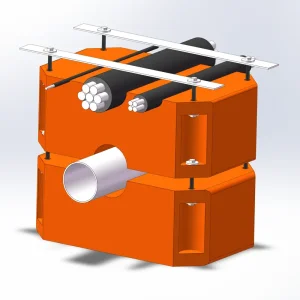
Integrated Cable Troughs
Custom-molded pathways allow telemetry, power, and umbilical dredge lines to sit securely along the pipeline without chafing.
Life-Cycle Economics
Zero corrosion maintenance, non-toxic UV resistance, and full post-lifecycle material recyclability minimize long-term total cost of ownership.
Engineered Deployment Scenarios Across Continents
From subsea tie-ins to mining tailings impoundments, our pipe float systems adapt to complex hydrological conditions.
Nearshore Harbors & Port Dredging
Maintaining clear maritime shipping lanes requires flexible discharge lines that remain stable despite vessel wakes, strong coastal crosswinds, and changing tidal heights.
Mining Tailings & Slurry Transport
Discharging high-density mineral ores and abrasive slurry across tailing storage facilities (TSFs) requires corrosion-proof, chemical-resistant pipe shells.
Subsea Pipeline Float Tie-Ins
Staged buoyancy modules provide controlled positioning during offshore pipe-laying, preventing excessive stress and bending moments during immersion.
Inland River Desilting & Floodways
Navigating tight river channels requires high-visibility markers, puncture-proof hulls, and simple assembly to accommodate swift repositioning along the riverbed.
Hydro Reservoir Protection
Modular floating barriers intercept surface debris, drift logs, and surface silt ahead of water turbine intakes to protect hydropower generation machinery.
Custom OEM Engineered Platforms
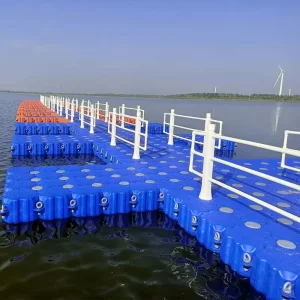
Custom rotomolded modular pontoons support pumping stations, floating monitoring stations, watercraft docking systems, and industrial aeration equipment.
Strict Quality Assurance for International Tenders
Meeting rigorous international marine engineering benchmarks, Lloyd's register guidelines, ASTM standards, and ISO environmental parameters.
ASTM D1693 ESCR Testing
Tested for Environmental Stress-Crack Resistance (ESCR) exceeding 1000 hours in aggressive chemical solutions to ensure zero crack initiation under cyclical hydraulic strain.
Accelerated Weathering (QUV)
Complies with ASTM G154 accelerated UV solar weathering, maintaining over 85% of initial tensile strength and elongation-at-break after extensive exposure cycles.
Density & Closed-Cell Integrity
Certified PUR foam filling under ASTM D1622 ensures uniform density without interior voids, preventing water ingress even in high-humidity and wave-pounded conditions.
ISO 9001/14001 Quality Loops
Complete lot traceability from virgin polymer resin batches to end-of-line acoustic wall-thickness checks and mechanical pull tests on through-bolt attachments.
Technological Evolution: Smart Flotation & Circular Polymers
Advancing the frontier of marine industrial flotation through sensor integration, sustainable raw materials, and precision digital asset management.
Smart IoT Telemetry Beacons
Integrating low-power LoRaWAN and satellite transponders into buoy headers to relay real-time tilt, strain loads, water ingress, and pipeline trajectory data to control rooms.
Bio-Based & Circular Resins
Testing certified post-consumer recycled (PCR) blends with performance-enhancing cross-linking agents to deliver lower lifecycle carbon footprints while maintaining impact resilience.
Advanced Hydrodynamic Modeling
Employing computational fluid dynamics (CFD) to design streamlined outer contours that minimize current drag and reduce pipeline fuel consumption during long towing operations.
Technical & Procurement FAQ
Direct technical answers to common engineering questions regarding HDPE pipe floats, buoyancy sizing, and international logistics.
What is the standard buoyancy safety margin for dredging pipelines?
We recommend sizing total float buoyancy to exceed total weight (pipe + conveyed slurry + joint hardware) by at least 20% to 30%. This maintains roughly 25% of the outer pipe diameter above water, preventing wave swamping and minimizing tow drag.
How does rotomolded HDPE compare to fabricated steel floats?
Rotomolded HDPE provides permanent resistance to seawater corrosion, eliminates routine sandblasting or repainting, and will not sink if the outer shell is punctured thanks to its solid, hydrophobic closed-cell polyurethane foam interior.
Can floats accommodate customized pipeline diameters and cables?
Yes. We offer precision CNC tooling to produce float bodies that match any steel or HDPE pipe outer diameter from 110mm up to 1200mm+. Floats can also be configured with custom-molded longitudinal channels to carry auxiliary power cables and telemetry umbilicals.
What documentation is required for international freight quotations?
To provide an accurate CIF/FOB quote, we need the pipe outer diameter, wall thickness, conveyed medium specific gravity, pipeline length, and target destination port. Our engineering team prepares complete packing lists and optimal container stowage designs.
What is the standard warranty coverage period?
Our products include a warranty covering 18 months from delivery or 12 months from on-site commissioning, whichever occurs first, protecting against raw material defects, environmental stress cracking, and shell separation.
How do you prevent pipe floats from slipping along the line?
Internal clamping profiles are sized to match the pipe's outer diameter. For high-energy swell conditions or flexible rubber hoses, anti-slip rubber friction liners and integrated locating collars prevent longitudinal movement during operation.
Precision Flotation & Marine Anchorage Systems
Explore our heavy-duty mooring buoys, navigation systems, and subsea tie-in platforms built to withstand demanding offshore environments.