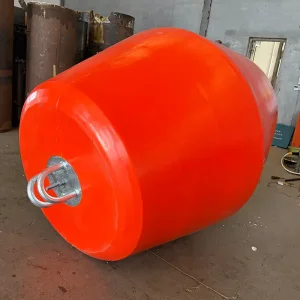
High-Integrity Mooring & Dynamic Flotation Modules
Engineered for high-strain offshore operations, marine berths, and deepwater hydrodynamic applications.

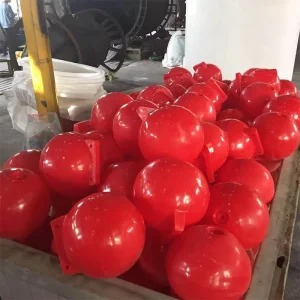



Executive Summary: Global Landscape of Designated Mooring Buoys
In modern offshore maritime infrastructure, designated mooring buoys (DMBs) serve as critical, safety-contingent physical assets. Serving deepwater ports, chemical vessel anchorages, aquaculture systems, and floating energy platforms, the designated mooring buoy operates under cyclically violent hydro-mechanical strains. Historically dominated by vulnerable fabricated carbon-steel hulls, the maritime domain has undergone a massive metallurgical-to-polymeric paradigm shift. Contemporary operational requirements demand corrosion-impermeable rotational molded high-density polyethylene (LLDPE/HDPE) skins matrixed with closed-cell polyisocyanurate or polyurethane formulations.
Marine failures predominantly originate from long-term bio-fouling degradation, inner structural framework fatigue under torsional cyclic tension, and micro-cracking induced by extreme ultraviolet photochemical oxidization. As OEM manufacturers, Shandong Binzhou Juhua Rubber & Plastic Co., Ltd. (Juhua) addresses these thermodynamic and structural liabilities through digitally monitored variable-frequency speed rotational sintering alongside calibrated tensile-stress engineering.
The Chinese Factory Advantage: Structural & Yield Efficiencies
How state-of-the-art rotational molding automation delivers unmatched dimensional control, cost resilience, and prompt dispatch cycles for major engineering EPCs.
Monolithic Shell Integration
Unlike steel mooring solutions suffering weld-seam oxidation, our specialized multi-axis carousel rotomolding equipment yields stress-free, seamless PE bodies with variable-frequency algorithmic wall thickness controls.
Scale Raw-Material Economics
Situated within Shandong's massive industrial chemical cluster, our factory ensures access to virgin UV20+ stabilized marine polyethylene grades at wholesale efficiency, mitigating international supply-chain volatility.
Rapid Prototype-to-Batch Turnaround
In-house CNC mold manufacturing enables proprietary tooling development within 14–21 business days, facilitating dynamic adaptations to non-standard marine chain-troughs, umbilical slots, or mooring eye configs.
Automated Quality Assurance
Every designated buoy shell is verified with electronic ultrasonic thickness gauges and infrared pyrometric thermal tracking, ensuring zero cavitation, uniform tensile cross-linking, and pristine cellular buoyancy integrity.
Mission-Critical Deployment Scenarios
Operational durability across extreme marine regimes, from heavy swell open-ocean transfer sites to corrosive industrial tailings facilities.
Bulk Terminal & Harbor Berth Limits
Engineered for multi-berth identification systems and channel margin retention. Built to absorb vessel impact energies while retaining anchor-chain tension with zero risk of hull denting or dynamic hull puncture.
Offshore Aquaculture Grids
Anchoring multi-hectare offshore high-energy submersible fish-farming cages. Designed with biological anti-adhesion smooth walling to deter algae colonies, minimizing parasite growth and hydrodynamic drag.
Floating Solar & Offshore Wind Systems
Providing permanent tensioning nodes for floating photovoltaic (FPV) matrices and subsea cable inter-array positioning, maintaining continuous buoyancy through cyclonic wave spectra.
Mining Tailings & Sump Containment
Specialized chemical-resistant PE formulations designed to maintain absolute structural stability across acidic or alkaline tailings reservoirs, anchoring silt curtains and slurry pipeline alignments.
Hydroelectric Dam Spillway Barriers
Deployed as high-impact safety booms, debris arresters, and surface trash diversion barriers upstream of turbine intakes, preventing debris intrusion while anchoring warning delineations.
Naval & Coastal Defense Perimeter
Heavy-duty, high-visibility designated anchoring buoys functioning as physical demarcations, acoustic monitor stations, and coastal perimeter monitoring support across restricted naval bases.
Industry Trends: The Next Generation of Marine Buoys
Emerging standards shaping maritime procurement, material science advancements, and ecological imperatives.
Smart IoT Telemetry Integration
Transition from passive floatation to active data-nodes. OEM designated buoys are increasingly built with internal cavitations for battery-backed satellite transceivers, GPS tension-drift warnings, and wave-swell logging systems.
Zero-VOC & Eco-Recyclable Polymers
With stricter IMO decarbonization goals and microplastic bans, clients favor cross-linked polymer formulations containing zero heavy metals or lead stabilizers, boasting 100% recyclability at operational end-of-life.
Hybrid Mooring Morphologies
Adoption of centralized modular through-pipe tension arrangements. Replacing conventional pad-eyes, single-piece central structural steel spindles distribute massive vertical snatch loads across the entire displacement body.
Extreme Hydrophobic Foam Filling
Replacing traditional styrenic cores, high-pressure closed-cell polyurethane resins (≥40 kg/m³) are injected into the hull, eliminating any water absorption even in the event of continuous catastrophic surface breaches.
Engineering Buoyancy Calculation Methodology
Marine failures often trace back to under-buoyancy miscalculations caused by assuming still water or ignoring anchor-line submerged mass. Our engineering team utilizes a rigorous hydrodynamic metric:
Effective Reserve Net Buoyancy (R_net) = [Displacement Volume (V) × Water Density (ρ)] - [Dry Buoy Mass + Dynamic Mooring Tension (T_dyn) + Biofouling Reserve (M_bio)] ≥ Total Working Load × 1.30
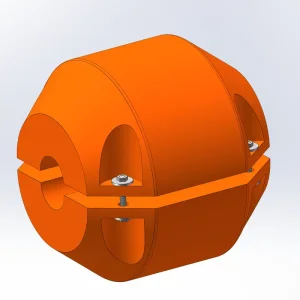
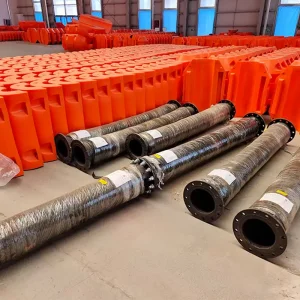
For dredging pipes, the baseline rule mandates: Total float buoyancy ≥ (pipe weight + slurry weight + accessories) × 1.20 to 1.30, ensuring at least 25% of pipe clearance remains dry above the waterline under high-speed slurry transit.
Designated Mooring Buoys & Flotation: Engineer FAQ
In-depth responses clarifying polymer behavior, mechanical tension capacities, and structural longevity parameters.
Deepwater Flotation, Tie-In Modules & Subsea Accessories
Complete your dredging, anchoring, or fluid conveyance pipeline setup with matched flotation infrastructure.