
Featured Marine Pipeline & Subsea Buoyancy Equipment
Engineered to meet rigorous offshore and high-density industrial discharge standards. Browse core certified assemblies below.

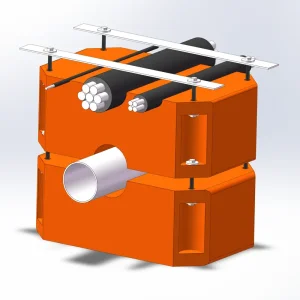


Engineering Nautilus Pipe Floats for Ultra-Reliable Hydrodynamic Stability
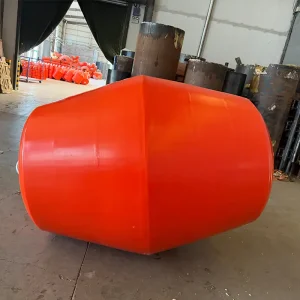
Marine infrastructure development, deep-channel navigation maintenance, and trans-continental mineral processing demand an uncompromising tier of marine pipeline support. The Nautilus Pipe Float series, developed in conjunction with global EPC requirements, addresses catastrophic shear stress, cyclic wave kinetics, and high slurry densities encountered across mega-dredging corridors. In conventional operations, buoyant hulls constructed with sub-par resins suffer from environmental stress cracking (ESC) and micro-fractures induced by harmonic slamming. The Nautilus design paradigm redefines rotational molding using multi-layered, linear low-density virgin polyethylene (LLDPE) reinforced with cross-linked closed-cell polyurethane (PU) foam interiors.
Manufactured under ISO 9001 and ISO 14001 continuous feedback controls at our high-capacity production hub in Lizhuang Town, Huimin County, Binzhou City, Shandong, every pipe float shell undergoes strict thermal cycle management. Through real-time infrared temperature surveillance, wall thicknesses remain uniform along critical structural load radials. Consequently, pipeline assets maintained via Nautilus assemblies achieve zero water ingress, prolonged hydrodynamic equilibrium, and up to twenty years of service life without maintenance-induced downtime.
Global dredging contractors, port authorities, and offshore mining engineers are shifting away from fabricated steel pontoon floats due to aggressive seawater oxidation, heavy manual handling requirements, and costly cathodic replacement schedules. The Nautilus PE system provides an inert, chemical-resistant alternative that yields a positive net buoyancy safety coefficient of 20% to 30% over dynamic aggregate payload limits. Sizing configurations account for the specific gravity of discharged slurries—often reaching 1.6 to 1.8 t/m³ during riverbed desilting or marine iron sand extraction.
By providing factory-direct OEM engineering adaptations—spanning integrated cable raceways, high-tensile hot-dip galvanized and marine-grade stainless hardware, and custom-bored elastomeric liners—Juhua Marine Flotation bridges the gap between mechanical fluid transport dynamics and long-term structural survivability across harsh maritime theaters.
Global Macro Trends in Marine Buoyancy & Dredging Pipe Flotation
How international coastal defense, automated dredging fleets, and deep-sea mining are reshaping flotation equipment standards.
Escalating Slurry Densities & Deep-Cut Channels
Modern cutter suction dredgers (CSD) and trailing suction hopper dredgers (TSHD) pump solids with significantly higher particulate concentration to maximize volumetric reclamation yields. Standard buoyancy modules calibrated solely for sea-water loads fail when aggregate compaction peaks, causing partial pipeline submersion, violent hydraulic bucking, and joint rupture. Nautilus engineering models incorporate high-density dynamic safety factors ensuring consistent freeboard reserves under transient payload surges.
Transition to Integrated Power & Sensor Telemetry
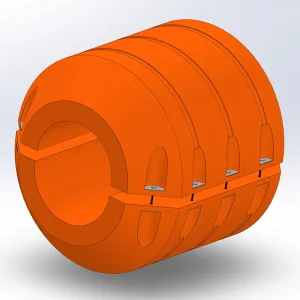
Smart reclamation and autonomous dredging require high-voltage electric propulsion, subsea sensory data transmission, and optical fiber loops directly tethered along the floating discharge line. Traditional floating modules lack secure cable paths, leaving expensive auxiliary lines exposed to shear, pinching, and marine life damage. Next-generation Nautilus designs feature recessed channels and clamp lockouts that protect power and instrumentation feeds from destructive ocean chop.
Decarbonization, Circular Polymers & Durability
Global ESG mandates prohibit sacrificial painted metallic equipment in fragile coastal wetland and barrier reef ecosystems. Toxic anti-fouling paints and oxidized rust slough off steel pontoons into marine reserves. Nautilus rotomolded polymers utilize pure, food-contact grade or non-leaching UV-stabilized resins that do not release micro-pollutants over decades of harsh sun exposure and saltwater exposure, simplifying decommission recycling workflows.
Buoyancy Optimization: Mathematical Modeling & Sizing Matrix
Under-dimensioning float volumes is the leading cause of offshore discharge line failures. Our calculation models prioritize total working weight under maximum slurry load factors rather than static empty-pipe weights.
| Nominal Inner Pipe OD (mm) | Outer Float Diameter (mm) | Total Length / Unit (mm) | Wall Thickness (PE Shell) | Standard Net Buoyancy (kg) | Recommended Slurry S.G. Rating |
|---|---|---|---|---|---|
| OD 160 mm - 250 mm | 500 mm - 680 mm | 800 mm - 1100 mm | 5.5 mm - 7.0 mm | 110 kg - 220 kg | Up to 1.30 t/m³ (Tailings / Mud) |
| OD 280 mm - 400 mm | 750 mm - 980 mm | 1200 mm - 1500 mm | 7.0 mm - 9.5 mm | 350 kg - 680 kg | Up to 1.45 t/m³ (Coarse Silt / Gravel) |
| OD 450 mm - 630 mm | 1100 mm - 1400 mm | 1400 mm - 1800 mm | 9.5 mm - 13.0 mm | 850 kg - 1,800 kg | Up to 1.65 t/m³ (Heavy Sand / Boulders) |
| OD 710 mm - 900 mm | 1500 mm - 1850 mm | 1800 mm - 2200 mm | 13.0 mm - 16.5 mm | 2,100 kg - 3,600 kg | Up to 1.75 t/m³ (Deep-Water Marine Sand) |
| OD 1000 mm - 1200 mm | 2000 mm - 2400 mm | 2200 mm - 2600 mm | 16.0 mm - 22.0 mm | 4,200 kg - 6,800 kg | Up to 1.85 t/m³ (High-Concentration Ores) |
Buoyancy Margin Equation (Recommended Freeboard Guideline)
Total Required Net Buoyancy (Fb) = [ Wpipeline + Wslurry_max + Whardware + Wmarine_growth ] × Csafety (1.20 ~ 1.30)
Ensures that a minimum of 25% (one quarter) of the pipe body diameter remains exposed above the waterline. This preserves structural freeboard reserve, improves visibility for nearby marine traffic, and prevents line-snapping dynamic wave overtopping.
China Factory 4.0: Precision Rotomolding & Scaled Production
Based in the industrial manufacturing center of Binzhou, Shandong, Juhua Rubber & Plastic balances raw production volume with automated process controls, giving global EPC procurement managers consistent quality and rapid turnarounds.
Closed-Loop Thermal & Variable Frequency Control
Unlike manual open-flame systems that cause thin corner geometry, Juhua’s production lines integrate digital variable-frequency speed controls alongside automated electronic heat monitoring. Rotational speed across biaxial axes is balanced to ensure wall-thickness deviation stays within ±3% of design tolerances, preserving structural integrity under sudden hydrodynamic impact.
Standardized Mold Modular Interchangeability
With precision CNC tooling libraries, Nautilus float shells maintain interchangeable mating profiles across production batches. A half-shell manufactured today aligns with bolt patterns and outer contours of assemblies built five years ago. This backward compatibility eliminates site fitting modifications and simplifies long-term spare-parts inventory management.
Turnkey Supply from Shandong Logistic Gateways
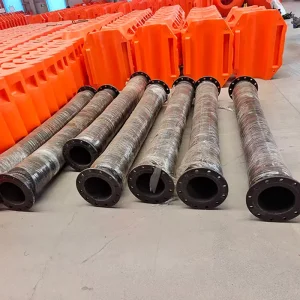
Strategically located close to Qingdao and Tianjin maritime logistics hubs, Juhua provides end-to-end container packaging and flat-rack loading for rapid worldwide mobilization. We deliver fully coordinated float modules alongside matched HDPE dredging pipes, flexible heavy-duty rubber discharge hoses, and mooring anchoring accessories to streamline site assembly.
Localized Application Scenarios & Operational Case Studies
From tidal navigation channels to hypersaline open-pit tailing dams, see how Nautilus pipe floats perform across challenging commercial marine environments.
Harbor Deepening & Berth Expansion
In busy ports across Southeast Asia and the Middle East, dredging pipelines operate adjacent to active commercial shipping lanes. Pipe floats must remain visible in all weather conditions and feature non-snagging, rounded profiles that minimize snag risks for mooring vessels and workboats. High-visibility UV stabilizers preserve color retention under intense tropical sunlight, while integrated reflective markers maintain channel safety during nighttime operations.
Land Reclamation & Coastal Defense
Megaprojects requiring long sand-discharge runs need flotation stability across varying breaker surf zones. When ocean swells pass over the floating line, uneven wave loading places significant twisting strain on pipe joints. Nautilus modules provide balanced hydrodynamic lift that dampens cyclical torsional stress on HDPE pipe welds and rubber flanged connections, helping avoid shoreline pipeline failures.
Mineral Tailings & Corrosive Ponds
Mining operations in South America and Western Australia require continuous tailings slurry transfer across evaporation reservoirs and process settling lagoons. These fluids often carry extreme pH levels, heavy suspended solids, and chemical residues that break down painted steel pontoons in months. Nautilus rotomolded LLDPE floats resist chemical and salt attack, maintaining reliable buoyancy throughout long-term mining projects.
Expanded Waterway Infrastructure & Flotation Accessories
Pair your pipeline buoyancy setups with our certified mooring buoys, subsea support modules, and safety containment barriers.
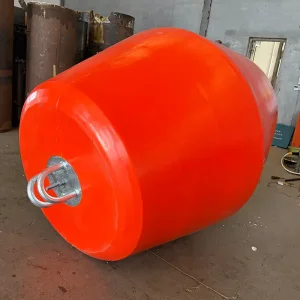

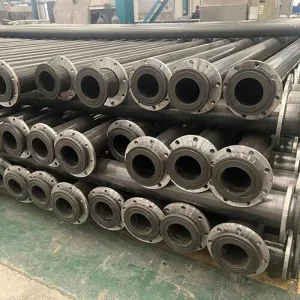

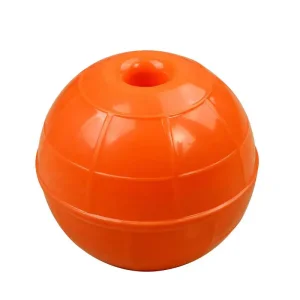
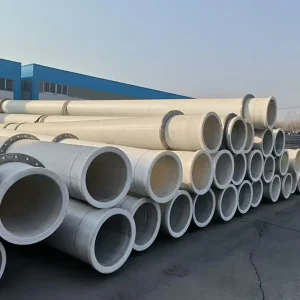
Material Engineering: Virgin LLDPE & Closed-Cell Polyurethane Foam
Every Nautilus unit is designed to meet strict field survivability standards, backed by batch-traceable resin certifications, hydrostatic testing, and automated polyurethane core filling.
Outer Shell: High-Impact UV-Stabilized Polyethylene
Shell construction utilizes 100% virgin polymer resin (grade LLDPE 7042/644) blended with UV8 to UV16 stabilizers and carbon black or high-visibility orange/yellow pigment masters. Rotational molding is run without inner mold releases, preventing cross-lamination voids. This construction yields high tensile strength (≥ 16 MPa), balanced elongation at break (≥ 400%), and strong impact resistance down to -40°C, preventing brittle fracture when pipes rub together in heavy chop.
Inner Core: Non-Absorbent Closed-Cell Polyurethane Foam
The hollow chamber is filled under temperature-controlled conditions with high-density (32 to 38 kg/m³) closed-cell polyurethane foam. Even if the outer PE skin suffers puncture damage from rocks or workboat collisions, the hydrophobic closed-cell core prevents water migration throughout the body. The float retains over 95% of its original rated buoyancy, keeping lines operational and helping avoid unexpected pipeline sinkages.
Frequently Asked Questions by Marine Engineers & Sourcing Officers
Key answers to the operational, commercial, and technical questions asked by marine contractors and EPC estimating teams.
1. What are pipeline floats and how do they function on active sites?
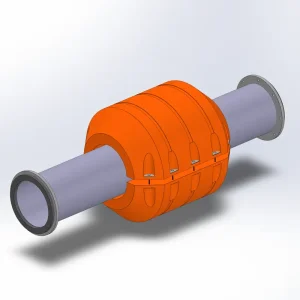
Pipeline floats (often called dredge floats or modular buoyancy shells) are circular clamp-on polyethylene structures filled with closed-cell foam. They wrap securely around discharge pipes—such as HDPE, steel, or flexible rubber hoses—to keep the pipeline safely buoyant, balanced, and visible above the water surface during marine desilting, channel dredging, or water-transfer jobs.
2. How is total pipeline buoyancy calculated for heavy slurries?
Float sizing must account for the fully loaded working pipeline rather than an empty line. Add the dry pipe weight, the heaviest planned slurry volume (often 1.3 to 1.8 t/m³), and connected flange hardware. Floats should provide 20% to 30% more buoyancy than this sum, ensuring roughly one quarter of the pipeline remains exposed above water to handle changing wave loads safely.
3. Why choose rotomolded polyethylene over welded steel pontoons?
Polyethylene is naturally corrosion-proof against saltwater, acidic runoffs, and UV rays, meaning it will not rust or require sacrificial anode systems. Rotomolded PE shells are also much lighter to handle, simple to install without heavy cranes, and pop back into shape after minor knocks, avoiding the costly re-welding and painting cycles of steel floats.
4. What is the standard warranty period and coverage scope?
The standard warranty coverage runs for 18 months from delivery handover to the project site, or 12 months after active commissioning, whichever threshold arrives first. This protects against manufacturing issues, material delamination, premature UV degradation, and internal core breakdown when units are run within recommended operating parameters.
5. What details are required to generate an accurate quotation and CAD drawing?
To help our engineering team calculate the right sizing, please provide: the outer pipe diameter (OD) and material thickness, pumped material type and maximum slurry density, total discharge line length, local water conditions (open marine, river, or tailings pond), target freeboard, and your preferred delivery port.
6. Can Nautilus pipe floats be customized with cable routes or branding?
Yes. We can tailor the internal diameter to match specific outer pipe sleeves, cast longitudinal channels for power/control cables or telemetry wiring, mold in project numbers or company branding, and match specific safety colors (standard safety orange, bright yellow, or marine signal green).