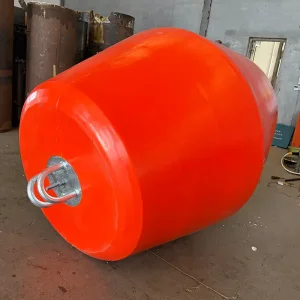
High-Performance Flotation & Marine Pipeline Inventory
Explore our certified rotationally molded pipeline floats, heavy-duty suction hoses, navigation buoys, and deepwater buoyancy modules engineered for harsh aquatic operations.
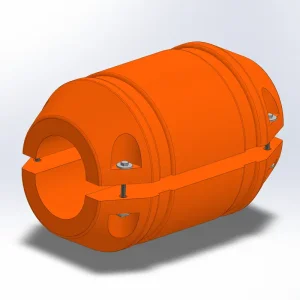
Custom Durable Pipe Floats for Reliable Marine Operations
View Specifications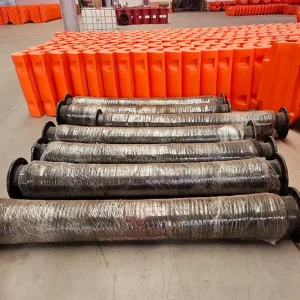
Custom Heavy-Duty Rubber Pipelines for Slurry Transport
View Specifications
High-Quality Pipe Floats for Water Transfer & Mining
View Specifications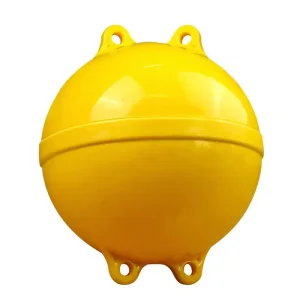
ODM ABS Float Ball for Marine & Freshwater Buoyancy
View Specifications
Custom Reliable Marine Buoys for Waterway Operations
View Specifications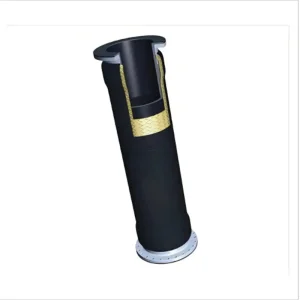
Custom Premium Rubber Hoses for Industrial Transport
View Specifications
ODM Deepwater Pipeline Support Subsea Floats
View Specifications
ODM Heavy-Duty Marine Buoys for Navigation & Safety
View SpecificationsEngineering Principles & Pipeline Buoyancy Hydrodynamics
A rigorous review of structural dynamics, hydrostatic displacement calculations, and polymer wear resistance in continuous heavy-media conveyance.
Hydrodynamic Buoyancy Calibration
Under-sizing buoyancy modules causes sagging, severe hydrodynamic drag, and premature flange cracking under cyclonic swells. Standard dredge pipe calculation balances total distributed payload using mathematically verified reserve coefficients:
Ensures 25% to 30% pipe diameter freeboard visibility above mean tidal height.
Polymer Mechanics & Cross-Linking
Constructed with rotational-grade Linear Low-Density Polyethylene (LLDPE) enriched with UV-8 stabilizers and carbon black. This matrix inhibits photochemical degradation, achieving tensile yields exceeding 18 MPa and zero stress corrosion when exposed to continuous marine brine.
Closed-Cell Hydrophobic Polyurethane Core
Even if intense oceanic collisions breach the external polyethylene armor shell, the inner expanded polyurethane foam core (density 35–45 kg/m³) prevents water uptake. Capillary water absorption remains <1% by volume, ensuring continuous line float integrity.
China Factory 4.0: Supply Chain Agility & Precision Rotomolding
Shandong Binzhou Juhua Rubber & Plastic Co., Ltd. deploys automated rotational systems to deliver uncompromising quality, standard interchangeability, and scalable output.
Closed-Loop Thermal Feedback
Automated bi-axial arm rotation with real-time internal temperature sensors guarantees uniform shell curing and zero weak-spot wall variances.
Interchangeable Mold Tooling
Standardized CNC-machined split-body molds ensure that replacement halves mate flush with pipe floats supplied years prior without field alterations.
Raw Material Batch Traceability
Every polymer lot undergoes Melt Flow Index (MFI) and density verification, backed by 3.1 material certificates to guarantee compliance with ISO standards.
Direct-to-Berth Container Stacking
Nesting designs engineered for optimized standard 40ft High Cube container packing save international EPCs up to 35% on global maritime freight costs.
| Nominal Inner Diameter (ID) | Float Outer Diameter (OD) | Overall Length | Wall Thickness | Nominal Net Buoyancy | Recommended Fasteners |
|---|---|---|---|---|---|
| 110 mm - 160 mm | 500 mm | 800 mm | 5.5 mm - 6.5 mm | 110 kg - 145 kg | Galvanized / SS316 M14 Bolts |
| 200 mm - 280 mm | 650 mm | 1100 mm | 7.0 mm - 8.5 mm | 280 kg - 360 kg | Galvanized / SS316 M16 Bolts |
| 315 mm - 450 mm | 900 mm | 1200 mm | 8.5 mm - 10.0 mm | 620 kg - 780 kg | Hot Dip Galvanized M18 Bolts |
| 500 mm - 710 mm | 1200 mm | 1500 mm | 10.0 mm - 13.5 mm | 1350 kg - 1800 kg | Marine Grade SS316 M20 Bolts |
| 800 mm - 1200 mm | 1800 mm - 2200 mm | 2000 mm - 2500 mm | 14.0 mm - 18.0 mm | 3500 kg - 6800 kg | Heavy Hex Structural A325 / SS316 |
Enterprise Procurement Criteria: Mitigating Marine Project Risk
A checklist designed for procurement leads, EPC contractors, and dredging directors to verify buoyancy equipment before award.
True Pipe OD & Expansion Allowance
Rigid steel, flexible rubber, and thermally expanding HDPE pipes exhibit distinct dimensional tolerances under operating head pressures. Always state exact pipe SDR, flange dimensions, and rubber liner thickness to guarantee proper float clamping without shell deformation.
Dynamic Slurry Density Variances
Slurry densities exceeding 1.6 t/m³ in iron ore or copper tailings applications can submerge standard water-rated floats. Sizing calculations must include solid settling dynamics during unexpected pump trip incidents to prevent line ditching.
Comprehensive Fastener Metallurgy
Bolt corrosion remains the primary point of field failure. Specify hot-dip galvanized grade 8.8 bolts for inland freshwater dredging, or marine-grade AISI 316 stainless steel with nylon locking nuts for continuous coastal and high-salinity estuarine projects.
Technology Roadmap: Smart Flotation & Circular Polymers
Exploring next-generation buoyancy technologies: embedded sensor networks, bio-circular resins, and advanced hydrodynamic contours.
IoT-Enabled Smart Float Telemetry
Prototypes under development incorporate integrated micro-sensors within the PU foam core to continuously report structural stress, inner temperature, and pipeline submergence via satellite LoRaWAN to dredge bridge operators.
Closed-Loop Circular Polymers
Collaborating with polymer compounders to integrate up to 30% mechanically upcycled ocean-bound plastic while maintaining ESCR benchmarks and UV resistance under harsh equatorial sun exposure.
Vortex Shedding & Drag Reduction
Computational Fluid Dynamics (CFD) modeling of grooved exterior hulls and segmented tapered collars reduces tidal cross-flow drag by 14%, minimizing anchor point mooring loads in deep river estuaries.
Frequently Asked Technical Questions
Expert answers addressing sizing formulas, polyurethane fill properties, environmental compliance, and international shipping protocols.
How do you calculate buoyancy needs for heavy mining slurry?
Mining tailings and mineral slurries have specific gravities between 1.3 and 1.8 t/m³. Calculating float size strictly based on water weight (1.0 t/m³) leads to line submersion. Always apply the operational weight equation incorporating slurry specific gravity, pipe schedule, and a 30% buoyancy reserve factor.
What prevents floats from slipping along smooth HDPE pipes?
Our pipe float halves are rotationally molded with internal anti-slip friction ribs and engineered dimensional tolerances. When assembled using torque-specified fasteners, the ribs bite securely against the HDPE surface, resisting axial currents without gouging the pipeline.
What is the standard warranty and documented field lifespan?
Under continuous marine UV exposure, our high-density polyethylene shells have an operational lifespan of 10 to 15 years. Standard manufacturing warranty covers structural shell integrity and foam bonding for 18 months from factory handover or 12 months after field installation.
Can you provide custom cable troughs and sensor conduits?
Yes. OEM and ODM customization includes integrated cable pathways molded into the top half of the float shells. This allows safe routing of power cables, remote control signals, or discharge pressure transducer lines along floating dredge operations without external clamping.
Explore Additional Buoyancy Solutions & Marine Accessories
Review our specialized subsea modular floats, high-visibility marine warning systems, custom mooring buoys, and recreational rotomolded water platforms.
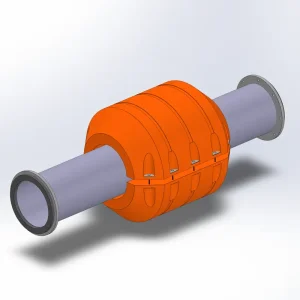
Modular Buoyancy Pipeline Float for Subsea Installation
View Specifications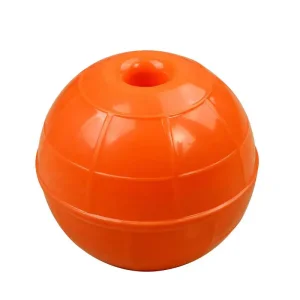
ODM Heavy-Duty ABS Float Ball for Water Engineering
View Specifications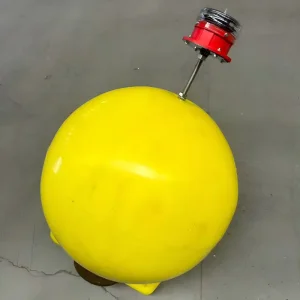
ODM High-Visibility Floating LED Safety Ball
View Specifications
Heavy-Duty Pipeline Float System for Subsea Installations
View Specifications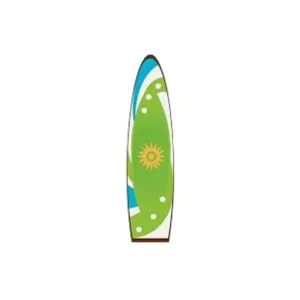
ODM Rotomolded Surfboard Water Sports Solution
View Specifications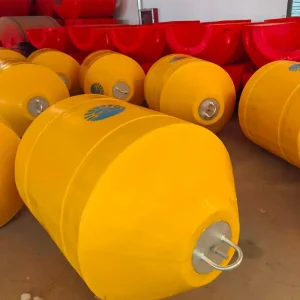
Custom Mooring Buoy for Boat Berths & Offshore Stations
View Specifications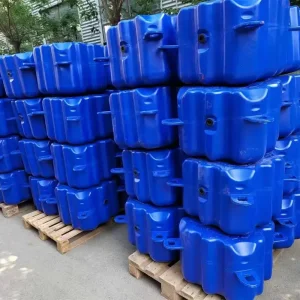
ODM Durable Floating Boat Pontoon Platforms
View Specifications