High-Performance Flotation Hardware
Engineered rotomolded polyethylene solutions customized for dredging slurry, subsea tie-ins, offshore mooring, and structural harbor support.




Global Industrial Landscape & Enterprise Procurement Analysis
A macroeconomic and structural breakdown of the shift toward advanced rotomolded High-Density Polyethylene (HDPE) pontoon floats in global marine operations.
Material Decoupling from Steel
The maritime engineering sector is phasing out conventional welded steel drum pontoons and polyurethane-coated iron pontoons. Traditional steel floats undergo accelerated oxidation under chloride ion exposure, requiring recurring sandblasting, biocidal coating reapplications, and sacrificial anode replacements. HDPE polymers provide zero galvanic reaction, resistance to biofouling, and immunity against seawater salinity.
TCO Optimization for EPC Buyers
For international Engineering, Procurement, and Construction (EPC) contractors managing capital-intensive land reclamation, offshore wind ports, and deep-water dredging, Total Cost of Ownership (TCO) serves as the primary evaluation metric. HDPE pontoons reduce dry docking demands, lower logistic weights by up to 60%, and provide operational lifespans exceeding 15 to 20 years in high-UV open water environments.
Dynamic Slurry Buoyancy Compliance
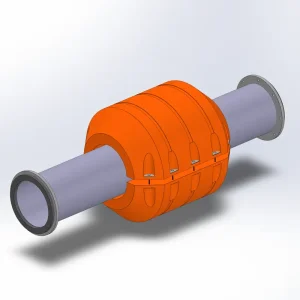
Procuring floats for heavy discharge and slurry lines entails variable hydrodynamics. Slurry density ranges from 1.2 t/m³ to upwards of 1.8 t/m³ during deep dredging operations. Enterprise procurement requires mathematically verified buoyancy reserves that maintain pipeline integrity, preventing negative freeboards and sub-surface dragging across shallow estuary zones.
Core Procurement Rule of Thumb: Total pontoon float buoyancy must consistently satisfy the condition: Total Buoyancy ≥ (Dry Pipe Mass + Full Hydraulic Medium Mass + Mechanical Fasteners) × 1.25 to 1.30. This maintains approximately 25% of the pipe diameter above the waterline, preventing wave overtopping and hydrodynamic drag.
Macro Industry Solutions & Systemic Engineering Integration
How rotational moulding integrity, closed-cell EPS foam matrices, and specialized clamping architectures resolve modern hydraulic challenges.
Continuous Rotomolding Architecture
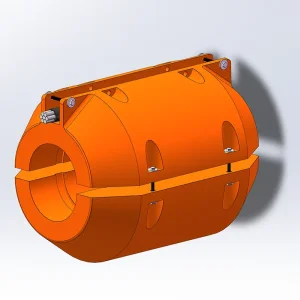
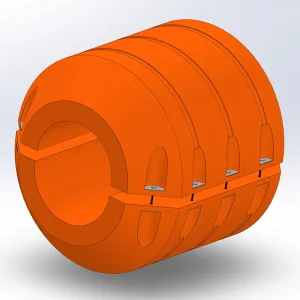
Unlike blow moulding or extrusion-welding methods prone to seam parting, modern industrial marine floats utilize high-precision rotational moulding with electronic automatic temperature measurement. This process ensures uniform wall thickness at complex structural radiuses, preventing stress-concentration cracks when the pontoon is subjected to torsional wave slamming and flexural bending moments.
Hydrophobic EPS Foam Infusion
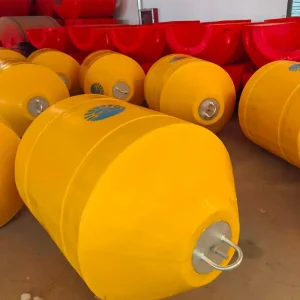
Float bodies are internally stabilized with high-density, closed-cell Expanded Polystyrene (EPS) foam core. With water absorption rates below 1% under dynamic immersion tests, the core guarantees that even if the outer HDPE armor shell sustains external ballistic or abrasive mechanical puncture from sharp coral or dredging equipment, water ingress remains localized and buoyancy failure is prevented.
Integrated Cable & Ancillary Troughs
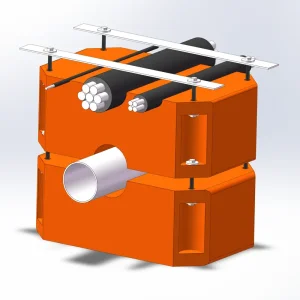
Modern electrical dredging and automated hydraulic discharge configurations require combined conveyance of high-voltage power conduits, digital telemetry feeds, and slurry pipes. Advanced pontoon designs feature molded axial raceways and cable troughs, securing electrical umbilical lines away from structural friction zones and corrosive water interfaces.
Technical Roadmap, Future Horizons & Localization Frameworks
Aligning polymer formulations with global decarbonization goals, smart sensor integration, and regional maritime regulatory compliance.
IoT Structural Health Telemetry (2025–2030)
The next iteration of industrial HDPE pontoon floats incorporates embedded MEMS inclinometers, internal hydrostatic pressure sensors, and LoRaWAN/NB-IoT beacons. This telemetry framework enables automated calculation of pipeline deflection curves, warns ground control of localized sedimentation build-ups inside the pipe, and reports mooring tension shifts in real time.
Bio-Circular Polyethylene Matrices
In response to international maritime circularity mandates, next-generation rotomolding resins are shifting toward certified post-consumer recycled (PCR) polymer compounds and mass-balanced bio-based polyethylenes. Optimized additive compounds preserve UV resistance ratings above UV8/UV15 without increasing brittleness under sub-zero or tropical conditions.
Global Compliance & Field Support
Deployments across international jurisdictions demand strict verification against standards such as IALA maritime buoy guidelines, ASTM D1693 environmental stress crack resistance (ESCR), and ISO 9001/14001 process criteria. Enterprise suppliers maintain localized distribution hubs, dedicated technical documentation, and certified on-site assembly supervision to reduce vessel laytime.
Frequently Asked Questions: Technical Engineering & Procurement
Detailed engineering explanations answering specific requirements of dredge masters, marine consultants, and purchasing directors.
Specialized Pipeline & Buoyancy Modules
Explore heavy-duty dredging floats, modular marine buoys, and pipeline protection products engineered to global maritime specifications.