Heavy-Duty Buoyancy & Pipe Support Systems
Manufactured from cross-linked, UV-stabilized virgin polymer matrices with integrated hydrodynamic stability configurations.
Engineering Floating Buoy Markers: Polymer Integrity & Marine Hydrodynamics
A comprehensive examination of physical resilience, reserve buoyancy calculation, and rotational casting precision in offshore applications.
Polymer Material Science (UV-20 Stabilized)
Unlike steel buoys prone to accelerated electrochemical pitting and localized oxidation, modern floating buoy markers utilize high-density polyethylene (HDPE) or high-grade linear low-density polyethylene (LLDPE) blended with carbon black or UV-hindered amine stabilizers (HALS). This creates an inert barrier resistant to salinity, chemical effluents, and microbial biofilms.
- Tensile strength at yield: ≥ 21 MPa
- Elongation at break: > 800%
- Environmental Stress Crack Resistance: F50 > 1000 hrs
Monolithic Shell & Foam Core Mechanics
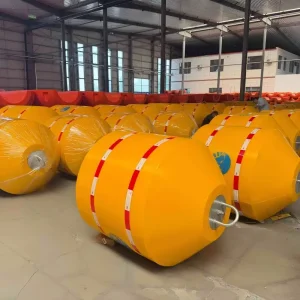
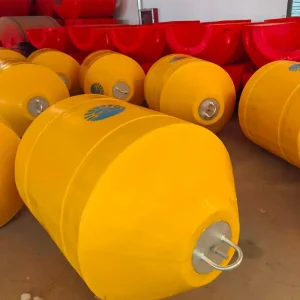
Manufactured via multi-axis bidirectional rotational molding, our buoy skins achieve isotropic wall thickness with zero seam welds or thermal stress points. The internal void is filled with high-density polyurethane (PU) or closed-cell expanded polystyrene (EPS) foam (density 35–45 kg/m³), ensuring permanent positive buoyancy even if punctured during vessel collision.
- Zero water absorption inside the closed-cell foam
- Compressive strength: ≥ 0.2 MPa
- Retains buoyancy under continuous hydrostatic loads
Mooring Core Tension & Force Transfer
High-energy mooring buoys incorporate hot-dip galvanized internal structural steel pad-eyes or central tie-rods (grade Q235B or Q355B), isolating the rotational polyethylene hull from catastrophic tension forces. The tension line transfers mooring wave kinematics straight to the anchor seabed sinker, eliminating shear stress cracking across the polymer skin.
- Central pass-through or bridle mooring options
- Hot-dip galvanization ≥ 85 μm according to ISO 1461
- Proof load tested up to 2.5× design working load
China Factory 4.0: Supply Chain Resilience & Rotational Precision
Operating from Huimin County, Binzhou City, Shandong Province—integrating multi-station automated bi-axial ovens, ultrasonic wall thickness verification, and containerized logistics.
Variable-Frequency Speed Regulation
Our bi-axial rotomolding carousels employ real-time variable-frequency speed controls. Dynamic heating envelopes allow molten polymer to flow into corners, flanges, and internal ribs with zero micro-voids, guaranteeing isotropic tensile resistance across acute angles.
Precision Tooling & Rapid Tool Turnaround
In-house 5-axis CNC mold machining centers enable custom CAD-to-mold turnaround in under 18 business days. EPC contractors facing unique bathymetric, pipeline diameter, or anchorage configurations receive project-tailored tooling without intermediate agency markups.
Shandong Seaport Export Logistics
Direct intermodal access to Qingdao and Tianjin ports ensures high-volume containerized shipments (OT, HQ, and Flat Rack) can be staged within 48 hours of final QC clearing. This provides international marine dredging consortia with reliable delivery timelines without demurrage risk.
Macro Industry Solutions & Engineered Applications
From shallow coastal waterways to heavy offshore slurry pipelines, every flotation system is tuned to environmental currents, cyclic wind shears, and specific gravity gradients.
Navigation & Channel Delineation
Engineered strictly to IALA Maritime Buoyage Systems (Region A & Region B). Lateral, cardinal, isolated danger, and safe water markers utilize color-pigmented shells (grade 8 Xenon test colorfastness) integrated with radar reflectors and self-contained solar marine lanterns.
- Focal height compliance: 1.2m to 4.5m
- Visual range: 2 to 6+ Nautical Miles
- Cast-in ballast keels for high self-righting moments
Dredging & Tailings Slurry Transport
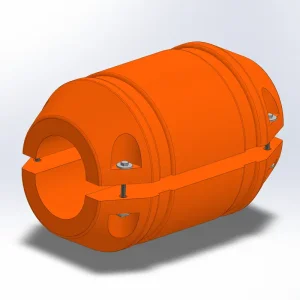
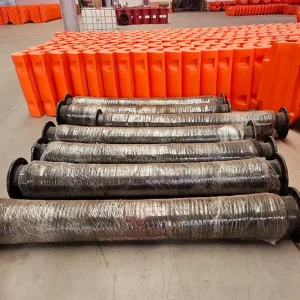
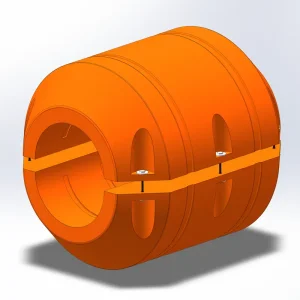
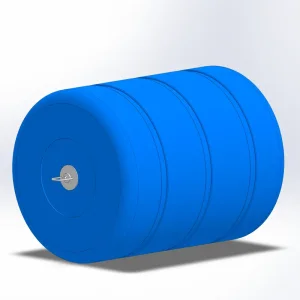
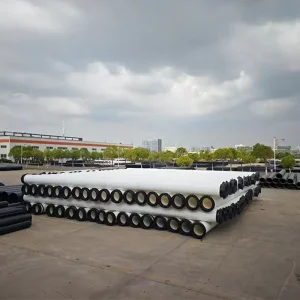
Supporting steel and HDPE pipelines conveying abrasive mineral ores, tailings, or dredged silt. Clamp-on cylindrical float halves feature grooved inner ribs that prevent pipeline slippage under longitudinal wave friction, keeping discharge lines buoyant and free from seabed scraping.
- Matched to outer diameters: 110mm to 1200mm
- Configured for slurry densities: 1.1 to 1.8 t/m³
- Marine grade 304/316 or galvanized fasteners
Offshore Energy & Subsea Cabling
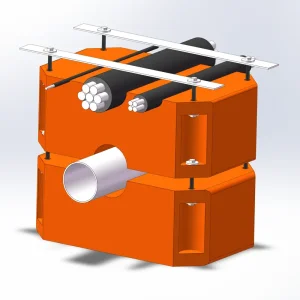
Specialized flotation bodies equipped with integrated lower cable troughs. Safeguard submerged electrical transmission cables, fiber optic umbilicals, and offshore wind substation links from dynamic flex fatigue, benthic chafing, and anchor snagging.
- Independent utility channel pass-throughs
- Prevents localized minimum bend radius violation
- Anti-rotational locking geometry
Hydraulic Intake & Security Barriers
Continuous modular floating barriers designed for hydroelectric reservoirs, power plant water intakes, and municipal reservoirs. Block floating wood debris, invasive aquatic biomass, and unauthorized watercraft from approaching spillways and turbine penstocks.
- Integrated sub-surface debris screening skirts
- Interlinking galvanized or stainless mooring chains
- High tension threshold up to 250 kN breaking strength
Harbor Workboat & Barge Mooring
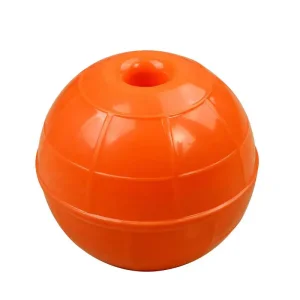
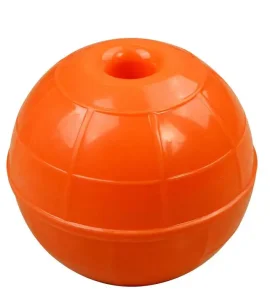
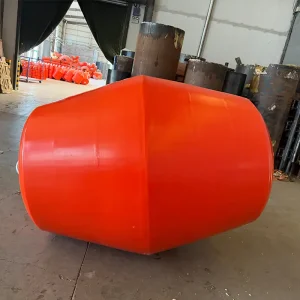
Heavy-duty cylindrical and spherical mooring buoys supporting tugboats, work vessels, and fuel transfer barges in river terminals. Direct steel pad-eye load bearing prevents skin crushing under heavy vessel impact and sudden tide drops.
- Working buoyancy from 500 kg to 15,000 kg
- Mooring hawser swivel systems prevent chain twisting
- Energy-absorbing elastomeric outer fenders
Global Enterprise Sizing Methodology & Engineering Rules
A reliable buoyancy module must account for total operating weight, dynamic environmental forces, and safety reserve margins.
F_total_buoyancy ≥ [ (M_pipe + M_fluid + M_hardware) × K_safety ] / ρ_water
•
M_pipe = Linear mass of empty steel or HDPE pipeline (kg/m)•
M_fluid = Mass of conveyed medium: π × (ID/2)² × ρ_slurry (accounting for heavy solids > 1.3 t/m³)•
M_hardware = Concentrated weight of flanges, bolts, instrumentation, and cabling (kg/m)•
K_safety = Dynamic reserve factor (Standard: 1.25 to 1.30 for rivers/lakes; 1.40 to 1.50 for high-swell open ocean)•
ρ_water = Water density (1000 kg/m³ for fresh water; 1025 kg/m³ for standard open seawater)
| Evaluation Parameter | Juhua Rotomolded Polyethylene Floats | Traditional Welded Steel Buoys | Fabricated Fiberglass (GRP) Buoys |
|---|---|---|---|
| Corrosion Resistance | 100% Rust-proof; inert to saltwater and acid/alkali mine runoff | Vulnerable to galvanic corrosion; needs recurring sacrificial anodes | Resistant to salt; vulnerable to osmotic blistering and resin breakdown |
| Impact Recovery | Elastic deformation absorbs kinetic shocks from workboats without rupture | Permanent denting, coating rupture, and seam weld cracking | Brittle fracture; catastrophic gel-coat shattering upon vessel impact |
| Maintenance Routine | Zero painting; anti-fouling bio-growth easily scraped; no drydocking | Annual sandblasting, repainting, ultrasonic thickness gauging | Periodic surface recoating, structural micro-crack inspections |
| Deployment Weight | Lightweight; simplifies crane rigging, field handling, and transport | Heavy; requires dedicated derrick barges and high-capacity hoists | Moderate; brittle edges require cautious rigging to avoid chipping |
| 20-Year Total Cost (TCO) | Lowest (Single capital expenditure, near-zero maintenance) | Highest (Recurring blasting, coating, and anode upkeep) | Moderate to High (Costly localized fiber patch repairs) |
International Maritime Compliance & Quality Engineering
Full manufacturing alignment with global maritime bodies ensures project approvals across commercial seaports and riverways.
IALA AISM Guidance
Navigational markers conform to IALA Recommendations E-108 for surface colors and rhythmic light sequences, guaranteeing compliance for port authorities.
ISO 9001:2015 & 14001
Strict quality-controlled batch molding, standardized documentation, resin lot tracings, and environmental health protocols govern the Huimin manufacturing complex.
ASTM Test Protocols
Polyethylene compounds undergo accelerated laboratory weathering tests: ASTM G154 (UV radiation) and ASTM D1693 (Environmental Stress-Cracking verification).
Turnkey Technical Files
Every commercial export order includes mill test certificates (MTC), hydrostatic foam fill certificates, buoyancy calculation curves, and anchor tension charts.
Future Roadmap: Smart Ocean Buoys & Eco-Responsible Design
Transforming passive buoyancy markers into smart telemetry sensor hubs that interface with automated maritime navigation networks.
IoT Marine Sensor Telemetry
Integrating compact NB-IoT, LoRaWAN, and satellite transceivers directly into the hollow mast structures of navigational buoys. Buoys can report tidal drift, current velocities, salinity levels, dissolved oxygen, and unmooring geofence breaches back to port management stations in real time.
- Autonomous GPS drifting breach alarms
- Real-time wave height (Hs) monitoring
Integrated Monocrystalline Solar Skirts
Moving away from externally mounted solar panels susceptible to high sea strikes, future marker shells feature flush-cast, flexible photovoltaic skins. This improves aerodynamic resistance and reduces bird resting spots, while charging internal LiFePO4 batteries in low-sun regions.
- Flush impact-resistant solar lamination
- Autonomous winter operating margins > 25 days
Circular Bio-Polymers & Clean Recovery
Advancing trials in post-consumer recycled marine plastics and circular ocean-bound polymer formulations. We ensure buoyant shell structures retain essential impact resilience while reducing scope 3 emissions for multinational port operators focused on sustainability.
- 100% recyclable polyolefin base materials
- Low volatile organic compound (VOC) polyurethane cores
Frequently Asked Questions: Buoyancy & Mooring Mechanics
Detailed technical answers for offshore procurement directors, harbor masters, and dredging operations superintendents.
What is the standard formula for sizing pipe floats in heavy dredging?
Total buoyancy must offset the empty pipe weight, hardware weight, and the fluid slurry weight, plus a 20% to 30% reserve margin. For high-density mineral slurry (e.g., 1.6 t/m³ in gold or iron ore dredging), calculate displacement based on slurry mass, ensuring roughly 25% of the float shell diameter remains visible above the water line for inspection.
How does rotomolded polyethylene outperform painted steel buoys?
Rotational polyethylene buoys are chemically inert, meaning they never rust or pit in saltwater environments. Unlike steel buoys that require costly drydock scraping, abrasive sandblasting, and multi-coat epoxy repainting every 24 to 36 months, polyethylene buoys maintain permanent self-colored pigment and elastic impact absorption.
What happens if the outer polyethylene skin of a marker buoy is punctured?
Our buoy markers utilize a monolithic rotational outer skin filled with high-density, closed-cell polyurethane (PU) or expanded polystyrene (EPS) foam. The closed-cell configuration prevents hydrostatic water migration. Even if a boat collision slices the outer skin, water cannot penetrate the foam core, preserving buoyancy and stability.
What quality certifications and warranty terms apply to Juhua products?
Our manufacturing operations operate under ISO 9001 and ISO 14001 certifications. Raw materials are verified for tensile yield, elongation, and UV protection. Standard commercial warranties run 18 months from buyer handover to the client, or 12 months post-installation, backed by our technical factory team in Shandong.
Can custom colors, daymarks, and topmarks match local marine regulations?
Yes. We customize rotational molds and raw resin compounding to produce IALA standard colors (red, green, yellow, black, white) with UV-stabilized pigments (UV-8 to UV-20). We also mold matching topmarks (cones, cylinders, spheres, St. Andrew's crosses) and radar reflectors into the design.
What details are needed to generate an accurate buoyancy quote?
Please share: (1) Pipe outer diameter (OD) and material, (2) linear pipe weight and conveyed fluid density, (3) operational water conditions (lake, river current, or offshore swells), (4) required reserve buoyancy percentage, and (5) total pipeline length or buoy units needed, along with your destination seaport.
Auxiliary Flotation, Barrier & Storage Equipment
Engineered for containment, vessel anchoring, and sub-surface fluid conveyance across complex industrial sites.
Connect Directly with Our Flotation Engineering Office
Skip the standard sales scripts. Send your engineering drawings, pipe dimensions, and environmental bathymetry directly to our design team in Shandong for custom buoyancy calculations, CAD layouts, and export packing assessments within 24 hours.
Request Project Engineering Proposal