
Engineering Pipeline Floats & Buoyancy Modules Showcase
Direct factory supply of certified rotomolded polyethylene pontoon floats and marine assemblies engineered for harsh open-sea hydrodynamic loads, high silt friction, and chemical immersion.

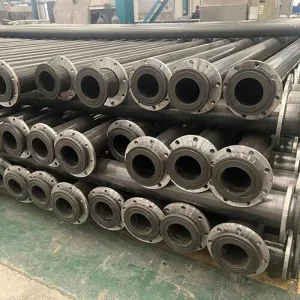
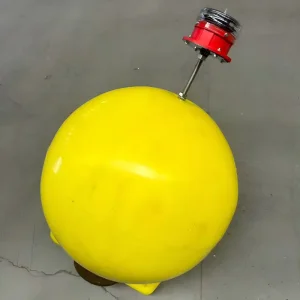



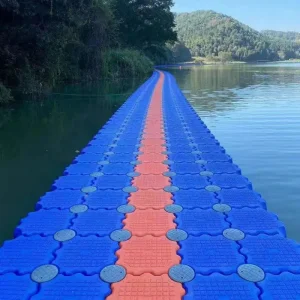
The Global Infrastructure Reality: Marine Dredging & Pontoon Flotation Dynamics
Marine dredging, tailings slurry transport, and land reclamation industries require unmatched structural reliability. Learn why legacy steel pontoons are systematically replaced by rotomolded polyethylene pontoon floats across 80+ international maritime territories.
Global Dredging CAPEX & Dredge Fleet Modernization
The global marine dredging market is projected to exceed USD 21.4 Billion by 2030, accelerated by navigation channel deepening for ultra-large container vessels (ULCVs) and extensive coastal protection against rising sea levels. High-capacity Cutter Suction Dredgers (CSDs) and Trailing Suction Hopper Dredgers (TSHDs) require continuous discharge line stability without downtime.
- Shift from corroding welded steel drums to seamless rotomolded PE shells
- High buoyancy-to-weight ratios minimizing booster pump energy consumption
- Full adherence to PIANC (World Association for Waterborne Transport Infrastructure)
Mining Tailings Slurry Transport in LatAm & Australia
Global mining operations across Chile, Peru, Western Australia, and South Africa operate long-distance tailings disposal and slurry pipelines across artificial settling ponds and tailing storage facilities (TSFs). Floating slurry pipelines encounter slurry densities ranging from 1.35 to 1.85 t/m³ with abrasive particulate slurries.
- Engineered custom inner diameters accommodating SDR 11 / SDR 17 HDPE pipe
- Closed-cell polyurethane foam cores preventing catastrophic sinking if perforated
- Chemical resistance against acidic leaching liquors and hyper-saline process waters
Total Cost of Ownership (TCO) Paradigm Shift
While traditional fabricated steel floats suffer from progressive marine coating failure, pitting corrosion, and weld seam fatigue, rotationally moulded Virgin Linear Low-Density Polyethylene (LLDPE) floats offer a service life exceeding 15 to 20 years with zero periodic anti-fouling repainting.
- Reduction of maintenance overhead by up to 68% over a 10-year project lifecycle
- Integrated UV-8 to UV-20 stabilizers resisting intense maritime tropical irradiance
- Standardized modular split-halves for rapid field repositioning without cranes
Engineering Buoyancy Formulation, Hydrodynamic Stability & Sizing Algorithms
A catastrophic failure mode in floating dredging operations is under-buoyancy caused by sizing for clean water rather than saturated high-density slurry. Our engineering calculations guarantee optimal waterline freeboard even under dynamic surging wave conditions.
Outer Shell: Stress-Crack Resistant Polyethylene
Manufactured using CNC-machined cast aluminum tooling under computer-controlled thermal cycles. Outer shells utilize grade PE100 / virgin LLDPE with antioxidant packages, guaranteeing no environmental stress cracking (ESCR > 1,000 hours per ASTM D1693 condition B).
- Uniform wall thickness distribution (±1.0 mm tolerance control)
- High elastic yield dampening impact energy from marine workboats
- Smooth fluorocarbon release surface minimizing marine barnacle fouling
Core Matrix: Hydrophobic In-Situ Polyurethane Foam
Pressurized in-situ injection of closed-cell polyurethane foam with an expanded core density of 32 to 38 kg/m³. Water absorption rate is strictly below 0.05 g/cm³ per ASTM D2842, guaranteeing long-term net positive displacement even upon ballistic shell punctures.
- Compressive strength exceeding 0.20 MPa preserving core shape
- Self-extinguishing fire rating (UL94 HF-1 compliant formulation)
- 100% mechanical keying to inner PE wall preventing slippage
Clamp Fastening & Torque Retention Dynamics
Equipped with hot-dip galvanized grade 8.8 or marine-grade AISI 316/304 stainless steel threaded rods, heavy-duty self-locking nylon insert flange nuts, and oversized pressure-distributing washers. Custom-molded anti-slip internal rib geometries prevent longitudinal pipeline creepage.
- Vibration-resistant torque clamping across high-shear booster discharge
- Molded-in positioning keys eliminating circumferential spinning
- Embedded eyelets for quick lanyard attachment & tow-bridle linkage
Accurate Pipe Float Buoyancy Sizing Method for Slurry Transport
To guarantee operational pipeline equilibrium without buckling under water turbulence, total net buoyancy must exceed the submerged gravitational vector of the steel/HDPE pipe, joint flanges, internal slurry mass, and dynamic wave impact forces by a safety coefficient factor (β) of 1.25 to 1.35 (or >1.40 in exposed open-sea locations).
Where:
• W_pipe = π × (OD_pipe - t) × t × ρ_material × Length
• W_slurry = π × (OD_pipe - 2t)² / 4 × ρ_slurry × Length (Note: ρ_slurry up to 1.85 kg/L in copper/iron sands)
• β = Hydrodynamic Reserve Factor (Standard: 1.25 - 1.30; Open-Sea Wave Action: 1.35 - 1.45)
• Target Submergence Line: Approximately 65% to 75% float draught, exposing 25% to 35% freeboard for visual navigation warning.
Pro-Tip: Underestimating slurry specific gravity will cause premature pipeline submersion, increased seabed drag, bend fatigue, and localized rupture at hose couplings.
Standard Pipeline Pontoon Float Specifications & Indicative ODM Pricelist
Explore transparent reference pricing frameworks for dredge pipe floats, slurry pontoons, and modular buoyancy units. Custom bore diameters, wall thicknesses, and cable-trough integrations available upon engineering drawing submission.
| Model / Size Index | Suitable Pipe OD (mm) | Float Outer Dia. (mm) | Length (mm) | Total Net Buoyancy (kg) | Wall Thickness (mm) | Indicative Price Range (USD/Pair) |
|---|---|---|---|---|---|---|
| JH-PF-110 | 110 mm (4") | 350 mm | 600 mm | 50 kg | 5.5 – 6.5 mm | $32.00 – $48.00 |
| JH-PF-200 | 200 mm (8") | 550 mm | 800 mm | 160 kg | 6.0 – 7.5 mm | $65.00 – $92.00 |
| JH-PF-315 | 315 mm (12") | 850 mm | 1,100 mm | 550 kg | 7.0 – 8.5 mm | $145.00 – $195.00 |
| JH-PF-450 | 450 mm (18") | 1,100 mm | 1,300 mm | 1,150 kg | 8.0 – 10.0 mm | $275.00 – $380.00 |
| JH-PF-630 | 630 mm (24") | 1,400 mm | 1,700 mm | 2,300 kg | 9.5 – 12.0 mm | $560.00 – $740.00 |
| JH-PF-800 | 800 mm (32") | 1,750 mm | 2,000 mm | 4,200 kg | 11.0 – 14.0 mm | $1,050.00 – $1,390.00 |
| JH-PF-1000 | 1,000 mm (40") | 2,100 mm | 2,300 mm | 7,100 kg | 13.0 – 16.5 mm | $1,850.00 – $2,450.00 |
| JH-PF-1200+ (Heavy-Duty ODM) | 1,200 mm (48") | 2,400 mm | 2,600 mm | 10,500 kg | 15.0 – 19.0 mm | Custom Engineered Quote |
* Notice: Indicative prices are FOB Qingdao / Tianjin port based on standard virgin LLDPE with PU foam infill and grade 8.8 galvanized bolt kits. Volume discounts (FCL 20GP/40HQ tier pricing), custom cable trough molds, marine stainless 316 hardware, and higher foam densities (45+ kg/m³) are quoted individually upon request.
Localized Application Scenarios & Environmental Operational Protocols
Flotation dynamics change dramatically between salt estuaries, hyper-arid tailing ponds, and turbulent open coastal bays. Here is how Juhua pontoon floats are optimized for localized marine scenarios.
1. Deepwater Seaport Dredging & Coastal Fairway Widening
Operational in heavy traffic marine harbors (e.g., Rotterdam, Singapore, Dubai Maritime City). Floating dredge pipelines run continuously alongside tugboats and cargo vessels. Integrated international orange and caution yellow hues ensure high visual conspicuity under fog and nighttime navigation.
- Options with radar reflectors and solar LED strobe integration
- Smooth cylindrical hull profiles that deflect minor glancing boat collisions
- Flexible rubber expansion joint integration mitigating torsional strain
2. High-Density Mining Tailings & Slurry Transport
Common across the copper deposits of the Atacama Desert, Australian gold/bauxite deposits, and Canadian oil sands. Heavy mineral sediments can settle along pipe inverts during pump shutdowns, generating eccentric gravitational moment loads.
- Engineered ballast distribution maintaining upright pontoon orientation
- Dual top cable troughs to safely float electric telemetry and pump control cables
- Chemical inertness across pH 2.0 (acid runoff) to pH 12.5 (alkaline tailings)
3. Mega Land Reclamation & Coastal Beach Replenishment
Major infrastructure projects in Southeast Asia and the Middle East move millions of cubic meters of dredged sand over multi-kilometer lines. Long-distance floating discharge lines operate across tidal surge zones where pontoons regularly rest directly on abrasive seabed mudflats during low tide.
- Reinforced heavy-wall bottoms resisting jagged coral and pebble wear
- Rapid lock-pin hardware reducing assembly time for 5-kilometer line runs
- Superior flexural modulus accommodating tidal curve transitions
4. Subsea Tie-In, Pipe Laying & Controlled Positioning
Offshore oil, gas, and subsea outfall water pipes require controlled underwater buoyancy during lower-and-pull phases. Modular tie-in floats with metered ballast valves support controlled positive-to-neutral buoyancy transitions during seabed deployment.
- Precise buoyancy ratings preventing uncalculated pipeline bending moments
- Deep-water crush-resistant syntactical foam options available
- Quick-release release pin brackets for ROV or diver disconnection
5. Offshore Solar (FPV) & Floating Marine Renewables
With large-scale offshore and reservoir floating photovoltaics (FPV) accelerating, specialized pontoon floats securely support floating power conduits, medium-voltage subsea inverter cables, and high-volume raw water bypass loops.
- Zero chemical leachate certified safe for municipal drinking reservoirs
- UV-20 anti-aging ratings guaranteeing 25-year solar array parity
- Anti-static grounding continuity integration for high-voltage cables
6. Industrial Desalination & Power Plant Cooling Intakes
Combined cycle power plants and RO desalination facilities require floating intake lines to capture clean surface water while rejecting heavy sea bottom silt. Pontoon floats maintain water intake suction bells at exact, stable water depths.
- Biological antifouling repellent formulations that inhibit marine growth
- Corrosion-proof titanium and AISI 316 fastener compatibility
- Hydrodynamic split construction allowing quick filter bell inspection
China Supply Chain Resilience, Automated Tooling & Rotomolding Precision
Why Tier-1 marine engineering contractors and EPCs consolidate their marine flotation procurement with Shandong Binzhou Juhua. We leverage automated temperature measurement, CNC steel tooling, and port-adjacent supply chains.
Raw Polymer Bulk Economics
Direct supply contracts with Sinopec and PetroChina provide certified prime virgin polymer granules at bulk cost stability, eliminating the 15-25% raw material markups typical of smaller regional fabricators.
Automated Variable-Speed Rock & Roll Mills
State-of-the-art bi-axial shuttle rotomolding machines with automated multi-zone infrared thermal sensors ensure complete, pore-free resin melting without thermal degradation, achieving consistent wall thickness.
Logistical Clustering & Nested Freight Packing
Located near Qingdao and Tianjin maritime freight hubs, our semi-circular split-ring float design nests compactly into 40ft High Cube containers, tripling buoyant volume capacity per shipment and minimizing ocean freight.
Rapid In-House Mold Tooling
Dedicated tooling workshop capable of fabricating bespoke cast-aluminum or fabricated steel pipe float molds in as little as 10 to 14 business days, slashing prototype turnaround for specialized project pipelines.
Technology Roadmap: Smart IoT Telemetry, Bio-Resins & Ultra-Deep Buoyancy
The next decade of marine dredging and subsea transport demands intelligent feedback, enhanced circularity, and unprecedented structural resilience. Discover Juhua’s forward-facing technology vectors.
Phase I: Integrated IoT Smart Buoyancy Nodes
Development of embedded, self-powered LoRaWAN and satellite-enabled telemetry sensors within float shell recesses. Monitors real-time pipeline parameters including draught depth, water ballast leaks, slurry line vibration, and localized sea surface temperatures.
- Early alerts for pipe wall thinning via acoustic vibration signature analysis
- GPS tracking to locate runaway lines during tropical typhoons
- Real-time tilt and torsion warnings preventing line kinks
Phase II: PCR Closed-Loop Circular Polymers
Advancing multi-layer co-extrusion and cross-linked rotational molding utilizing Post-Consumer Recycled (PCR) ocean-bound plastics. Outer sacrificial armor incorporates 30% recycled ocean PE without compromising mechanical tensile strength or UV stability.
- Carbon-reduced flotation modules certified for EU green port mandates
- 100% recyclability of polyurethane cores via chemical glycolysis reclamation
- Lifecycle environmental declaration (EPD) audit trails for global ESG reports
Phase III: Deep-Subsea Syntactic Aerogel Hybrids
Expanding from near-surface dredging depths to high hydrostatic pressure regimes (>50 bar) for deepwater deep-sea mining and offshore tie-in operations. Syntactic epoxy aerogel microspheres eliminate foam crush collapse under heavy barometric ocean loads.
- Hydrostatic crush resistance tested up to 1,500 meters water depth (MSW)
- Low density (0.42 g/cm³) delivering maximum lift per cubic meter of sea displacement
- Modular interlocking geometry accommodating subsea tension clamps
Stringent QA Protocols, Factory Testing Standards & Regulatory Compliance
Every batch of Juhua pipe floats undergoes strict quality assurance protocols before leaving our facility, ensuring complete compliance with international marine classification societies.
ASTM D1693 & ISO 9001 Structural Testing
Certified lab testing guaranteeing raw material environmental stress-crack resistance (ESCR > 1,000 hrs), tensile yield strength (≥ 21 MPa), and Charpy impact resistance down to -40°C for Arctic and winter marine dredging operations.
- Electronic ultrasonic non-destructive shell wall thickness scans
- Continuous electronic temperature tracking throughout the rotomolding cycle
- Hydrostatic crush chamber verification for subsea rated modules
Third-Party Inspection & Marine Societies
Full factory audit welcoming Bureau Veritas (BV), Lloyd's Register (LR), DNV, or SGS inspection protocols. Detailed mill test certificates (MTC) supplied with batch traceability for every shipping container.
- Fastener tensile and salt-spray chamber testing (>1,000 hrs per ASTM B117)
- Closed-cell polyurethane foam density and water ingress verification
- CE marking and REACH environmental compliance certificates provided
Clear Commercial Warranty & Spares Interchangeability
Warranty coverage initiates upon handover to the project investor and extends up to 18 months post-delivery or 12 months in service. Standardized precision tooling ensures 100% interchangeability: any spare half matches previous batches without re-drilling.
- Emergency airfreight dispatch of replacement hardware and fasteners
- Detailed 3D step files provided for contractor naval buoyancy modeling
- Dedicated multilingual technical service engineers answering within 24 hours
Procurement & Engineering FAQ: Pipeline Pontoon Floats
In-depth technical answers addressing user search intent, naval architecture calculations, export logistics, and chemical compatibility for dredging and mining contractors.
What is the standard spacing recommendation between adjacent pipeline floats?
Standard dredge pipeline installations position floats with a gap equivalent to roughly 0.5 to 1.0 times the length of one float body, or clamped back-to-back in high-density slurry scenarios. Maintaining a measured gap allows the floating pipeline to flex naturally with swell movements without the pontoon outer shoulders colliding, preventing edge fractures during tidal flexing.
How do you compensate for slurry density when specifying pipeline buoyancy?
Slurry density ranges from 1.05 kg/L (silty water) up to 1.85 kg/L (concentrated iron or copper sand tailings). Calculations must use saturated operating slurry mass rather than clean water weight. Total float buoyancy must provide a 1.25x to 1.35x reserve factor above total pipeline weight (pipe + fully laden slurry + steel flanges) so that 25% to 30% of the pipe diameter floats above the waterline.
Why is rotomolded polyethylene preferred over welded steel drum pontoons?
Rotomolded virgin polyethylene floats never rust in seawater, eliminate the need for anti-corrosion recoating, and flex elastically upon vessel impact without permanent denting. Additionally, Juhua floats are filled with closed-cell polyurethane foam; if the outer shell suffers an impact rupture, the hydrophobic closed cells prevent water ingress, whereas a punctured steel pontoon immediately floods and sinks the discharge line.
Can you provide custom inner diameter bore sizes for non-standard pipelines?
Yes. While our standard tooling accommodates global HDPE pipe sizes (from 110 mm up to 1,200 mm OD), our CNC pattern facility can customize internal clamp ribs, install rubber friction lining gaskets for steel or PVC pipes, and integrate specialized channels or cable troughs for auxiliary electric wiring.
How does UV stabilization protect floats operating in tropical marine environments?
We blend high-performance hindered amine light stabilizers (HALS) into the virgin polyethylene resin prior to rotational molding (rated UV-8 to UV-20). This molecular package neutralizes photo-oxidative degradation from intense tropical solar radiation, preserving tensile strength, flexural modulus, and color vibrancy for over 15 to 20 years in outdoor equatorial marine service.
What is the standard production lead time and container packing efficiency?
Typical batch lead time is 7 to 15 business days for standard sizes up to two 40HQ container loads. Because our pontoon floats are molded in symmetrical split halves, they stack and nest efficiently inside standard sea containers, optimizing container cubic utilization and significantly reducing ocean freight costs per unit.
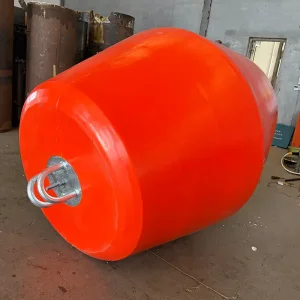
Subsea Anchoring, Mooring Buoys & Specialized Slurry Products
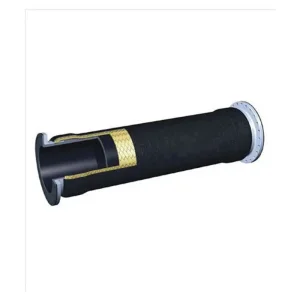
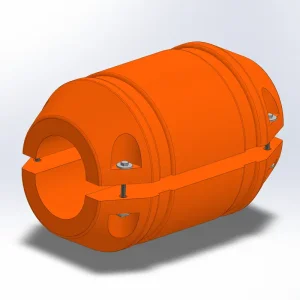
Complement your floating pipeline setup with certified marine mooring buoys, subsea tie-in solutions, heavy-duty armored rubber hoses, and custom rotational molded pontoons.
Need a Custom Sizing Calculation & Official Pricelist?
Submit your pipe outer diameter (OD), material grade, slurry specific gravity, and deployment coordinates. Our certified naval architecture team will return a complete buoyancy analysis and factory-direct quotation within 24 hours.