High-Integrity Pipe Floats & Marine Buoyancy Modules
Engineered with cross-linked closed-cell polyurethane foam and high-density virgin polyethylene shells to ensure zero sinkage under deep sea mechanical stress.

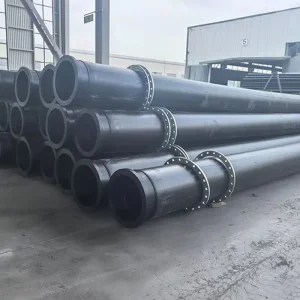




The Physics of Submerged Pipeline Flotation & Slurry Ballast
In modern dredging, harbor land reclamation, and marine industrial operations, selecting an OEM hose floater is fundamentally a study of dynamic hydrodynamic mechanics. A catastrophic failure occurs when pipeline buoyancy modules are specified only for static pure-water weights, omitting dynamic slurry specific gravity (SG), cresting wave fatigue, flow drag, and marine fouling.
Polyethylene hose floaters produced by Shandong Binzhou Juhua Rubber & Plastic Co., Ltd. (Giant Rubber) are engineered according to rigorous metacentric height ($GM$) stability formulas. Our structural casings neutralize axial shear forces caused by undulating swell periods and cyclic engine pump vibrations, preventing pipeline ovalization and flange separation.
Unlike steel buoyancy pontoons that experience rapid galvanic corrosion, internal moisture entrapment, and premature stress cracking, rotationally molded polymer floaters offer completely chemically inert, impact-resilient containment. Built with variable wall thickness profiles, our floating collars ensure uniform load transfer along rubber hoses and HDPE discharge pipes.
| Engineering Attribute | Standard Floats | Juhua Industrial Grade |
|---|---|---|
| Outer Shell Polymer | Recycled PE / Blends | 100% Virgin LLDPE / HDPE UV-8+ |
| Foam Core Chemistry | Low-density scrap filler | Closed-Cell PU (≥40kg/m³, 95% sealed) |
| Fastener Metallurgy | Electro-galvanized | Hot-Dip Galv. Grade 8.8 / SS316 Marine |
| Thermal Range | -10°C to +40°C | -40°C to +60°C Operational |
| Tensile Strength (ASTM D638) | ≤14 MPa | ≥21 MPa Yield Point |
China Factory 4.0: Supply Chain Resilience & Rotational Molding Precision
Our Lizhuang Town, Huimin County production hub integrates automated temperature-regulated rotomolding cycles with continuous ultrasonic wall thickness verification.
Variable-Frequency Automated Heating
Microprocessor-driven multi-axis biaxial rotation furnaces ensure that melt kinetics remain perfectly steady across the tooling surface. This eliminates weak internal seam lines, cold spots, or stress concentrators typically created by inconsistent manual heating.
Closed-Cell Polyurethane In-Situ Core
Every floater body is filled using high-pressure automated proportioners dispensing CFC-free polyurethane foaming chemicals. Curing at ≥40kg/m³ creates a dense closed-cell internal grid that cannot absorb moisture, even if the exterior polyethylene skin suffers structural puncture.
Standardized Mold Repeatability
Precision CNC-cut cast aluminum and premium fabricated steel molds ensure unmatched interchangeability. Replacement half-shells ordered years apart mate precisely with existing field pipelines, preserving assembly lines and standard bolt arrays.
Engineered Flotation Solutions for Challenging Marine Environments
From cutter suction dredge lines to open-ocean mining slurry pipelines, our floaters are custom-adapted to localized sea states, bathymetry, and project configurations.
Offshore Dredging & Land Reclamation
Supporting critical discharge pipelines carrying high-abrasion quartz sands and ocean sediments. Engineered freeboard profiles keep lines visible to commercial marine traffic while preventing bending fatigue along heavy-duty armored discharge strings.
Mining Tailings & High-Density Slurry
In tailings storage facilities (TSFs) and chemical processing plants, conveyed mineral slurries often exceed a specific gravity of 1.4 to 1.7. We calculate custom buoyancy allowances to handle heavy sediment settling without dragging floating transfer pipes under water.
Desalination Brine & Outfall Management
Hypersaline outfall lines demand extreme resistance to chemical corrosion and temperature fluctuations. Our high-density polyethylene structures withstand severe UV oxidation, coastal turbulence, and continuous contact with warm brine concentrations.
Subsea Tie-In & Controlled Positioning
Staged buoyancy modules provide calibrated dynamic uplift during critical underwater pipeline pull-ins, beach approaches, and bottom tow procedures, minimizing seabed dragging tensions and protecting subsea pipe coatings.
Harbor Security & Debris Containment
Linked rotomolded barrier floats and trash booms protect hydroelectric turbine intakes, canal gates, and port perimeters from aquatic biomass, trash, and unauthorized vessel entry with minimal maintenance overhead.
Instrumentation & Cable-Trough Integration
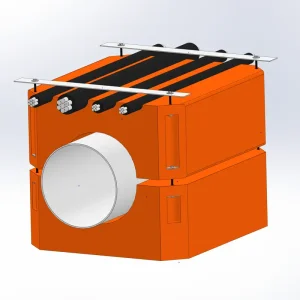
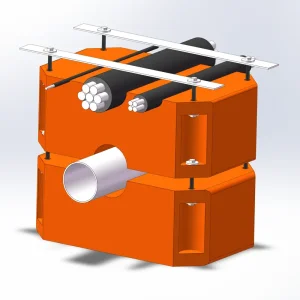
Specialized flotation modules incorporate recessed routing channels for power feeds, fiber-optic instrumentation, and auxiliary hydraulic lines, shielding critical utilities from abrasion, snagging, and marine weather exposure.
Strategic Total Cost of Ownership (TCO) for EPC Contractors
For international supply chain managers and project directors, equipment acquisition extends beyond unit ex-factory pricing. Realized profitability depends on field assembly labor, container packing efficiency, longevity in harsh environments, and maintenance down-time.
Juhua rotationally molded hose floaters deliver substantial lifecycle cost savings compared to alternative options:
- Logistical Nesting Design: Symmetrical modular half-rings stack inside 40ft High Cube containers, maximizing cubic space utilization and lowering per-unit freight rates to global ports.
- Zero Coating Maintenance: Unlike steel drums that need regular recoating and cathodic zinc anode replacement, UV-stabilized polyethylene remains rust-free and paint-free for over a decade.
- Rapid Clamp-On Erection: Ergonomic bolt recess channels allow two-man field teams using basic pneumatic tools to assemble complete sections around pipelines quickly, saving vessel charter hours.
Procurement Specifier's Checklist
Provide these technical project variables to receive a fast, accurate buoyancy sizing report within 24 hours:
The Evolution of Marine Flotation: Smart Telemetry & Circular Polymers
Marine buoyancy systems are evolving from passive components into active, sensor-enabled assets that monitor maritime conditions in real time.
IoT Structural Health Telemetry
We are integrating low-power wireless strain gauges and tilt inclinometers directly into molded float bodies. Connected to satellite and NB-IoT gateways, these modules track pipeline fatigue, dynamic torsion angles, and mooring loads in real time.
Bio-Based & Ocean-Recycled Resins
To support ESG goals for global offshore operators, our material research focuses on incorporating up to 35% chemically recycled ocean plastics into exterior casings without compromising ASTM D1693 environmental stress crack resistance (ESCR).
Advanced Hydrodynamic Low-Drag Geometries
Using computational fluid dynamics (CFD), we continue to refine the entry and exit contours of our floaters. Minimizing current drag coefficients ($C_d$) cuts transverse forces on anchors and lowers fuel consumption for dredge pump vessels.
Exceeding International Maritime & Quality Standards
Every Juhua buoyancy module leaves our facility with fully documented, traceable quality paperwork, in compliance with international testing frameworks.
ISO 9001:2015
Comprehensive quality management across raw material inspection, molding temperature logs, and post-demold cooling cycles.
PIANC Guidelines
Designed to satisfy World Association for Waterborne Transport Infrastructure standards for navigation channel resilience.
ASTM Testing Protocols
Verified by ASTM D1693 environmental stress-crack tests and ASTM D790 flexural performance standards in accredited testing labs.
18/12 Month Warranty
Protected by an 18-month handover / 12-month post-installation operational warranty backed by factory technical engineers.
Frequently Asked Questions on Pipe Float Sizing & Operations
Direct answers from our senior flotation design engineers to support your procurement evaluations.
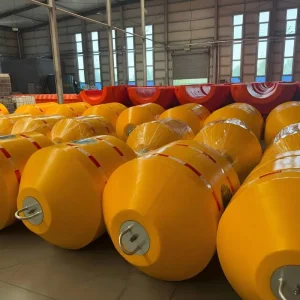
Pipeline floats (often called dredge floats or pipe buoyancy modules) are rotationally molded polyethylene bodies bolted around discharge pipelines, steel delivery conduits, or flexible rubber hoses. Their primary role is to maintain controlled buoyancy on the water surface, keep discharge lines aligned, prevent excessive pipeline sagging, and ensure visibility to maritime vessel traffic.
Total buoyancy must always exceed the combined weight of the pipeline, its connectors, and the internal slurry medium. The engineering formula is: $\text{Total Net Buoyancy} \ge (\text{Pipe Weight} + \text{Conveyed Medium Weight} + \text{Accessories}) \times 1.25 \text{ to } 1.30$. Using this safety factor guarantees that roughly 25% to 30% of the pipe diameter sits safely above the waterline, preventing submergence under heavy wind and wave loads.
High-density virgin polyethylene never rusts, pits, or degrades in salt water, unlike steel units. It needs no sandblasting, protective anti-fouling coatings, or internal corrosion monitoring. In addition, its natural flexibility absorbs collision impacts without puncturing, and our closed-cell polyurethane foam filling keeps it floating even if the shell is accidentally damaged.
Conveyed slurry containing heavy iron tailings, gravel, or coarse ocean sand often has a specific gravity (SG) ranging from 1.3 to 1.7—far heavier than freshwater (1.0) or standard seawater (1.03). Sizing for pure water results in an under-buoyant system that can sink once pumps start up. We adjust floater outer diameter, length, and pairing spacing according to your specific slurry SG.
The standard warranty begins on the date the equipment is formally handed over to the project client and concludes either 18 months following that handover or 12 months after the completed installation date—whichever threshold is reached first. Full technical documentation and replacement guarantees back all manufacturing quality parameters.
Yes. We operate dedicated tooling and mold fabrication shops that engineer floater internal diameters (ID) to match any steel, PVC, HDPE, or flanged rubber hose OD up to 1200mm+. We also produce custom-molded longitudinal troughs to carry power, instrumentation, and control lines safely across water.
Advanced Offshore Mooring, Barrier & Utility Buoyancy Solutions
Explore our extended series of mooring buoys, cable-trough pipe floats, and continuous aquatic perimeter protection barriers.