

High-Performance Marine Inventory
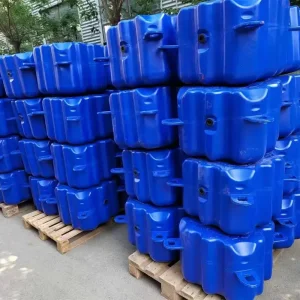
Precision Modular Dredging Floaters & Offshore Pontoons
Engineered for minimal hydrodynamic drag and reinforced with high-density polyurethane closed-cell core matrix.



20+
Years Rotomolding Experience
100+
Engineers & Production Crew
80+
Maritime Export Destinations
100%
Seamless Virgin PE Polymers
Manufacturing Superiority
Why Sourcing from Our Shandong Industrial Cluster Drives Global Project Viability
Strategic integration of high-throughput rotational casting tooling, petrochemical grade resin access, and automated multi-zone curing delivers structural integrity unmatched by standard composite extrusions.
Advanced Microprocessor Thermal Control
Our computerized rotational casting chambers deploy dual pyrometer infrared monitoring to regulate oven temperatures within ±1.5°C across all mould axes.
- Eliminates inner wall shrinkage and thermal porosity
- Guarantees standardized thickness across flange interfaces
- Yields consistent mechanical impact values (Charpy > 18 kJ/m²)
Monolithic Anti-Delamination Matrix
Utilizing high-pressure in-situ injection of high-density closed-cell polyurethane foam (38–45 kg/m³) with hydrophobic water absorption resistance below 0.1 g/cm².
- Hydrophobic barrier prevents core waterlogging on puncture
- Permanent bond between polyurethane core and PE outer skin
- Maintains designed waterline under heavy dynamic pipe sag
Scale Economics & Logistics Precision
Direct supply line situated in Binzhou, Shandong provides immediate maritime egress through Qingdao and Tianjin deepwater ports for consolidated ocean containerization.
- Nested half-shell geometries cut shipping volume up to 40%
- Shortened lead-times for large capital infrastructure projects
- Full traceability with factory batch certifications and MTRs
Industry Intelligence
Global Flotation Trends: Transition from Steel Cylinders to Polymers
How stringent ESG standards, maritime corrosive environments, and deep dredging imperatives are reshaping pipeline buoyancy specifications.
Zero Marine Degradation Mandate
Conventional welded steel pontoons deteriorate rapidly under saline spray and biological fouling, shedding heavy metal residues and flaking anticorrosive paints into sensitive marine habitats.
Modern rotational moulded virgin LLDPE/HDPE provides a zero-corrosion, biologically neutral casing with high UV8 to UV20 stabilization, extending marine asset longevity to 15+ operational years.
Dual Conveyance: Slurry + Electrification
Electrification of modern mega-cutter suction dredgers (CSD) necessitates conveying high-voltage power cables (6.6kV–15kV) alongside abrasive slurry lines to reach shore power terminals.
Custom OEM pipe floaters feature pre-engineered cable troughs and secondary retention clamps to isolate high-voltage umbilicals away from mechanical flexure zones, avoiding pinch points.
Severe-Condition Hydrodynamics
Offshore open-sea tailing disposals encounter extreme multi-axial wave forces, requiring floaters to act as shock absorbers rather than rigid load concentration nodes.
Rotomolded semi-flexible jackets dampen cyclic bending stresses, protecting expensive flange collars, flexible rubber discharge joints, and high-tensile mooring assemblies from fatigue rupture.
Field Deployment Calculations
Engineered Sizing Methodology: Slurry Density vs. Freeboard Stability
Accurate float spacing ensures discharge stability and prevents submerged pipelining under peak slurry concentrations.
Theoretical Reserve Margin
The Hydrodynamic Rule of Thumb
Sizing pipeline buoyancy modules based on empty or fresh-water-filled pipe weights is a frequent source of pipeline submersion. Slurry specific gravity regularly reaches 1.3 to 1.6 kg/dm³ during reclamation dredging. Safe operations demand deliberate excess reserve.
- Maintain at least 25% of pipe diameter above the static waterline
- Factor in localized bolt, flange, cable, and connector hardware mass
- Account for biological marine crustacean fouling over prolonged stays
Total Buoyancy (F_b) ≥ (W_pipe + W_medium + W_hardware) × k
Where k represents the engineering safety factor: k = 1.25 to 1.30 for calm inland lagoons; k = 1.35 to 1.50 for rough offshore conditions.
Global Use Cases
Localized Engineering Implementations Across Extreme Environments
From sub-zero mining tailings to equatorial land reclamation, our modular flotation casings undergo stress validation for harsh field deployments.
Port Deepening & Terminal Reclamation
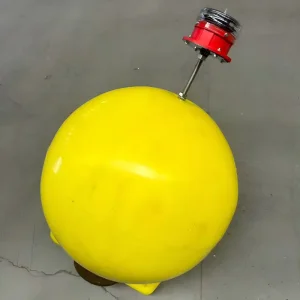
Heavy harbor traffic requires steady channel demarcation alongside active dredging lines. Our high-visibility safety-orange floaters integrate with navigation marks to maintain visible navigation lanes during non-stop berthing expansions.
Mining Tailings Decant & Ash Disposal
Handling acidic or alkaline mineral tailings demands chemical resistance beyond coated carbon steel. Our rotomolded polyethylene casings resist chemical degradation across pH 1 to 14, isolating internal pipe conduits against aggressive leaching slurries.
Reservoir Desilting & Waterway Intake
Hydroelectric power dams, municipal intake pumps, and environmental trash interceptors rely on modular HDPE floating barriers and bypass modules to capture silt curtains and floating debris, maintaining clear turbine channels.
Procurement Dynamics
Addressing EPC & International Dredging Contractor Demands
Technical specifications and logistical factors that determine selection by international commercial procurement teams.
Interchangeability & Mould Repeatability
Global fleets rotate pipe modules internationally. Sourcing from standardised CNC-machined aluminum tooling ensures that replacement float halves align with existing pipeline hardware across varied production years.
Third-Party Inspections (SGS, BV, Lloyd's)
Global supply agreements require rigorous quality verification. We facilitate third-party QA protocols, including ultrasonic wall thickness testing, hydrostatic immersion tests, raw material MFI checks, and tensile drop impacts.
Fast Assembly Clamping Hardware
Field installations run on narrow marine weather windows. Our systems utilize galvanized or 316 stainless steel tensioning hardware with anti-loosening lock nuts, engineered for rapid pneumatic ratcheting from maintenance workboats.
Specialized Project Solutions
Engineered Municipal, Mining & Harbour Buoyancy Elements
Explore our extended series of custom rotational moulded marine elements and high-tensile pipeline platforms.



What are dredging pipeline floats and how do they function?
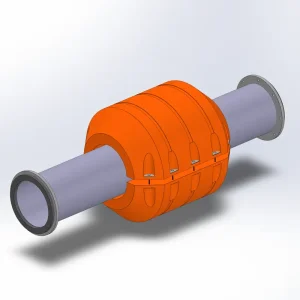
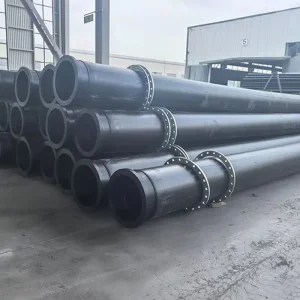
Pipeline floats, also recognized in marine engineering as dredge floats or buoyancy jackets, are clamp-on modular polyethylene shells filled with rigid polyurethane foam. Clamped around steel, HDPE, or composite discharge hoses, they keep the pipeline buoyant, aligned, and visually distinct on the water while maintaining hydrodynamic stability under cross-currents.
How do you calculate the exact number of floats needed for a slurry pipeline?
Total float buoyancy must exceed the combined deadweight of the conduit, structural fittings, and internal slurry medium. As an engineering baseline, total buoyancy should deliver a 25% to 30% reserve margin above this total weight, maintaining approximately one-quarter of the pipe diameter above the water line under maximum slurry density.
Why is rotational moulded polyethylene preferred over fabricated steel floats in seawater?
Polyethylene is chemically inert and completely impervious to seawater corrosion, salt spray degradation, and electrolytic corrosion. Unlike welded steel pontoon tanks that can rust, suffer localized weld cracks, or require regular toxic repainting, rotomolded PE floats require virtually zero maintenance over their service life.
What is your standard manufacturer warranty term?
Our standard international warranty begins when the product is transferred to the primary client/investor and runs for 18 months from the confirmed handover date or 12 months after on-site commissioning, whichever milestone arrives first, backed by full factory material defect liability.
What engineering variables must be supplied to obtain a detailed buoyancy quotation?
To calculate suitable buoyancy options, please share: pipe outer diameter (OD), wall thickness and substrate material, target slurry density (specific gravity in kg/m³ or t/m³), pipeline installation length, environmental site criteria (river, lake, sheltered harbour, or open offshore), required freeboard percentage, and destination discharge port.
Can float bodies be customized for auxiliary utility channels and odd pipe diameters?
Yes. We regularly design and mould customized float shells incorporating secondary cable channels, integrated power supply troughs, mooring eyelets, and customized inner bore clamp diameters to match any non-standard steel or HDPE conduit profile.