

Mooring Infrastructure
Technical Pricelist & Quotes
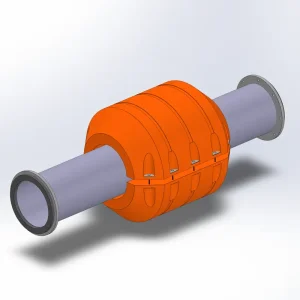
Engineered for high-viscosity discharge, deep-water port operations, and hostile oceanic installations. The catalog below displays our field-proven, rotomolded buoyant hulls and mooring systems manufactured to strict ISO 9001 and marine regulatory standards.


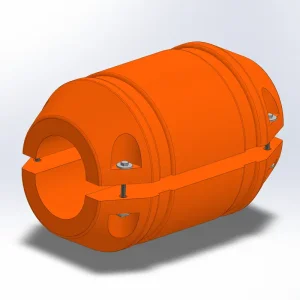
The global marine dredging, land reclamation, and coastal infrastructure sector is currently witnessing unprecedented capital reinvestment driven by three structural macroeconomic drivers: the mandatory deepening of major maritime shipping fairways to handle ultra-large container vessels (ULCVs up to 24,000 TEU), massive urban coastal reclamation initiatives throughout the Asia-Pacific and Arabian Gulf corridors, and the rigorous remediation of riverine siltation caused by accelerated climate-induced hydrological events. Within this complex operating paradigm, floating discharge pipelines serve as the indispensable vascular network of modern marine excavation.
Historically, dredging contractors relied heavily upon welded steel pontoons and rigid pontoon assemblies to suspend discharge lines. However, historical operational audits reveal that steel pontoons introduce substantial project liabilities: unrecoverable corrosion in hyper-saline oceanic environments, severe hull fatigue induced by perpetual cyclical wave oscillation, catastrophic sink risks upon localized hull breaches, and exorbitant transport costs attributable to non-nestable bulk geometry. The modern dredging paradigm has irrevocably shifted toward high-grade, rotationally molded Medium-Density and High-Density Polyethylene (MDPE/HDPE) pipe floats encapsulated with closed-cell polyurethane (PUR) core matrices.
As offshore reclamation zones push farther into unprotected coastal waters, dredging pipeline assets are routinely subjected to high-energy swells, cross-current shear stresses, and severe UV photo-oxidation. Consequently, leading global EPC contractors, port authorities, and hydraulic reclamation consortia evaluate flotation manufacturers not merely as molders of plastic shells, but as integrated hydro-mechanical partners capable of engineering precision-metered buoyancy distribution, validated finite-element structural integrity, and standardized interchangeability across extensive commercial pipeline fleets.
Navigational depth maintenance requires Cutter Suction Dredgers (CSD) and Trailing Suction Hopper Dredgers (TSHD) to discharge continuously across busy shipping routes. Floats must exhibit high-visibility marine yellow/orange pigmentation with luminescent retro-reflective markers to prevent vessel impact while maintaining fixed channel corridors.
Tailings management facilities (TMFs) require slurry pipelines carrying mineral waste with specific gravities frequently surpassing 1.65. Floats must possess specialized chemical resistance to withstand cyanide, acidic drainage, and abrasive mineral solids without softening or degrading during continuous multi-year operational cycles.
Municipal water supplies, inland canals, and hydroelectric dams demand low-draft flotation modules capable of maneuvering through shallow waters, winding channel bends, and turbulent river hydraulics without scouring benthic ecologies or snagging submerged debris arrays.
In the highly specialized arena of marine flotation manufacturing, China—and specifically the industrial manufacturing cluster anchored in Binzhou, Shandong—has established a world-class manufacturing center. Shandong Binzhou Juhua Rubber & Plastic Co., Ltd. (operating internationally as Juhua / Giant Rubber) exemplifies this industrial evolution. With over two decades of dedicated rotational molding advancement, modern facilities, and an export footprint spanning over 80 sovereign nations, Juhua bridges the historical gap between rapid OEM production scalability and stringent, Western-grade quality management frameworks.
Traditional rotational molding historically suffered from thermal inconsistencies, leading to non-uniform wall thicknesses, structural embrittlement at radii, and inadequate polymer sintering. Modern Chinese manufacturing leaders have revolutionized this process through the integration of variable-frequency speed controls, multi-axis computerized biaxial arm kinematics, and electronic real-time internal mold temperature telemetry. This industrial automation ensures that every single polyethylene shell exhibits uniform, isotropic material density, eliminating structural micro-fissures and stress-concentration zones.
We utilize 100% virgin linear low-density and medium-density polyethylene resins compounded with Class 8 hindered-amine light stabilizers (HALS) and antioxidant matrices, guaranteeing long-term resistance against UV radiation and thermal degradation.
Internal buoyancy chambers are filled under automated metering with high-density, closed-cell polyurethane foam ($\ge 35\text{ to }40\text{ kg/m}^3$). Closed-cell percentages exceeding 92% ensure absolute water non-absorption even if outer polymer hulls incur localized rupture.
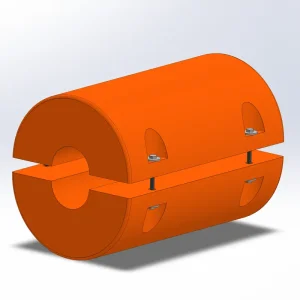
By investing heavily in precision CNC-milled aluminum tooling molds, our production units maintain strict concentricity. Replacement half-shells integrate seamlessly with previously deployed units, eliminating costly offshore retrofit downtime.
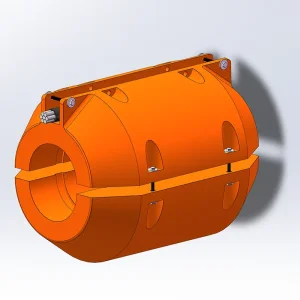
Our engineered geometric profiles allow nesting of paired semicircular modules, maximizing volumetric container utilization (TEU/FEU) and lowering ocean shipping costs by up to 35% compared to non-optimized circular buoyant bodies.
A frequent error observed in dredging procurement is the miscalculation of buoyancy margins based on hydrostatic assumptions of pure water. In operational conditions, a dredging discharge line functions as an intensive dynamic conduit transporting multi-phase slurries—water carrying suspended silica sand, gravel, clay clumps, or heavy iron ore tailings. When the internal slurry density exceeds $1.3\text{ g/cm}^3$, improperly sized buoyancy systems submerge below critical waterline thresholds, creating excessive drag, bending strain on flanges, and premature catenary sagging that can lead to catastrophic pipeline ruptures.
Marine engineers must perform rigorous buoyancy sizing calculations factoring in the bare pipe structural weight, maximum slurry specific gravity, bolted coupling weights, electrical transmission umbilical cords, and an engineering reserve factor ($C_R$) ranging from 20% to 30% to accommodate hydrodynamic wave slap, current draft, and marine biofouling growth.
Achieving an optimal working waterline corresponds to keeping approximately 25% to 30% of the pipe float’s total outer diameter above the calm waterline (Freeboard Target). Operating below this freeboard target exposes the floating conduit to severe hydrodynamic drag forces, which in cross-currents can overwhelm anchor systems and twist pipe strings, inducing catastrophic rotational shear along the bolt connections.
| Nominal Pipe OD (mm) | Float Dimensions (OD × Length mm) | Net Buoyancy Rating (kg) | Shell Thickness (mm) | PUR Foam Density | Recommended Fastener Grade |
|---|---|---|---|---|---|
| Ø 250 mm (10") | Ø 700 × 1000 | ~ 310 kg | 8.0 - 9.5 mm | 35 - 38 kg/m³ | Hot-Dip Galv. Class 8.8 / AISI 304 |
| Ø 355 mm (14") | Ø 900 × 1100 | ~ 540 kg | 9.0 - 11.0 mm | 35 - 38 kg/m³ | Hot-Dip Galv. Class 8.8 / AISI 316 |
| Ø 500 mm (20") | Ø 1200 × 1300 | ~ 1,120 kg | 10.0 - 12.5 mm | 38 - 40 kg/m³ | Marine Stainless AISI 316 / Dacromet |
| Ø 630 mm (24") | Ø 1400 × 1500 | ~ 1,850 kg | 11.0 - 14.0 mm | 38 - 42 kg/m³ | Marine Stainless AISI 316 High-Tensile |
| Ø 800 mm (32") | Ø 1800 × 2000 | ~ 3,900 kg | 13.0 - 16.5 mm | 40 - 45 kg/m³ | High-Tensile B7 / 2H Coated Marine |
| Ø 1000 mm (40") | Ø 2200 × 2200 | ~ 6,700 kg | 15.0 - 19.0 mm | 42 - 48 kg/m³ | Special Heavy Marine Flange Sets |
The operating parameters for marine flotation vary drastically based on hydrodynamic exposure, sediment chemistry, and local regulatory conditions. Understanding these specific application variables ensures precision engineering and prevents premature in-situ failures.
Confined maneuvering conditions demand high impact resistance against vessel collisions, tug wake turbulences, and rapid tidal fluctuations.
Continuous pumping over 3 to 10 kilometers. Floats must absorb continuous mechanical vibration from CSD discharge pumps without loosening clamp bands.
Extreme chemical toxicity and high solids concentration require dense MDPE shells immune to acidic leaching, hydrocarbons, and severe weathering.
Engineered staged buoyancy modules guide subsea pipelines to accurate seabed touch-down zones during complex bottom-pull and tie-in installations.
Potable water facilities require food-grade certified, non-toxic polyethylene materials that resist algae accumulation without leaching harmful additives.
The dredging and marine flotation sector is actively transitioning from passive buoyancy equipment into instrumented, intelligent marine structures. Key forward-looking technical vectors shaping commercial procurement include:
Procuring marine flotation systems for extensive capital dredging projects requires meticulous review of technical metrics beyond superficial price-per-kilogram quotes. International engineering, procurement, and construction (EPC) contractors must ensure prospective suppliers satisfy rigorous material qualification standards before approving production tooling:
Mandate factory mill test certificates verifying Tensile Strength at Yield (> 21 MPa via ISO 527), Elongation at Break (> 400%), and Environmental Stress Crack Resistance (ESCR > 1,000 hours under ASTM D1693 Condition B, 10% Igepal).
Verify that foam fill achieves an absolute closed-cell percentage ≥ 90% (DIN 53428) with water absorption not exceeding 0.20 kg/m² under continuous prolonged hydrostatic submergence tests.
Confirm clamping bolts incorporate hot-dip galvanizing (≥ 85 μm zinc coating conforming to ISO 1461) or marine Grade AISI 316 stainless steel with specialized anti-galling thread coatings to facilitate field maintenance and repositions.
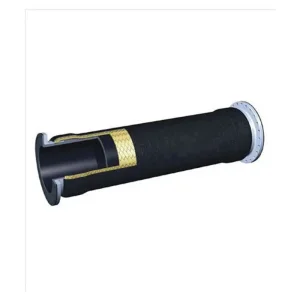
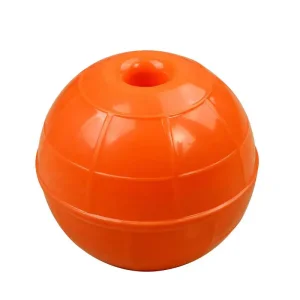
Explore our extended series of rotationally molded marine components, modular floating barriers, multi-chamber safety buoys, and dynamic high-pressure rubber discharge hoses engineered for high-demand maritime works.

Authoritative, physics-based answers to key technical questions routinely posed by marine project managers, dredging superintendents, and procurement executives.
The standard manufacturer warranty activates on the verified handover date from the buyer to the end client/investor and terminates 18 months post-handover, or 12 months after the initial operational installation date—whichever threshold transpires first. This warranty guarantees structural integrity against environmental stress cracking, UV resin embrittlement, and internal polyurethane foam separation under normal operating design conditions.
Unlike blow molding, which leaves thin spots at complex corners, rotational molding yields stress-free, seamless, uniform-wall polymer bodies with reinforced outer radii. Compared to fabricated steel pontoons, rotomolded PE floats are completely immune to saltwater rust, resist aggressive marine borers, do not require sacrificial anodes or recurring repainting, and eliminate catastrophic sinking risks because our closed-cell PUR foam matrix prevents flooding even if punctured.
Discharge slurry specific gravity dictates the submerged line displacement. If slurry density shifts from clean water ($1.0\text{ t/m}^3$) to coarse sand ($1.55\text{ t/m}^3$), the wet pipeline weight increases substantially. Floating support must be adjusted by either decreasing longitudinal float spacing or deploying larger-diameter buoyancy modules to maintain the mandatory 25% freeboard, preventing the pipe from dragging bottom or over-stressing flex joints.
To produce an exact engineering specification, clients should provide: (1) Pipe exact outside diameter (OD) and material (HDPE, steel, or rubber), (2) Conveyed slurry density ($\text{g/cm}^3$ or $\text{t/m}^3$), (3) Working environment (open sea, tidal estuary, enclosed lagoon, or tailing pond), (4) Local current velocities and significant wave height ($H_s$), and (5) Intended freeboard percentage and destination seaport for optimized container nesting calculations.
Yes. Juhua engineers and manufactures customized rotomolding tooling incorporating molded-in longitudinal grooves to hold 3-phase high-voltage power cables, remote telemetry instrumentation lines, or auxiliary hydraulic return runs. External hulls can also be molded with sensor-mounting brackets, reflective band channels, and anti-slip inspection steps to enhance offshore operations.
Our pipe floats feature precision internal clamping diameters designed to compress slightly around standard pipe outer dimensions. For dynamic high-swell applications or smooth HDPE lines, we supply high-friction ribbed elastomeric gaskets or internal anti-slip ridges molded directly into the half-shells. When torqued to specified values with Class 8.8 / AISI 316 fasteners, the floats remain securely fixed longitudinally without damaging the pipe wall.
Require a custom buoyancy calculation, structural finite element review, or rapid containerized FOB/CIF quotation for an upcoming tender? Our engineering desk responds within 24 hours.