Modular Systems
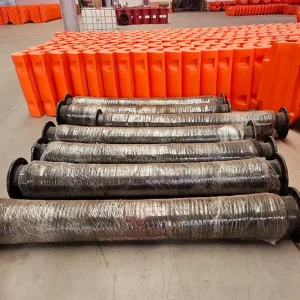
Engineered for high-impact resistance, extreme hydrodynamic loads, and corrosive marine deployment. Direct-fit solutions matched to your outer diameter (OD) and slurry gravity requirements.


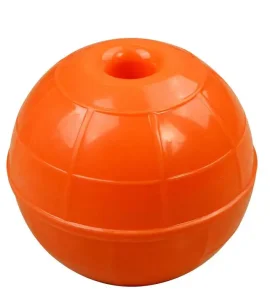

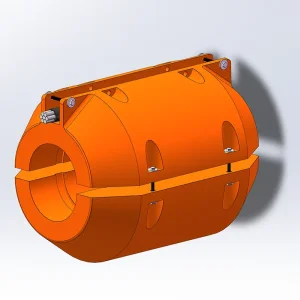
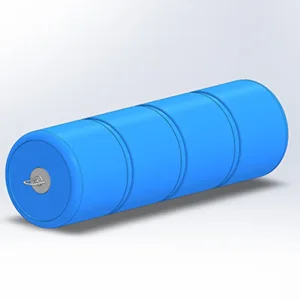

Modern capital dredging and continuous hydraulic conveyance have undergone a paradigm shift over the past two decades. Marine operators worldwide have systematically retired heavy, corrosion-prone welded steel pontoons in favor of precision rotomolded Linear Low-Density Polyethylene (LLDPE) buoyancy modules filled with closed-cell polyurethane (PUR).
Historically, offshore dredging operations relied on rigid steel cylinders welded around steel delivery pipes. These legacy setups suffered catastrophic galvanic and chloride pitting corrosion, suffered localized puncture risks from workboat impact, and caused excessive drag in tidally dynamic waters. In contrast, modern polymeric dredging floating pipelines deliver a flexible, resilient, hydrodynamic structure engineered to survive cyclic wave slamming, solar ultraviolet oxidation, and highly abrasive multiphase slurry mixtures.
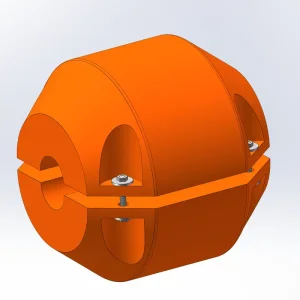
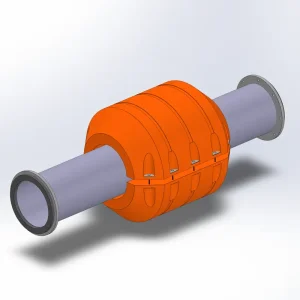
The contemporary standard demands an integrated polymer composite structure. At Shandong Binzhou Juhua Rubber & Plastic Co., Ltd. (Juhua), we manufacture two-piece half-shell floats molded with virgin high-density / linear low-density polyethylene incorporating UV15+ carbon black and hindered amine light stabilizers (HALS). The inner cavity is mechanically injected with high-density polyurethane closed-cell foam (≥38–45 kg/m³), guaranteeing that even in the unlikely event of outer shell breach under severe dynamic collision, water ingress is physically prevented, and pipeline buoyancy equilibrium remains intact.
Computational Fluid Dynamics (CFD)-optimized profiles decrease drag coefficients (Cd) by up to 28% compared to cylindrical configurations, drastically attenuating transverse anchoring loads during cross-current rip tides.
Direct high-pressure polyurethane foaming processes create non-hygroscopic, closed-cell micro-matrices that eliminate moisture absorption beneath high hydrostatic heads, guaranteeing buoyant stability for 15+ operational years.
Modern cutter suction dredge (CSD) installations integrate high-voltage power conduits, fiber-optic sensory feedback, and air-bleed relief lines directly within recessed channels molded natively into float bodies.
International dredging contractors (such as Jan De Nul, Van Oord, DEME, Boskalis, and China Harbour Engineering) demand stringent adherence to physical buoyancy modeling rather than catalog approximations.
A fatal failure mode in offshore slurry piping is under-buoyancy subsidence during peak sand concentration. Slurry densities can instantaneously surge from 1.05 t/m³ (light silt suspension) to over 1.65–1.80 t/m³ (coarse gravel and compacted seabed core). Sizing pipeline floats only for water or static pipe weight guarantees catastrophic submersion, kinked discharge hoses, and severe pipeline rupture under dynamic dredge pumping shocks.
Btotal = [ Wpipe + Wlining/accessories + (π × (ID/2)² × L × ρslurry) ] × (1 + Rreserve)
Where: Wpipe is dry weight of steel or HDPE discharge pipe; ID is pipe inner diameter; L is section length; ρslurry is max design slurry density (recommended ≥ 1.6 t/m³); Rreserve is safety reserve coefficient (typically 25% to 35% in river environments, 30% to 50% in open coastal swell zones).
| Evaluation Parameter | Commercial Grade / Standard Float | Juhua Industrial-Grade Rotomolded Solution | Engineering Impact on Dredging Lifecycle |
|---|---|---|---|
| Outer Shell Material | Recycled PE Blends with Low UV Stabilization | 100% Virgin LLDPE / HDPE (UV15+ Marine Grade) | Prevents environmental stress cracking (ESCR > 1000 hrs ASTM D1693); survives 10+ years tropical sun. |
| Foam Core Density | 28 – 32 kg/m³ Open/Mixed Cell Polyurethane | 38 – 45 kg/m³ High-Crosslink Closed-Cell PUR | Eliminates water absorption under hydrostatic head; retains net positive buoyancy even if punctured. |
| Bolt Fastener Integrity | Grade 4.8 Electro-Galvanized Mild Steel | Hot-Dip Galvanized Grade 8.8 / Stainless Steel 316 | Eliminates catastrophic shear fracture during cyclic torsional pipeline snaking in 2.5m wave conditions. |
| Wall Thickness Uniformity | ±25% Manual Rotomolding Dispersion | ≤±5% CNC Automated Variable Frequency Thermal Cycle | Uniform mechanical impact resistance around clamping radii, preventing stress concentration cracking. |
Located in Huimin County, Binzhou City, Shandong Province, Shandong Binzhou Juhua Rubber & Plastic Co., Ltd. demonstrates the transformation of modern Chinese rotational molding from manual workshop practices into an automated Industry 4.0 production ecosystem.
Rotational molding has historically suffered from uneven wall thickness due to uncontrolled mold cooling cycles and non-uniform burner flame heating. Juhua's Factory 4.0 facility integrates fully computerized bi-axial rotational arms equipped with infrared pyrometric internal mold temperature sensors and automated variable-frequency speed regulation. This ensures that every kilogram of polymer powder transitions through its thermodynamic melt index in an oxygen-inert atmosphere, resulting in an exceptionally uniform cross-sectional density free of micro-voids, bubbles, and localized weak points.
Furthermore, our integrated supply chain architecture located in Shandong's primary chemical industrial cluster grants immediate, cost-stabilized access to premium petrochemical feedstock (Sinopec and PetroChina virgin polymers). With an active inventory of standardized molds ranging from OD 110mm up to OD 1200mm, alongside heavy-duty modular steel frames, Juhua can scale production from single-container custom orders to multi-kilometer megaproject pipeline flotation orders within days, mitigating the crushing project-standby penalties common in maritime dredging.
Standardized CNC precision molds ensure that replacement float halves delivered years later seamlessly bolt together with units already anchored offshore.
Every production run is documented with density testing, tensile elongation verification, melt index rheometry, and foam compression testing certificates.
In-house CNC mold-carving facilities allow prototype fabrication for proprietary pipe outer diameters, eccentric lines, and integrated sensor pods within 14 calendar days.
Engineered nesting ratios allow pairs of half-shells to stack compactly inside 40ft High Cube containers, minimizing ocean shipping freight volume and reducing landing costs.
From megaproject artificial island reclamation across the Persian Gulf to deep-water navigation canal deepening in Southeast Asia, floating slurry lines operate under severe hydrodynamic stresses.
Global vessel scaling (up to 24,000 TEU mega-container ships) requires relentless capital dredging of approach channels from Rotterdam to Singapore. Floating pipelines keep navigation channels navigable while continuously moving seabed spoils miles away.
In the arid highlands of Chile, Peru, and Western Australia, mine tailings lagoons necessitate floating decant pipelines and abrasive slurry transfer lines that withstand hyper-saline, acidic water matrices without stress rupture.
Rising sea levels and urban coastal growth drive massive sand discharge campaigns. Floating pipelines maintain straight slurry flow over 5+ nautical miles in open swells, delivering continuous fill to reclamation zones.
Different water bodies expose floating discharge systems to radically divergent mechanical and chemical failure vectors. Here is how Juhua's specialized flotation systems solve localized marine challenges.
River mouth environments experience 180° current reversals every 6 hours. Juhua's hydrodynamic teardrop profiles and tapered float ends eliminate snag hazards, reducing anchoring strain on discharge catenary curves.
Operating near sensitive reef systems requires zero hydraulic oil leakage and minimal sediment plume spillage. Combined floating barriers and closed-pipeline floats ensure dredged spoil cannot spill into coral lagoons.
Hydroelectric dam desilting in sub-zero alpine climates demands extreme cold ductility. Our modified LLDPE matrices withstand severe freeze-thaw surface expansion and sub-zero impacts down to -40°C without brittle fracture.
Direct answers to complex hydrodynamic, metallurgical, and buoyant calculation questions frequently raised by EPC marine project engineers.
Advanced high-volume water transfer, integrated cable-channel modules, subsea tie-in modules, and heavy-duty slurry transport pipelines engineered for international contractors.